
Website Agency: The Complete Guide for 2026

Last updated: January 10, 2026
Choosing the right one Website agencyprojects can determine the success or failure of your digital presence. In 2026, it's no longer just about pretty designs - modern website agencies combine technology, strategy and performance optimization into an overall package that delivers measurable results.
A professional website development agency not only brings you a visually appealing online presence, but also technical excellence, search engine optimization and long-term support. The challenge: The market is flooded with providers and the differences in quality are enormous.
Key takeaways
- Full service vs. specialist: Choose an agency for website projects based on your project scope - full-service agencies offer everything from a single source, specialists score points with in-depth knowledge
- Technology stack 2026: WordPress, TYPO3 and Shopware remain leaders, while headless CMS and cloud solutions are becoming increasingly important
- Mobile-first is standard: 70% of all new websites will be developed with mobile-first and PWA technologies in 2026
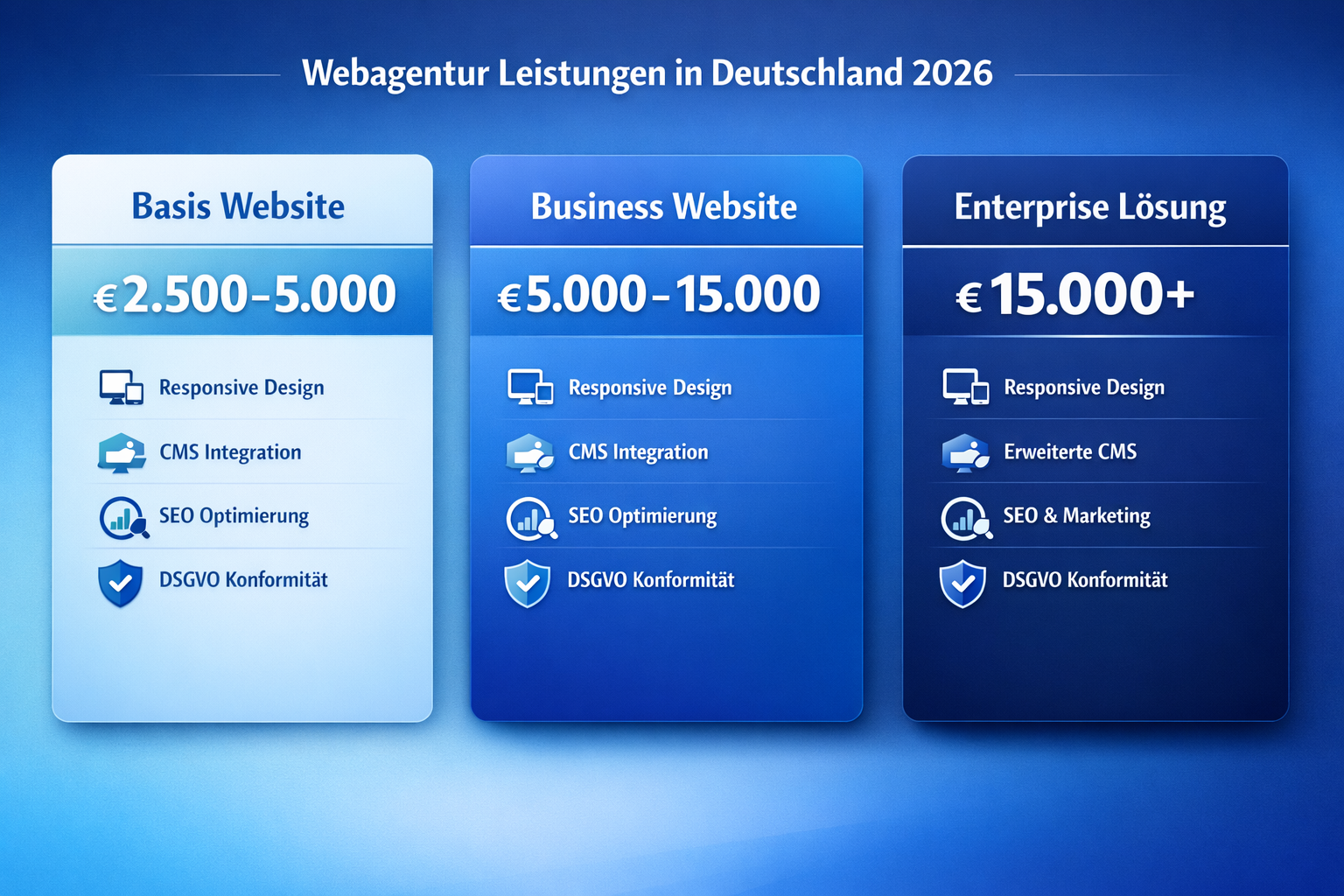
- Price transparency: Expect €2,500-5,000 for basic websites, €5,000-15,000 for business solutions and €15,000+ for enterprise projects
- AI integration: Agencies use AI-powered design processes for real-time analysis and dynamic interface customization
What does a website development agency do?
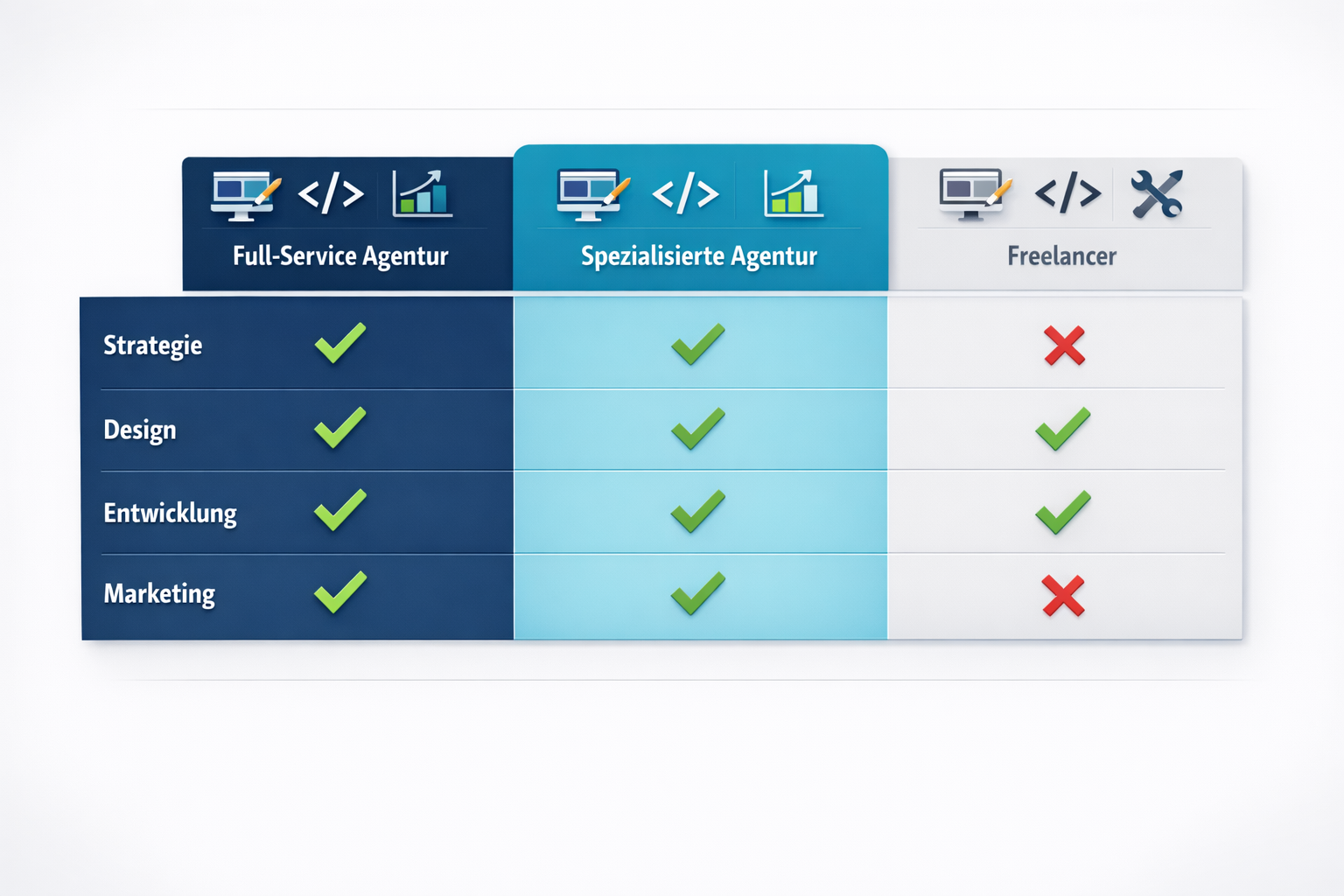
A website development agency plans, designs and programs professional websites that both function technically flawlessly and support your business goals. The scope of services extends from the initial consultation through design and programming to maintenance and marketing.
Core services of modern website agencies
Strategic consulting and conception
- Target group analysis and user journey mapping
- Competitive analysis and market positioning
- Information architecture and sitemap development
- Content strategy and editorial planning
Design and user experience
- Responsive web design for all devices
- UI/UX design according to current standards
- Brand identity integration
- Barrier-free design according to WCAG 2.1 AA
Technical development
- Frontend development with modern frameworks
- Backend programming and database integration
- CMS integration (WordPress, TYPO3, Shopware)
- API development and third-party integrations
Performance and security
- Speed Optimization and Core Web Vitals
- SSL certificates and security measures
- GDPR compliant implementation
- Regular backups and updates
The Website speed optimization plays a central role in this because loading times directly influence both user experience and Google rankings.
Difference between agency and freelancer
Agencies offer:
- Interdisciplinary teams with different specialists
- Substitution arrangements for vacation or illness
- Greater project capacities
- Comprehensive quality assurance
- Long-term care and support
Freelancers score with:
- Direct communication without a middleman
- Often cheaper hourly rates
- Flexibility for smaller projects
- Personal support
“Cloud-based development processes accelerate project implementation by up to 30% compared to traditional approaches.”[1]
Choose an agency if your project is complex, requires multiple disciplines, or requires long-term support. Freelancers are better suited for smaller, clearly defined tasks with a limited budget.
What types of website agencies are there?
Website agencies can be divided into three main categories: full-service agencies, specialized agencies and boutique agencies. Each has its strengths and suits different project requirements.
Full-service agencies
Full-service agencies cover the entire spectrum of digital services - from strategy to design and development to marketing and support.
Advantages:
- Everything from a single source – one contact for all areas
- Seamless integration between design, development and marketing
- Large teams with diverse expertise
- Comprehensive project support from start to finish
Disadvantages:
- Higher costs due to larger structures
- Sometimes less specialization in niches
- Longer decision-making processes
Ideal for: Medium-sized to large companies with complex requirements and budget for comprehensive support.
Specialized agencies
These agencies focus on specific industries, technologies or services. Examples include WordPress specialists, e-commerce agencies or agencies for specific industries.
Specialization areas:
- Technology focus: WordPress, Shopware, TYPO3, Headless CMS
- Industry focus: Web design for craftsmen, Doctors, Lawyers
- Service focus: SEO agencies, Accessibility, Performance optimization
Advantages:
- Deep expert knowledge in your field
- Industry-specific best practices
- More efficient processes through specialization
- Often better value for money in their niche
Disadvantages:
- Limited range of services
- Additional partners may be necessary for other areas
Ideal for: Projects with clear requirements in a specific area or industry.
Boutique agencies
Small, often owner-managed agencies with 2-10 employees that offer personal support and individual solutions.
Characteristics:
- Personal contact with the owner
- Flexible, uncomplicated collaboration
- Creative, tailor-made solutions
- Fast decision-making processes
Ideal for: Smaller companies and startups that value personal support and are looking for individual solutions.
The Web design agency Your choice should fit your company size, budget and specific requirements.
How do I choose the right agency for website projects?
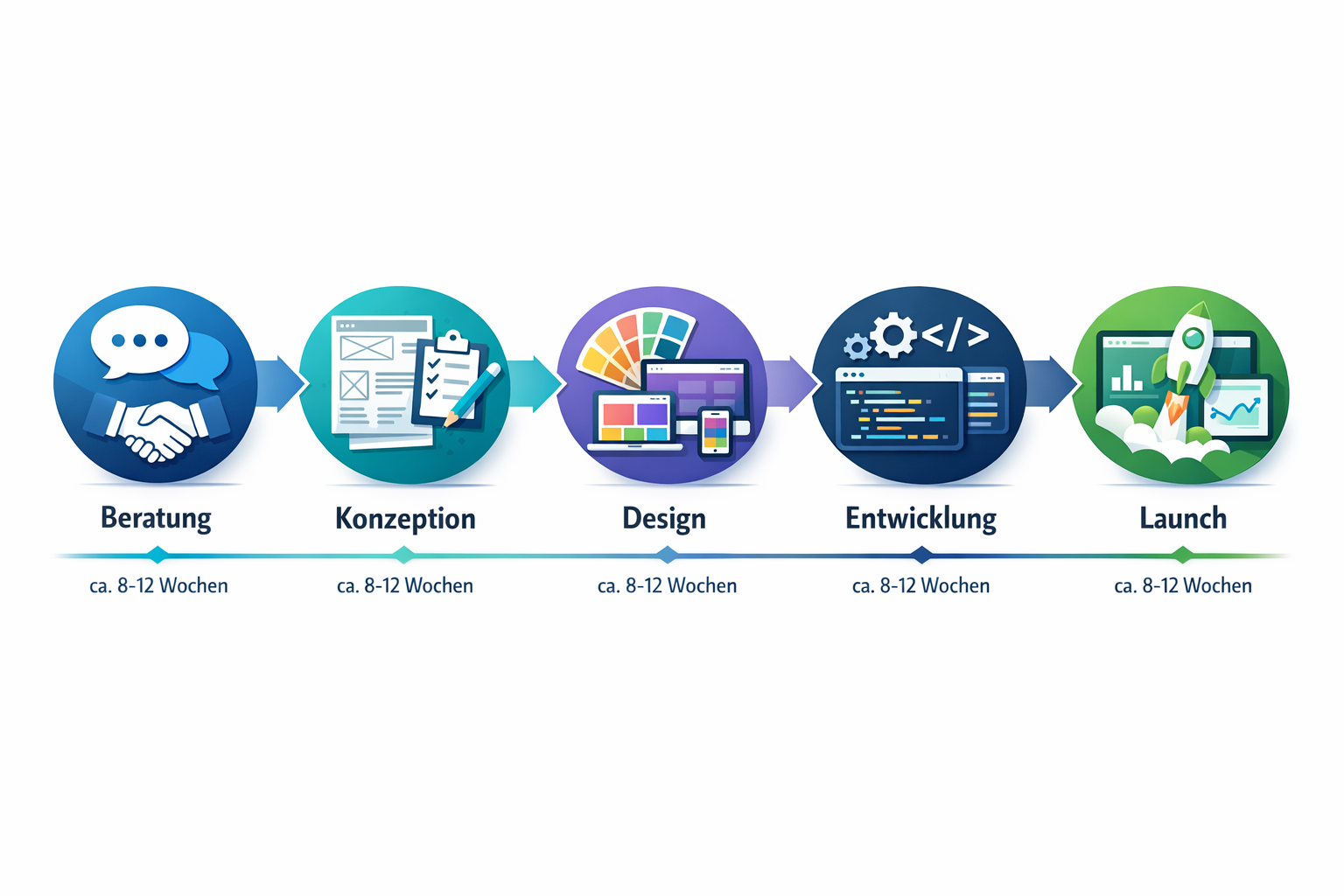
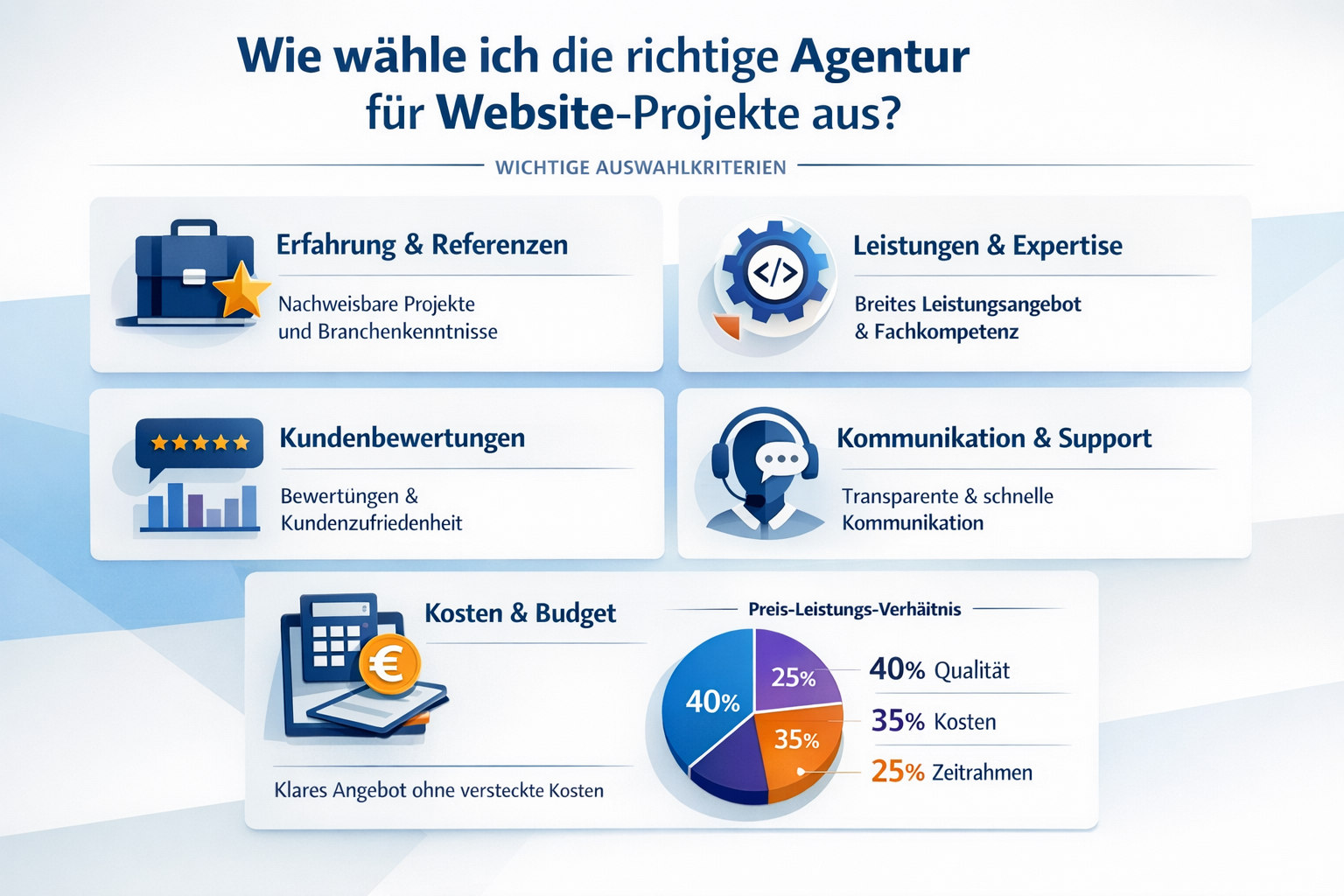
Selecting the right website development agency is based on six crucial criteria: portfolio quality, technical expertise, communication, value for money, references and cultural fit. A systematic assessment of these factors minimizes the risk of making a wrong decision.
Check portfolio and references
What you should pay attention to:
- Similar projects in your industry or scale
- Technical diversity and modern implementations
- Currentness of the work (not older than 2-3 years)
- Measurable results and case studies
Critical questions:
- Are the websites still online and functional?
- How fast do the reference websites load?
- Does the mobile display work properly?
- Are the designs contemporary or outdated?
Common Error: Allow yourself to be dazzled by visually impressive designs without checking the technical quality. Always test reference websites for speed, mobile viewing and accessibility.
Assess technical competence
A modern website development agency should master the following technologies in 2026:
Must-have technologies:
- Responsive design and mobile-first development
- Progressive Web Apps (PWA)[1]
- Headless CMS and API integration[1]
- Cloud based hosting solutions
- SEO optimization and core web vitals
- GDPR compliant implementation
Nice to have in 2026:
- AI-supported design processes[3]
- Generative Engine Optimization (GEO)[2]
- Green hosting and CO2 reduction[1]
- Voice Search Optimization
- Augmented reality integration
Ask specifically: “What technologies do you use for mobile-first development?” or “How do you ensure that the website is GDPR compliant?” Vague answers are a warning sign.
Communication and project management
Important aspects:
- Clear contact persons and accessibility
- Structured project process with milestones
- Regular status updates
- Transparent documentation
- Feedback processes and revision rounds
Warning signs:
- Delayed or unclear responses to inquiries
- No clear project plans or timelines
- Lack of documentation of decisions
- Unstructured communication channels
“Choose an agency that communicates proactively and addresses potential problems early rather than hiding them.”
Assess the price-performance ratio
Typical pricing structures:
| Service package | Price range | Included services |
|---|---|---|
| Basic website | €2,500 – €5,000 | 5-10 pages, responsive design, CMS, basic SEO |
| Business website | €5,000 – €15,000 | 10-30 pages, custom design, advanced features, SEO optimization |
| Enterprise solution | €15,000+ | Extensive websites, custom development, integrations, support |
Be aware of hidden costs:
- Hosting and domain fees
- SSL certificates
- Maintenance and updates
- Content creation
- Additional rounds of revision
- Training
Always request a detailed offer with a breakdown of all positions. Flat rate prices without specification are risky.
Test cultural fit
The best technical agency is of little use if the collaboration doesn't work.
Questions for assessment:
- Do they really understand your business goals?
- Do they speak your language or just technical jargon?
- Do they come up with their own ideas or just implement them?
- Does their working style match your expectations?
Practical test: Arrange a non-binding initial consultation and pay attention to your gut feeling. Do you feel understood? Are your questions answered competently? Is listening actively?
There is one for SMEs Web design agency for SMEs often a better choice than an agency that specializes in corporations – the way they work and their requirements differ significantly.
How much does a professional website development agency cost?
The cost of a professional website agency in 2026 ranges from €2,500 for simple websites to over €50,000 for complex enterprise solutions. The price depends on the scope, complexity, technology and agency type.
Price factors in detail
Design complexity:
- Template-based: €500 – €2,000
- Custom design: €2,000 – €8,000
- Custom illustrations and animations: +€1,000 – €5,000
- Extensive UX research: +€2,000 – €10,000
Technical implementation:
- Standard CMS installation: €1,000 – €3,000
- Custom theme development: €3,000 – €10,000
- Complex functions (booking systems, configurators): €5,000 – €20,000
- API integrations: €2,000 – €8,000 per integration
Content and SEO:
- Basic SEO setup: €500 – €1,500
- Professional SEO optimization: €2,000 – €5,000
- Content creation: €100 – €300 per page
- Professional texts from a copywriter: €200 – €500 per page
Additional services:
- Photography and video production: €1,000 – €10,000
- Accessibility according to WCAG 2.1 AA: €1,500 – €5,000
- GDPR Compliance Package: €500 – €2,000
- Multilingualism: +30-50% per additional language
Calculate ongoing costs
Many companies forget about the ongoing costs after the launch.
Monthly fixed costs:
- Hosting: €10 – €500/month (depending on traffic and requirements)
- Domain: €10 – €50/year
- SSL certificate: €0 – €200/year
- Maintenance and updates: €50 – €500/month
- Backup service: €10 – €100/month
Variable costs:
- Content updates: €50 – €150/hour
- Technical support: €80 – €200/hour
- SEO support: €500 – €5,000/month
- Performance monitoring: €50 – €300/month
Common Error: Budget only the development costs and underestimate the running costs. Plan at least 15-20% of development costs per year for maintenance and updates.
Understand billing models
Fixed price:
- Clear overall price for a defined service package
- Planning security for both sides
- Changes outside of scope cost extra
- Ideal for: Projects with clear requirements
Time and material:
- Billing based on actual effort
- Flexibility for changes
- Harder to calculate
- Ideal for: Projects with unclear scope or agile development
Retainers:
- Monthly flat rate for ongoing support
- Guaranteed agency availability
- Often a better hourly rate than individual billing
- Ideal for: Long-term cooperation with regular needs
Value-based pricing:
- Price based on value to your business
- Focus on ROI instead of effort
- Requires clear metrics for success
- Ideal for: Performance-oriented projects with measurable goals
The Have your website professionally created also means investing in quality - the cheapest offers often lead to expensive improvements.
How does a website project with an agency work?
A professional website project goes through five main phases: consulting and conception, design, development, testing and launch. The total project duration is typically 8-16 weeks, depending on complexity and scope.
Phase 1: Consulting and conception (2-3 weeks)
Kickoff meeting:
- Introduction of everyone involved
- Clarification of business goals
- Definition of target groups
- Discussion of technical requirements
- Determination of the schedule
Strategic planning:
- Competitive analysis
- Develop user personas
- Define user journeys
- Create sitemap
- Determine content strategy
- Select technology stack
Deliverables:
- Project plan with milestones
- Sitemap and information architecture
- Requirements document
- Wireframes for main pages
"A thorough design phase saves time and money later. Design changes cost 10x less than post-development changes."
Phase 2: Design (3-4 weeks)
Mood boards and style tiles:
- Explore visual direction
- Define color palettes
- Set typography
- Develop imagery
Design drafts:
- Homepage design (usually 2-3 variants)
- Template designs for subpages
- Mobile views
- Interactive elements and animations
Feedback loops:
- Presentation of the designs
- Revision rounds (typically 2-3)
- Finalizing the design
- Design approval
Important: Clear revision regulations in the contract. Usually 2-3 rounds of revision are included, after which there is a charge.
Phase 3: Development (4-6 weeks)
Frontend development:
- HTML/CSS implementation of the design
- Responsive programming
- Animations and interactions
- Implement accessibility
Backend development:
- CMS integration
- Database setup
- Custom functionalities
- API integrations
Content integration:
- Enter texts
- Optimize and upload images
- Store SEO metadata
- Build internal linking
The Have a WordPress website created is often faster than custom development, but offers less flexibility for very specific requirements.
Phase 4: Testing and quality assurance (1-2 weeks)
Technical tests:
- Browser compatibility (Chrome, Firefox, Safari, Edge)
- Device tests (desktop, tablet, smartphone)
- Performance tests and loading times
- Security checks
- Check GDPR compliance
Functional tests:
- Test all links
- Check forms
- Go through navigation
- Test the search function
- Check content for errors
SEO audit:
- Check meta tags
- Control heading structure
- Alt texts for images
- Generate sitemap
- Configure robots.txt
User Acceptance Testing:
- Test phase with the customer
- Collect feedback
- Make final adjustments
Phase 5: Launch and handover (1 week)
Pre-launch checklist:
- Backup of the old website
- Prepare DNS settings
- Activate SSL certificate
- Set up analytics and tracking
- Configure cookie banner
Go Live:
- Go live website
- Set up redirects (301 redirects)
- Activate monitoring
- First performance checks
Training and documentation:
- CMS training for your team
- Documentation of functions
- Maintenance instructions
- Contacts for support
Post-launch support:
- Monitoring in the first few weeks
- Bug fixing included (typically 30 days)
- Performance optimization
- Feedback evaluation
Common Error: Going live too early without thorough testing. Allow enough time for quality assurance – errors on the live website damage your reputation.
What technologies will website agencies use in 2026?
In 2026, website agencies will primarily rely on WordPress, TYPO3 and Shopware as CMS solutions, while headless CMS and cloud-based systems will become increasingly important[1]. The choice of technology depends on project requirements, scalability and budget.
Content Management Systems (CMS)
WordPress (market share ~43%)
- Advantages: Huge plugin ecosystem, easy to use, large community, cheap development
- Disadvantages: Security risks with poor maintenance, performance problems with complex sites
- Ideal for: Blogs, corporate websites, small to medium e-commerce projects
- Cost: €2,500 – €15,000 for professional implementation
TYPO3
- Advantages: Enterprise-ready, high security, multilingual sites, granular rights management
- Disadvantages: Steep learning curve, higher development costs, fewer developers available
- Ideal for: Large corporate websites, public administration, complex multilingual projects
- Cost: €10,000 – €50,000+
Shopware
- Advantages: Specialized in e-commerce, German development, GDPR compliant, modern architecture
- Disadvantages: Higher license costs, more complex than WooCommerce
- Ideal for: Professional online shops, B2B commerce
- Cost: €15,000 – €100,000+
Headless CMS (Strapi, Contentful, Sanity)
- Advantages: Maximum flexibility, API-first, multichannel publishing, modern development
- Disadvantages: Higher development costs, more complex maintenance
- Ideal for: Apps + website, complex integrations, international projects
- Cost: €20,000 – €80,000+
Frontend technologies
Modern JavaScript frameworks:
- React/Next.js: Popular for dynamic, interactive websites
- Vue.js/Nuxt.js: More beginner-friendly, good performance
- Svelte/SvelteKit: Increasingly, very fast, smaller bundle sizes
Progressive Web Apps (PWA):
70% of new websites will be developed with PWA technologies in 2026[1] because they:
- Provide app-like experience in the browser
- Enable offline functionality
- Support push notifications
- Offer faster loading times through caching
Cloud and hosting
Cloud platforms:
- AWS (Amazon Web Services): Market leader, maximum flexibility
- Google Cloud Platform: Strong in AI integration
- Microsoft Azure: Popular in enterprise environments
- Vercel/Netlify: Specialized in Jamstack and Static Sites
Advantages of cloud-based development:
- Up to 30% faster project implementation[1]
- Automatic scaling during traffic peaks
- Global Content Delivery Networks (CDN)
- Better resiliency
AI integration and automation
AI-supported design processes:
Modern agencies use AI for real-time analysis of user behavior and dynamic interface customization[3]. That means:
- Personalized content delivery
- Automatic A/B testing optimization
- Predictive analytics for user behavior
- Automated accessibility checks
AI chatbots:
Companies that implement AI-powered chatbots see conversion rate increases of up to 20%[1].
Generative Engine Optimization (GEO):
GEO has developed from a buzzword to an established expertise[2]. Agencies now optimize websites for:
- ChatGPT and other AI assistants
- Google SGE (Search Generative Experience)
- Structured data for AI parsing
- Context-rich content structures
Sustainability and performance
Green hosting:
CO2 reduction and sustainable hosting will be standard on the agenda of modern web development agencies in 2026[1].
Performance optimization:
- Core Web Vitals as a ranking factor
- Image Optimization (WebP, AVIF)
- Lazy loading and code splitting
- Server-Side Rendering (SSR)
The Website speed optimization is no longer a nice-to-have, but is directly relevant to sales - slow websites lose visitors and rankings.
What do I have to pay attention to when working with an agency?
When working with a website agency, clear contracts, defined communication channels and realistic expectations are crucial for the success of the project. Misunderstandings and unclear agreements are the most common reasons for failed website projects.
Clarify contractual principles
Essential contract components:
- Scope of services: Detailed description of all services
- Milestones and timeline: Concrete deadlines for each project phase
- Payment methods: Rates, payment terms, conditions
- Revision regulations: Number of included change loops
- Rights and Licenses: Who owns the design, code, content?
- Warranty: Support period after launch
- Termination clauses: What happens if a project is canceled?
Important questions before signing the contract:
- What happens when requirements change?
- How are additional services billed?
- Who hosts the website and who owns access?
- Is there a guarantee for certain performance values?
- How long is the agency available for bug fixes after launch?
Common Error: Accept vague wording in the contract. Insist on precise definitions – “modern website” means different things to everyone.
Structuring communication
Effective communication channels:
- Permanent contact person: One person on both sides as primary contact
- Regular meetings: Weekly or bi-weekly, depending on the project phase
- Project management tool: Asana, Trello, Jira or similar for transparency
- Documentation: Record all decisions in writing
- Feedback process: Structured feedback rounds instead of ad hoc change requests
Communication best practices:
- Feedback always in writing and with screenshots/examples
- Clearly identify priorities (must-have vs. nice-to-have)
- Agree on realistic response times
- Define escalation paths for urgent problems
Know your own responsibilities
Your tasks as a customer:
- Provide content: Deliver texts, images, videos on time
- Give feedback: Constructively and within agreed deadlines
- Make decisions: Timely approvals for designs and concepts
- Provide contact person: Ensure availability for queries
- Provide access: Hosting, domain, existing systems
Typical reasons for delays:
- Delayed content delivery (most common reason!)
- Slow feedback processes
- Unclear decision-making paths for the customer
- Constantly new requirements (“scope creep”)
"A website project is a partnership. The best agency cannot be successful if the client does not fulfill his responsibilities."
Actively support quality assurance
Your role in testing:
- Test the website thoroughly yourself
- Involve different stakeholders
- Use different devices and browsers
- Check all forms and functions
- Check texts for errors
Checklist for acceptance:
- ✅ All agreed pages available
- ✅ Design complies with approvals
- ✅ Mobile display works perfectly
- ✅ All links work
- ✅ Send forms correctly
- ✅ Loading times under 3 seconds
- ✅ GDPR compliance given
- ✅ Accessibility implemented
- ✅ SEO basics implemented
- ✅ Analytics and tracking works
Plan long-term care
Maintenance and Support:
- Regular updates (CMS, plugins, themes)
- Security monitoring
- Backup management
- Performance optimization
- Content updates
Service level agreements (SLA):
- Response times for support requests
- Availability guarantees
- Escalation processes
- Reporting and monitoring
Many agencies offer Create and maintain website as a complete package - this ensures long-term quality and timeliness.
How do I recognize a reputable website development agency?
You can recognize a reputable website agency by transparent communication, verifiable references, realistic promises and a professional appearance. Warning signs include unrealistic guarantees, pressure when concluding contracts and a lack of transparency in prices and processes.
Positive quality features
Professional appearance:
- Your website is technically flawless and modern
- Clear presentation of services and processes
- Transparent pricing or clear information on pricing
- Current case studies with measurable results
- Team introduction with real people and expertise
Competent advice:
- Asks lots of questions about your goals and target groups
- Critically questions your requirements
- Also make suggestions against your original idea
- Explains technical connections clearly
- Shows different solutions
Transparent way of working:
- Detailed offers with breakdowns
- Clear project plans with milestones
- Regular communication and updates
- Openness to challenges and problems
- Documented processes and workflows
Verifiable achievements:
- References with contact details (not just anonymous screenshots)
- Measurable results (increase in traffic, conversion rates, rankings)
- Long-term customer relationships
- Positive reviews on independent platforms
- Awards or certifications
Warning signals and red flags
Unrealistic promises:
- “Guaranteed #1 position on Google”
- “Website ready in 48 hours”
- “100% conversion increase guaranteed”
- “We do everything for €500”
Pressure and Manipulation:
- Limited time “special offers”
- Pressure to sign the contract immediately
- Deposit before detailed offer
- No opportunity for time to think
Lack of transparency:
- Vague service descriptions
- No clear prices or cost estimates
- Hidden costs in the small print
- Unclear ownership (who owns the website?)
- No access to work samples or code
Unprofessional behavior:
- Poor accessibility
- Late or no responses
- Grammar and spelling errors in offers
- No written agreements
- Missing contracts or terms and conditions
Technical warning signals:
- Your website is slow or buggy
- Reference websites no longer work
- No knowledge of current standards (GDPR, accessibility)
- Outdated technologies without justification
- No security or backup concepts
Research and due diligence
Verification options:
- Read Google reviews and reviews
- Contact references and ask about their experiences
- Check imprint and commercial register entry
- Check social media presence and activity
- Ask about memberships in industry associations
Critical questions in the initial interview:
- “Can you show me 3 similar projects?”
- “Who exactly will work on my project?”
- “How do you deal with delays?”
- “What happens if I’m dissatisfied with the result?”
- “What is your notice period for ongoing care?”
Comparison of several offers:
Get at least 3 offers and compare:
- Scope of services in detail
- Value for money
- Project duration and milestones
- Communication and advice quality
- Gut feeling and trust
One Web agency for startups For example, should have experience with rapid growth and limited budgets - specifically ask for relevant references.
What trends will shape website agencies in 2026?
The top trends for website agencies in 2026 are AI integration, mobile-first development, sustainability, accessibility and content-first strategies[1][4][5]. These developments are changing both the technical implementation and the strategic direction of web projects.
AI-powered development and personalization
Adaptive interfaces:
AI-supported design processes enable real-time analysis of user behavior and dynamic interface adjustment[3]. Websites adapt automatically:
- User behavior and preferences
- Time of day and context
- Device and screen size
- Previous interactions
Conversational AI:
AI-powered chatbots increase conversion rates by up to 20%[1] through:
- 24/7 availability
- Immediate answers
- Personalized product recommendations
- Qualification of leads
Content generation:
AI tools support:
- SEO-optimized texts
- Image generation and optimization
- Automatic translation
- A/B testing variants
Mobile-first and progressive web apps
Dominance of mobile use:
70% of all new websites will be developed with mobile-first and PWA technologies in 2026[1] because:
- Over 60% of web traffic comes from mobile devices
- Google uses mobile-first indexing
- Users expect app-like experiences
PWA advantages:
- Offline functionality
- Push notifications
- Installation on the home screen
- Faster loading times
- Lower data consumption
Sustainability and Green Web Design
CO2 reduction as standard:
Sustainable hosting and CO2 reduction will be standard on the agenda of modern agencies in 2026[1].
Green Design Principles:
- Optimized image sizes and formats
- Efficient code structures
- Dark mode for energy saving
- Reduced server requests
- Sustainable hosting providers
Measurable sustainability:
Tools like Website Carbon Calculator make carbon footprints transparent and comparable.
Accessibility as a duty and an opportunity
Legal requirements:
Accessibility and usability standards are increasingly important for user experience and Google rankings[1]. From 2025, stricter requirements will apply to many websites.
WCAG 2.1 AA standards:
- Keyboard navigation
- Screen reader compatibility
- Sufficient contrasts
- Understandable language
- Alternative texts for media
The Website accessibility is not only a legal requirement, but also significantly expands your target group.
Content-First and Brand Authority
Strategic Content Priority:
Content-first layouts with a focus on clarity and structure become the basis, professional content is a requirement instead of an optional addition for digital visibility[5].
E-E-A-T as a ranking factor:
Brand authority and proven expertise are Google's primary ranking factors in 2026[6]. Brands must become synonymous with specific topics.
Content strategies:
- Topic clusters instead of individual keywords
- Thought leadership content
- User-generated content integration
- Multimedia formats (video, podcast, infographics)
Headless and Composable Architecture
Decoupling frontend and backend:
Headless CMS solutions are becoming increasingly important for faster loading times and high scalability[1].
Advantages:
- Multichannel publishing (web, app, IoT)
- More flexible front-end technologies
- Better performance
- Easier scaling
Composable Commerce:
Modular systems enable best-of-breed approaches instead of monoliths.
Generative Engine Optimization (GEO)
Beyond SEO:
GEO has evolved from buzzword to established expertise, with deep synergies between GEO and traditional SEO[2].
GEO optimization includes:
- Structured data for AI parsing
- Context-rich content structures
- FAQ formats for direct answers
- Semantic markup optimization
- Optimization for featured snippets
AI search platforms:
- ChatGPT and GPT based assistants
- Google SGE (Search Generative Experience)
- Bing Chat
- Perplexity AI
The integration of Local SEO with GEO becomes particularly crucial for regional companies.
FAQ: Frequently asked questions about website development agencies
How much does a website from an agency cost?
A professional website from an agency costs between €2,500 for simple websites and over €50,000 for complex enterprise solutions. Price depends on scope, design complexity, features and ongoing support.
How long does it take to develop a website with an agency?
A typical website project takes 8-16 weeks from initial consultation to launch. Simple websites can be ready in 4-6 weeks, complex projects take 3-6 months or longer.
Do I need a full-service agency or a specialist?
Choose a full-service agency if you need comprehensive support from strategy to design to marketing. Specialists are better for clearly defined projects in a specific area such as e-commerce or a specific industry.
Do I own the website after development?
That depends on the contract. Typically, you own the content and data, while the agency may retain rights to the code or design. Clarify ownership relationships in writing in the contract before the start of the project.
What is the difference between an agency and a freelancer?
Agencies offer interdisciplinary teams, representation arrangements and greater capacities. Freelancers are often cheaper, offer more direct communication, but have limited capacity and no representation in the event of failure.
Do I have to provide the content myself?
Most agencies expect you to provide content, but often offer content creation as an additional service. Professional texts typically cost €100-500 extra per page.
How do I find the right agency for my project?
Check your portfolio and references, obtain at least 3 offers, have personal conversations, pay attention to communication and quality of advice, and compare not only prices, but also the scope of services and cultural fit.
What happens after the website launch?
After launch, you will need ongoing maintenance (updates, backups, security), possibly content maintenance, performance monitoring and SEO support. Many agencies offer maintenance contracts starting from €50-500/month.
Can I edit the website myself later?
Yes, if a content management system (CMS) such as WordPress or TYPO3 is implemented. The agency should train you on the CMS. Technical changes usually still require agency support.
How important is accessibility for my website?
Very important. Accessibility will be required by law for many websites from 2025, improving your SEO rankings, expanding your audience and demonstrating social responsibility. Budget €1,500-5,000 for WCAG 2.1 AA compliance.
What is mobile-first and do I need it?
Mobile-first means that the website is developed primarily for mobile devices and then adapted for desktop. Since over 60% of traffic is mobile and Google uses mobile-first indexing, this approach will be standard and essential in 2026.
How do I measure the success of my new website?
Before launching, define clear KPIs such as traffic, conversion rate, bounce rate, average time spent, leads generated or sales. Use Google Analytics and Search Console for tracking and arrange regular reporting with the agency.
Conclusion: Find the right agency for website projects
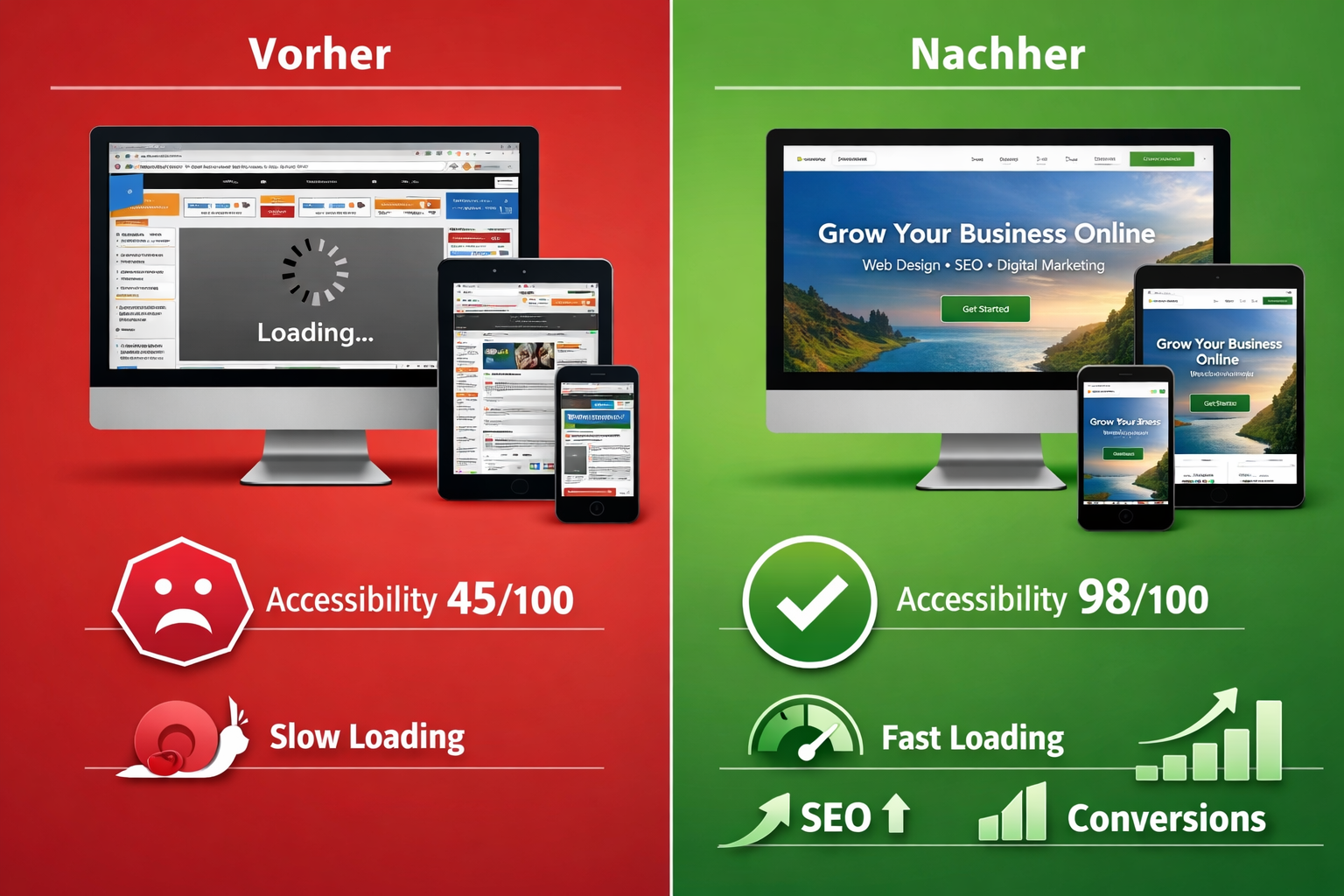
Choosing the right website development agency is a strategic decision that has a significant impact on the success of your digital presence. In 2026, a professional website is more than just a digital business card - it is your most important marketing tool, sales channel and brand ambassador all in one.
The most important success factors summarized:
✅ Clear objective: Before searching for an agency, define your business goals, target groups and requirements precisely
✅ Thorough research: Compare at least 3 agencies based on portfolio, references, expertise and cultural fit
✅ Technology competence: Pay attention to modern technologies such as mobile-first, PWA, cloud solutions and AI integration
✅ Transparent communication: Insist on clear contracts, defined processes and regular updates
✅ Realistic budget planning: Calculate not only development costs, but also ongoing maintenance and marketing
✅ Long-term partnership: A website is never “finished” – plan for continuous optimization and support
✅ Quality assurance: Invest time in thorough testing and acceptance before launch
✅ Compliance: Ensure GDPR compliance and accessibility from the start
Next steps for your website project
1. Document requirements (1-2 weeks)
- Define business goals and target groups
- List desired functions
- Set budget (development + ongoing costs)
- Plan timeline
2. Research agencies (2-3 weeks)
- Identify at least 5 potential agencies
- Check portfolios and references
- Read reviews and testimonials
- Create a shortlist of 3 favorites
3. Obtain offers (2-3 weeks)
- Send detailed briefing to shortlist
- Conduct initial discussions
- Compare offers (not just price!)
- Contact references
4. Make a decision (1 week)
- Weigh all factors
- Have the contract checked thoroughly
- Record clear agreements in writing
- Arrange a kickoff date
5. Start project
- Provide internal resources
- Prepare content
- Establish regular communication
- Actively participate in the project
The digital landscape is evolving rapidly. A professional website development agency will not only help you create a technically sound and visually appealing website, but will strategically position you for future growth. With the right partners, clear goals and realistic expectations, your website will become your company's most valuable asset.
Invest the time in a thorough agency selection - it's a decision that will shape your business for years. The best technology and the most beautiful design are of little use without the right strategy and collaborative partnership. Choose wisely, communicate clearly and stay actively involved - then your website project will be a success.
References
[1] Web Development Agency – https://www.hauptstadt-homepage.de/general/agentur-fuer-webentwicklung/
[2] Learn Grow Think Forward Our Agency Update 2026 – https://medialab-kn.de/lernen-growing-weiterdenken-unser-agentur-update-2026/
[3] Top web design agencies in Essen – https://webdesignagentur.de.com/top-webdesign-agenturen-in-essen/
[4] Web design 2026 The design trends – https://www.formwandler-interactive.com/blog/webdesign-2026-The -designtrends/
[5] Website Trends 2026 Future Websites – https://stratify.de/insights/website-trends-2026-zukunft-websites
[6] Web Design Seo Trends 2026 Strategy – https://cbachleitner.de/blog/webdesign-seo-trends-2026-strategie/
KI-Offenlegung: HINWEIS: Bilder wurden mit KI erstellt oder bearbeitet und sind keine realen Abbildungen. Teile der Texte wurden mit Hilfe von KI erstellt und redaktionell von einem Mensch bearbeitet.