
AI-powered email responses and social media integration: Automated workflows for companies
Imagine: A potential customer comments on your social media post at 10 p.m. While you sleep, your AI system captures this inquiry, categorizes it as a high-quality lead opportunity, automatically adds the person to your email list and sends a personalized welcome email - all without human intervention. When you come into the office the next morning, the lead is already qualified and waiting for your personal follow-up.
Welcome to the world of AI-supported email responses and social media integration: automated workflows for companies – a revolution that will no longer be optional in 2026, but essential for competitive companies. Gone are the days when marketing teams spent hours switching back and forth between email inboxes and social media dashboards.
Key takeaways
- 🚀 Drastic time savings: AI-powered email assistants reduce average response time by 40% and save teams up to 30% of the time typically spent on email management[1]
- 📈 Measurable increase in engagement: Automated but personalized email workflows increase open rates by 29% and click-through rates by 41%[1]
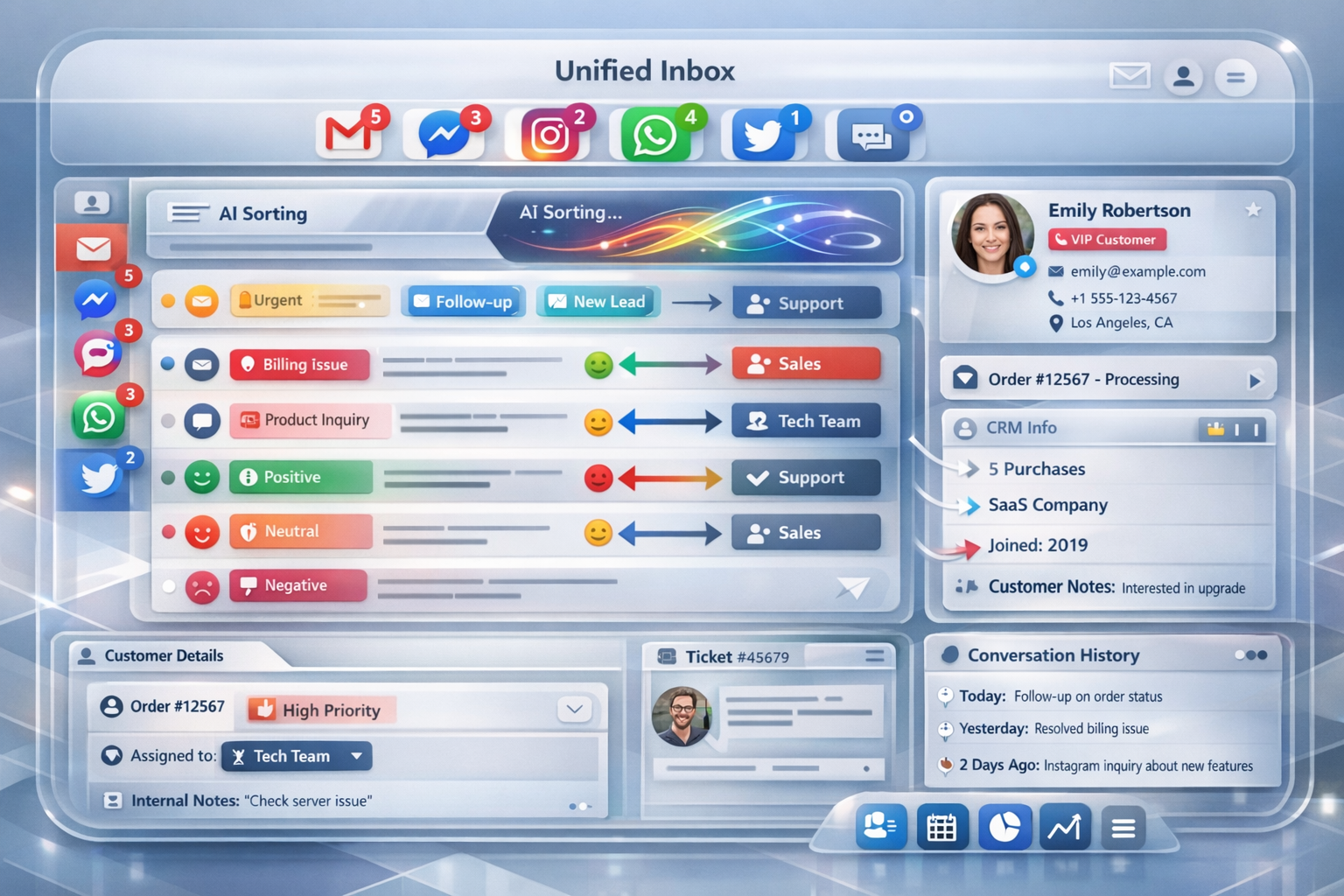
- 🔗 Seamless omnichannel integration: Modern AI systems combine email, SMS, WhatsApp and social media messages in a single interface with automatic categorization and intelligent routing[4]
- 🎯 Lead conversion on autopilot: Combining social media engagement with automated email sequences systematically converts prospects into qualified leads
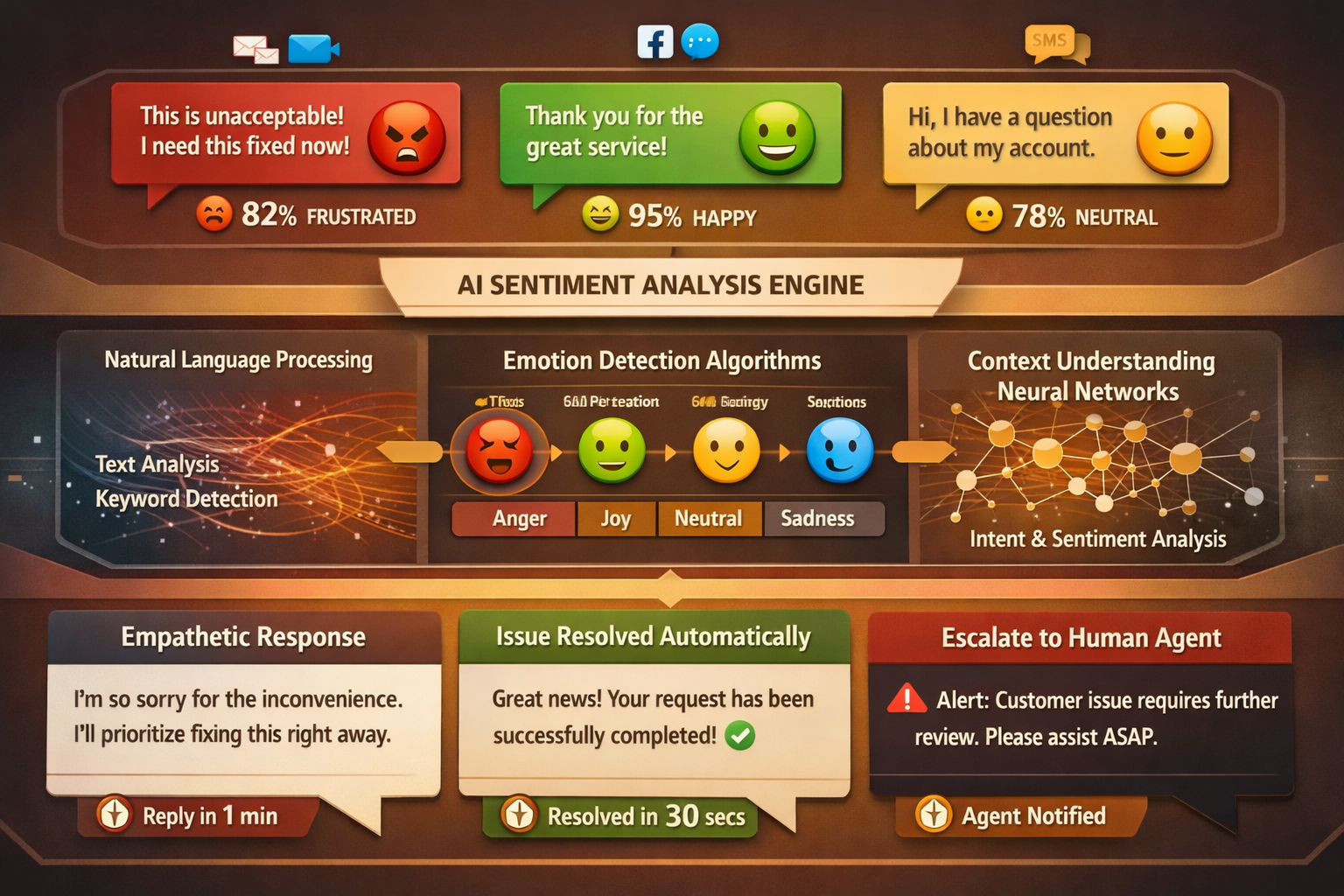
- 💡 emotional intelligence: Modern AI systems recognize customer sentiments through sentiment analysis and respond empathetically or escalate to human employees if necessary[2]
What does AI-powered email responses and social media integration mean for businesses?
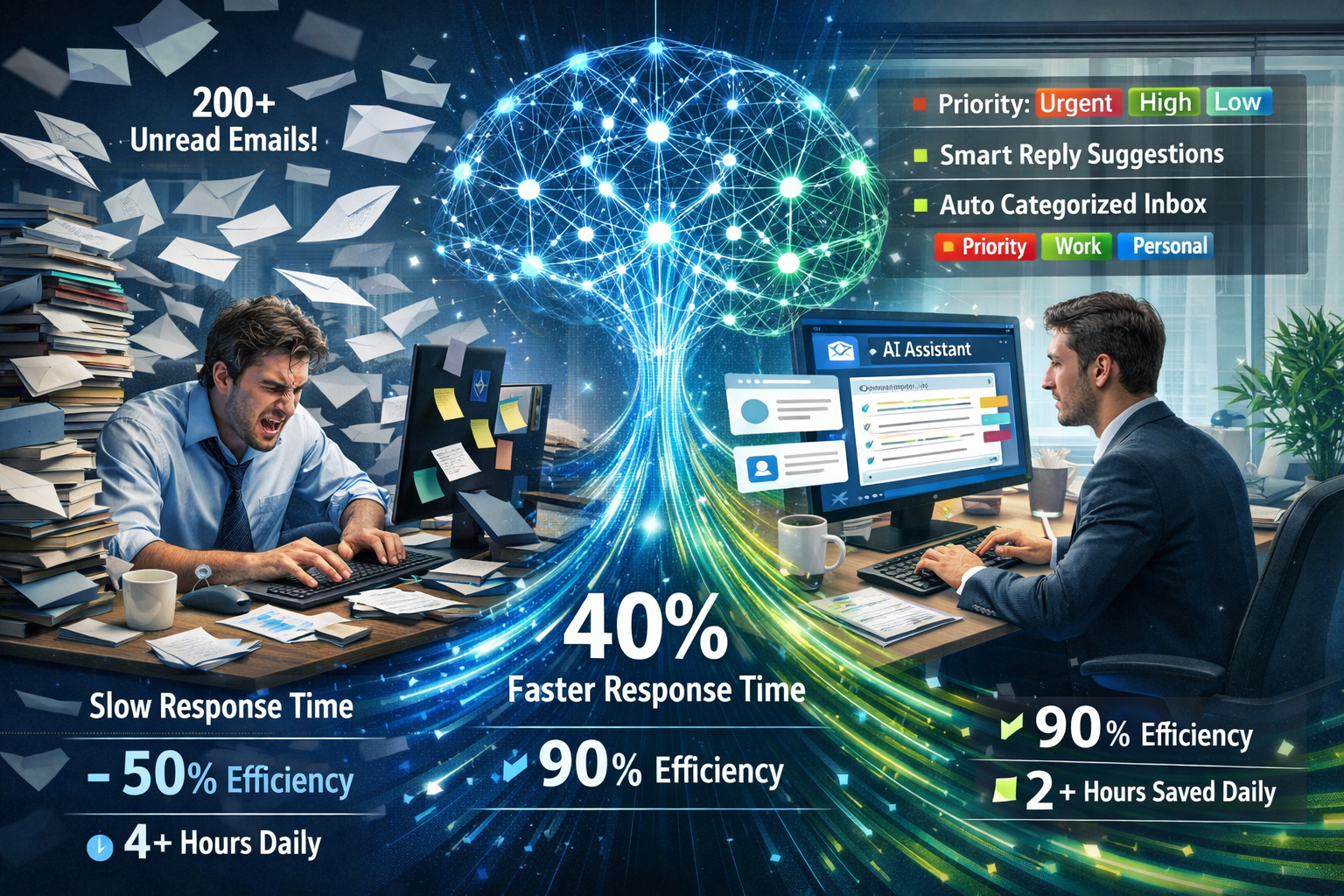
The AI-powered email responses and social media integration: Automated workflows for companies refers to an intelligent ecosystem in which artificial intelligence orchestrates, analyzes and automates communication across multiple channels. It's not just about simple autoresponders or scheduled posts, but about a networked system that learns, understands and acts independently.
The three pillars of integration
1. Smart email automation
Modern AI email assistants go far beyond simple templates. They read complete email histories, understand the context of past communications, and create contextual responses that prevent customers from having to answer the same question twice[1]. The system recognizes:
- urgency: Press inquiries will be prioritized
- Value: High-value advertisers receive preferential treatment
- Intent: What does the sender really want to achieve?
- CRM context: What history does this customer have with your company?
2. Social media monitoring and engagement
AI chatbots integrate seamlessly with Facebook Messenger, WhatsApp and Instagram, allowing businesses to reach customers where they already communicate - all manageable from a central platform[2]. The Social media automation captures mentions, comments and direct messages in real time.
3. Cross-channel data flow
The true value comes when both worlds merge: chat participants are automatically added to email lists, and email data informs personalized chat experiences for improved multi-channel communications[2].
“92% of companies are considering investing in AI-powered software like chatbots – not as a nice-to-have, but as a strategic necessity.”[8]
How do automated workflows work in practice?
An automated workflow is like a digital employee who never sleeps, never takes vacation and works consistently according to defined rules. Let's look at specific use cases:
Workflow Example 1: Social Media Lead to Qualified Prospect
Initial situation: A user comments on your LinkedIn post about a new product with “Sounds interesting, where can I find out more?”
Automated process:
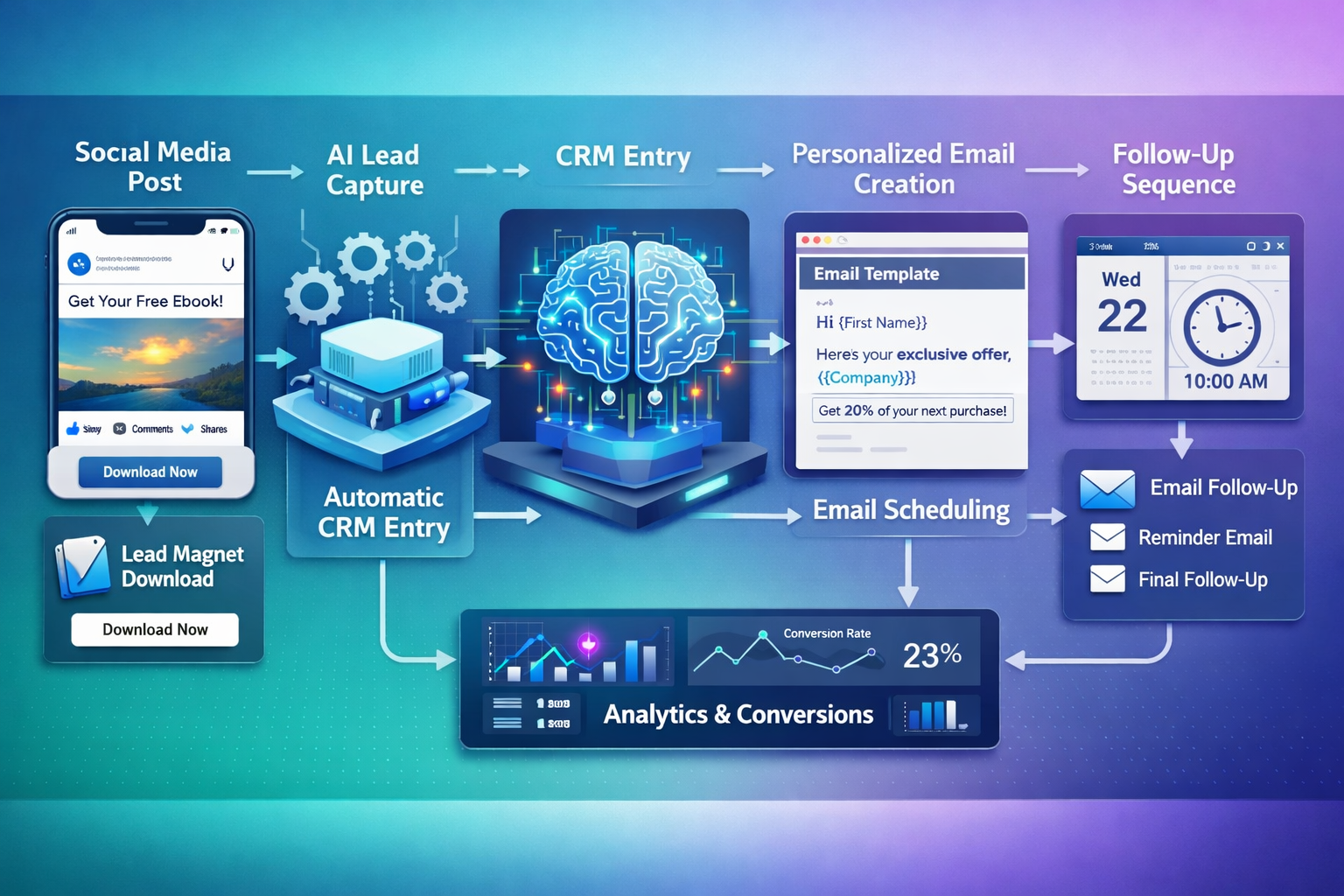
- AI detection (0-2 minutes): The system identifies this as a lead opportunity through natural language processing
- Social profile analysis (2-5 minutes): AI scans the public profile and determines industry, position, company size
- Auto reply (5 minutes): Personalized comment: "Hello [name], we're delighted! I'll send you more information via DM soon 😊"
- Lead capture (5-10 minutes): Direct message with link to specific landing page based on industry
- CRM entry (immediately): Contact details are automatically created in the CRM with tags: “LinkedIn”, “Product X”, “Industry Y”
- Email sequence start (15 minutes): First personalized email with relevant case studies from the lead’s industry
- Follow-up series (Day 3, 7, 14): Automatic but individualized emails based on interaction behavior
Result: A simple social media comment becomes a qualified lead with full documentation - no manual work.
Workflow Example 2: Omnichannel Customer Service
Modernity Omnichannel inbox managementsystems combine email, SMS, WhatsApp and social media messages into a single interface with automatic AI-powered categorization and routing to appropriate departments[4].
Practical implementation:
| channel | Automatic action | Human surrender |
|---|---|---|
| Instagram DM | Check product availability, communicate stock levels | Complex technical questions |
| Send order status updates, tracking links | Complaints with negative sentiment analysis | |
| Provide FAQ answers, document links | Contract negotiations | |
| Opening times, location information, simple inquiries | Individual advice requests |
The AI social media tools Automatically recognize when a request is too complex for automation and seamlessly forward it to the right human employee.
Workflow example 3: Content-to-conversion pipeline
69% of marketers already use AI for content creation, and 72% report improved results from AI-powered workflows[9]. Here is a typical automated content workflow:
Phase 1 – Content Creation:
- AI generates social media posts based on blog articles
- Automatic adaptation for different platforms (LinkedIn formal, Instagram visual, Twitter concise)
- Optimal posting times are determined by machine learning
Phase 2 – Engagement Tracking:
- Comments are analyzed for purchase intent
- Positive reactions trigger automatic follow-up DMs
- Prospects are segmented by engagement level
Phase 3 – Email Conversion:
- Highly committed users receive an invitation to an exclusive newsletter
- Automatic interest segmentation based on interacted posts
- Personalized email sequences with relevant content
With a professional Social media planner This entire process can be visualized and optimized.
The benefits of AI-powered email responses and social media integration: Automated workflows for companies
Implementing intelligent, automated workflows brings measurable benefits that go far beyond time savings.
⏱️ Drastic increase in efficiency
The numbers speak for themselves:
- 40% reduction the average response time for PR and media teams using AI email assistants[1]
- 30% fewer hours spent on email management[1]
- 29% higher open rates for automated but personalized emails[1]
- 41% better click-through rates through intelligent personalization[1]
In concrete terms, this time saving means: A team that previously spent 20 hours per week on email management wins 6 hours per week back – that’s over 300 hours per year for strategic work! Find out more in our guide to Save social media time.
🎯 Hyper-personalization at scale
Integration with CRM systems and customer data platforms enables chatbots to provide highly personalized experiences based on purchase history, preferences and previous interactions[2].
Example: A returning customer contacts you via Instagram:
- System recognizes him immediately via linked email address
- Knows his last three purchases
- Knows he is a newsletter subscriber
- Remembers his preference for sustainable products
- Responds with personalized product recommendations
This type of personalization was previously only possible with dedicated staff - now it runs automatically for each contact.
🧠 Emotional intelligence and sentiment analysis
Modern AI systems have emotional intelligence: Sentiment analysis enables the early identification of frustrated customers and allows systems to respond empathetically or escalate to people when necessary[2].
Practical example:
❌ Without sentiment analysis:
“I’ve called three times now and haven’t gotten an answer!”
→ Bot sends standard FAQ link
→ Customer even more frustrated
✅ With sentiment analysis:
“I’ve called three times now and haven’t gotten an answer!”
→ System detects high frustration (Sentiment Score: -0.8)
→ Immediate escalation to senior support staff
→ Automatic email to customer service manager for follow-up
→ Customer feels heard
📊 Data-driven decisions
Every interaction generates valuable data:
- Which social media posts generate the most email signups?
- What time of day are response times most important?
- Which product questions come up most frequently?
- Which channels do different customer segments prefer?
These insights enable continuous optimization and inform strategic decisions.
🔄 Consistent brand communication
A common problem with manual multi-channel communication: Different employees respond differently. AI systems ensure:
- Uniform tone of voice across all channels
- Consistent information (no contradictory statements)
- Branded messaging through trained language models
- Compliance security through predefined response limits
Implementation: How to get started with AI-powered email responses and social media integration
The path to full automation may seem overwhelming, but with the right strategy it can be achieved in manageable steps.
Step 1: Audit your current processes
Before you automate, you need to understand what you want to automate:
Self-analysis questions:
- How many hours does your team spend responding to emails each week?
- Which requests are repeated most often?
- Which social media channels are your customers most active on?
- How many social media leads are lost because follow-ups are late?
- Where do conversations between channels break off?
Document a typical customer journey across various touchpoints. A Optimize social media workflow Guide can help identify vulnerabilities.
Step 2: Choose the right tools
The tool landscape is diverse. Pay attention to:
Must-have features for 2026:
✅ Omnichannel inbox: Combines email, social media, messenger in one interface
✅ AI-powered answer suggestions: Context-aware drafts based on email history
✅ CRM integration: Seamless data flow between communication and customer database
✅ Sentiment analysis: Emotion detection for intelligent escalation
✅ Workflow builder: Visual creation of automation rules without coding
✅ Analytics dashboard: Measurable KPIs for all channels
✅ GDPR compliance: Particularly important for European companies
Specialized Social media management software often offers better integration than generic tools.
Step 3: Start with Quick Wins
Avoid the mistake of trying to automate everything at once. Start with:
Quick Win 1 – FAQ Automation:
- Identify the 10 most common questions
- Create high-quality answers
- Train the AI to recognize these questions
- Let the AI suggest answers (don't send them automatically)
- After 2 weeks of testing: Enable automatic replies
Quick Win 2 – Social to Email Bridge:
- Set up a simple lead magnet (e.g. free e-book)
- Automate DMs to users who comment on specific posts
- Capture email addresses via landing page
- Start 3-part welcome email series
Quick Win 3 – Smart forwarding:
- Define categories (Support, Sales, Press, General)
- Train AI to categorize automatically
- Set up routing rules
- Measure improvement in response times
Step 4: Continuous training and optimization
AI systems get better the more they learn:
Weekly optimization:
- Review miscategorized messages
- Correct inappropriate answer suggestions
- Add new FAQ topics
- Analyze escalation rates
Monthly strategy review:
- Which workflows have the best conversion?
- Where do customers drop off?
- Which channels are performing above/below expectations?
- ROI calculation: time savings vs. tool costs
A professional Editorial plan tool with automation helps to keep track of all automated processes.
Step 5: Scaling and advanced workflows
As soon as the basic workflows are running stable, expand them step by step:
Advanced automations:
🔹 Lead scoring: AI automatically scores leads based on engagement behavior
🔹 Predictive sending: Machine learning determines optimal transmission times per recipient
🔹 Dynamic content: Email content automatically adapts to recipient preferences
🔹 Churn prevention: System recognizes churn risk and triggers retention campaigns
🔹 Cross-sell automation: Product recommendations based on purchase history and social interactions
Challenges and best practices in AI-powered email responses and social media integration
Despite all the advantages, there are pitfalls you should avoid.
⚠️ Common mistakes and how to avoid them
Mistake 1: Too much automation too fast
❌ Incorrect: Have all emails and social media interactions answered immediately and fully automatically
✅ Correct: Start with suggested replies that are human-reviewed before they are sent
Mistake 2: Generic answers
❌ Incorrect: "Thank you for your message. We will be in touch soon."
✅ Correct: "Hello [name], thank you for your question about [specific topic]. Based on your interest in [product], [relevant info] might also be helpful..."
Mistake 3: Lack of human escalation
❌ Incorrect: AI answers all inquiries, including complex complaints
✅ Correct: Clear escalation rules for sentiment scores below -0.5, complaints, legal requests
Mistake 4: Neglecting data protection
❌ Incorrect: Automatically add all social media contacts to email list
✅ Correct: Double opt-in process with clear consent, GDPR-compliant data storage
Mistake 5: Lack of transparency
❌ Incorrect: Make customers believe they are communicating with people
✅ Correct: Clear labeling: "This answer was created by our AI assistant. If you have any questions, our team is available to help."
🏆 Best practices for successful implementation
1. Define clear boundaries
Determine what the AI is allowed to do and what it is not allowed to do:
- ✅ Check product availability
- ✅ Communicate order status
- ✅ Answer FAQ
- ❌ Conduct price negotiations
- ❌ Make legal commitments
- ❌ Finally resolve complaints
2. Maintain human touch
Automated messages should also sound warm and personal:
- Use emojis sparingly but specifically 😊
- Vary wording (not always exactly the same)
- Refer to specific details from the request
- Show empathy when faced with problems
3. Test, measure, optimize
Set clear KPIs:
| Metric | Target value 2026 | Measurement method |
|---|---|---|
| Average response time | < 5 minutes | Automatic tracking |
| Customer satisfaction | > 4.5/5 | Post-interaction survey |
| Escalation rate | <15% | Bot/human ratio |
| Email open rate | > 30% | Email Analytics |
| Social to email conversion | >8% | Funnel tracking |
4. Train your team
Your employees should:
- Understand how AI works
- Review and correct AI suggestions
- Know when manual takeover is necessary
- Be able to provide feedback to improve the AI
A collaboration with one Social media AI agency can assist with training and implementation.
🔐 Data protection and compliance
GDPR compliance is essential, especially in Europe:
Checklist for legally compliant automation:
- Explicit consent for email communication (double opt-in)
- Transparent privacy policy that explains AI usage
- Ability to opt-out in every automated message
- Data economy: Only collect necessary data
- Encrypted data transfer between systems
- Regular deletion of inactive contacts
- Documentation of all automation processes
- Clearly label automated messages
Future outlook: AI trends 2026 and beyond
Development does not stand still. Let's look at the trends AI-powered email responses and social media integration: Automated workflows for companies will shape in the coming years.
🚀 Specialized AI agent teams
An exciting trend orchestrated teams of agents, which take over strategy, content creation, distribution, performance analysis and sales synchronization - with marketing executives defining autonomous action boundaries[3].
Practical example of an AI agent team:
- Strategy Agent: Analyzes market trends and suggests content topics
- Content agent: Creates text, images and videos for various channels
- Distribution agent: Posts on relevant platforms at the optimal time
- Engagement Agent: Responds to comments and DMs
- Analytics agent: Measures performance and continuously optimizes
- Conversion agent: Identifies leads and initiates email sequences
These agents work together like a perfectly coordinated team – 24/7, without a break.
🎯 Hyper-contextualization
Future systems will not only understand What someone says, but also:
- Why (Motivation behind the request)
- When (point in the customer journey)
- Where (Geographical and cultural context)
- How (Preferred communication style)
A customer from Munich receives different answers than one from Hamburg - not only in terms of language, but also in terms of content, adapted to regional preferences.
🔮 Predictive engagement
Instead of just reacting to customer actions, AI systems become proactive:
- Predict which customers might leave soon
- Automatic retention campaigns before noticeable loss of interest
- Identification of up-sell opportunities based on behavioral patterns
- Optimal contact frequency per customer (not too much, not too little)
🌐 Voice and video integration
The Next Frontier: AI-Powered Voice and Video Communication:
- Automatic transcription of voice messages with intelligent response
- Video chatbots with realistic avatars
- Voice-to-text-to-email workflows
- Automatic translation for international communication
You can find out more about these developments in our article about AI marketing automation.
Conclusion: The future belongs to intelligent automation
AI-powered email responses and social media integration: Automated workflows for companies In 2026, they will no longer be a futuristic concept, but a business reality. The numbers speak for themselves: 40% faster response times, 30% time savings, 29% higher open rates and 41% better click-through rates[1].
But the real value doesn't just lie in efficiency. It's about, Communicate more humanely while you automate. Paradox? Not really. By letting AI take over the repetitive tasks, your employees free up time for what really matters: building real relationships, solving complex problems, being creative.
🎯 Your next steps
Can be implemented immediately (this week):
- Analyze your top 10 most common email and social media queries
- Create high-quality response templates
- Document your current time spent on communication
Short term (this month):
4. Test one Social media automation tool with free trial
5. Implement a simple workflow (e.g. automatic welcome email for new social media followers)
6. Measure initial results and optimize
Medium term (this quarter):
7. Expand to omnichannel integration
8. Implement sentiment analysis and intelligent escalation
9. Train your team to use AI assistants
10. Establish continuous optimization processes
Long term (this year):
11. Scale successful workflows across all channels
12. Implement advanced features like predictive engagement
13. Build an AI agent team for complete marketing automation
The question is no longer whether, rather how fast You implement these technologies. Your competitors are already doing it. With the right tools, a well-thought-out strategy and a focus on real value for your customers, you can not only keep up, but take the lead.
Do you need support with implementation? One Social media automation agency can accompany you through the entire process – from strategy to tool selection to full implementation.
The future of corporate communications is intelligent, automated and surprisingly human. Welcome to this new era! 🚀
References
[1] Ki Email Assistant for Media Companies – https://virtualworkforce.ai/de/ki-email-assistant-for-media-companies/
[2] AI Chatbots for Business 2026 The Ultimate Guide – https://www.2fox4.de/ki-chatbots-fuer-unternehmen-2026-der-ultimative-guide/
[3] Ki Trends 2026 How Ki Changes Communication – https://blog.fette-beute.com/ki-trends-2026-wie-ki-The -kommunikation-ver%C3%A4ndert
[4] Email Productivity AI Assistants – https://gmelius.com/de/blog/email-produktivitaet-ki-assisten
[8] Event Chatbots – https://www.cvent.com/de/blog/events/event-chatbots
[9] Social Media Trends 2026 The Ultimate Guide – https://lookfamed.de/news/social-media-trends-2026-der-ultimative-guide/
KI-Offenlegung: HINWEIS: Bilder wurden mit KI erstellt oder bearbeitet und sind keine realen Abbildungen. Teile der Texte wurden mit Hilfe von KI erstellt und redaktionell von einem Mensch bearbeitet.