
Editorial plan tool with automation: The future of content planning in 2026

Content creation has never been as complex as it is today. While companies struggle every day with the challenge of producing relevant content for different channels, one is revolutionizing Editorial plan tool with automation the way teams implement their content strategies. These intelligent systems transform chaotic planning processes into streamlined workflows that save time while increasing quality.
Key takeaways
• Automatisierte Redaktionstools Reduce manual planning effort by up to 70% and enable teams to focus on creative aspects
• AI-powered features such as automatic keyword research and content optimization measurably improve SEO performance
• Integrated workflows between different platforms eliminate duplication of effort and reduce human errors
• Datenbasierte Insights from automated analytics help with the continuous optimization of the content strategy
• Skalierbare Lösungen wachsen mit dem Unternehmen mit und passen sich verändernden Anforderungen an
What is an editorial plan tool with automation?

A Editorial plan tool with automation combines traditional editorial calendar functions with intelligent, automated processes. These tools go far beyond simple calendars and offer:
Core functions of modern automated editing tools:
- Intelligent content planning: AI-based suggestions for optimal publishing times
- Automatic keyword integration: SEO optimization is embedded directly into the planning process
- Cross-platform publishing: Simultaneous publication on different channels
- Performance tracking: Automatic collection and analysis of content metrics
- Workflow-automation: Streamlined approval processes and task distribution
The evolution of editorial planning
Traditional editorial plans consisted of Excel spreadsheets or simple calendars. Today automated systems make it possible intelligent content orchestration, which is based on target group behavior, market trends and performance data.
„automation in der Redaktionsplanung ist nicht nur ein Trend – es ist eine Notwendigkeit für Unternehmen, die in der digitalen Landschaft von 2026 wettbewerbsfähig bleiben wollen.“
Advantages of an automated editorial plan tool
The implementation of one Editorial plan tools with automation brings measurable benefits for content teams and companies:
Saving time and increasing efficiency
Automated processes eliminate repetitive tasks:
| Manual activity | Time required (traditional) | With automation | Time saving |
|---|---|---|---|
| Content scheduling | 2-3 hours/week | 15-30 minutes/week | 85% |
| SEO research | 4-5 hours/article | 30-45 minutes/article | 80% |
| Performance analysis | 6-8 hours/month | 1-2 Stunden/Monat | 75% |
| Cross-platform publishing | 1-2 hours/post | 5-10 minutes/post | 90% |
Improved content quality
Automated tools support this Qualitätssicherung through:
- Consistency checks: Automatic review of brand guidelines
- SEO optimization: Real-time suggestions for better search engine rankings
- Content gap analysis: Identification of missing topics in the content strategy
- Duplicate content detection: Avoiding duplicate content
Scalability for growing teams
A professional editorial plan tool with automation grows with the company:
- Multi-team management: Coordination of various content teams
- Role-based access rights: Secure collaboration with external partners
- Kapazitätsplanung: Automatic resource distribution based on team utilization
Important features for an effective editorial plan tool with automation
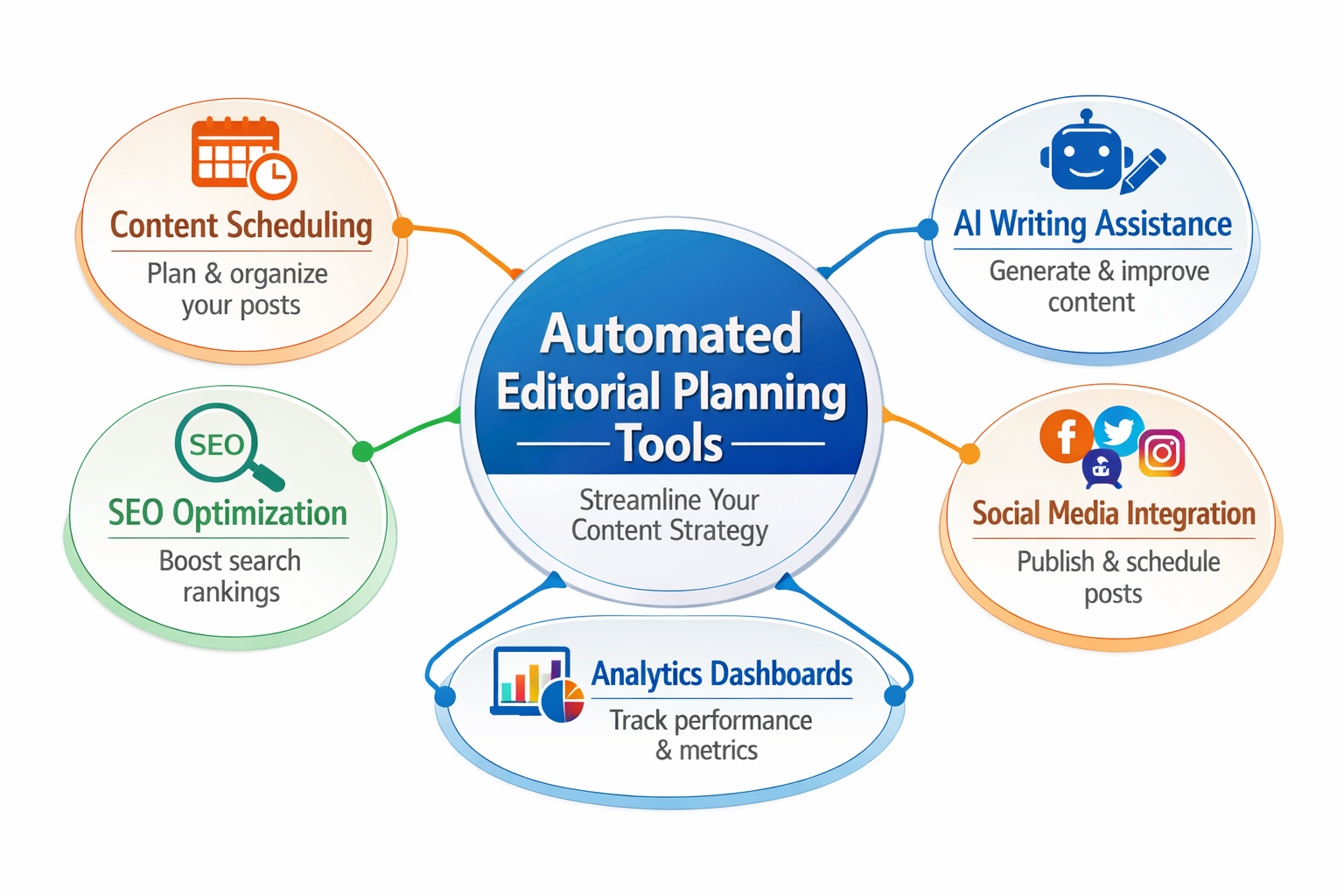
When choosing an automated editing tool, certain things should be considered Key functions the focus is on:
AI-powered content planning
Use modern tools Artificial Intelligence for:
- Trend analysis: Automatic identification of relevant topics
- Audience Insights: Data-based target group segmentation
- Content personalization: Adaptation to different buyer personas
- Predictive Analytics: Predicting content performance
Seamless integrations
An effective one Editorial plan tool with automation integrates with:
Social Media Plattformen:
- Facebook, Instagram, Linkedin, Twitter/X
- TikTok, YouTube, Pinterest
- Emerging platforms for future-proof strategies
Content management systems:
- WordPress, Drupal, Webflow
- Shopify, Magento for eCommerce
- Custom CMS solutions
Analytics and SEO tools:
- Google Analytics 4, Search Console
- SEMrush, Ahrefs, Moz
- Hotjar, Crazy Egg for User Behavior
Collaboration features
Erfolgreiche Content-Teams benötigen seamless collaboration:
- Real-time editing: Simultaneous editing by multiple team members
- Comment-Systeme: Strukturiertes Feedback und Revision-Management
- Approval Workflows: Automatisierte Freigabeprozesse
- Version Control: Track all content changes
Advanced automation capabilities
Intelligent automation goes beyond simple scheduling:
- Dynamic Content Adaptation: Automatic adjustment for different platforms
- A/B testing automation: Systematic testing of different content variants
- Performance-based optimization: Automatic Anpassung basierend auf Erfolgsmetriken
- Crisis Management: Automatic Pausierung bei negativen Events
A solution for EVERYTHING: management, idea creation, text creation, image creation in one tool:
Social@ALL Automation – “Social Media at Speed”
Top Editorial plan tools with automation 2026
The market for automated editorial tools has developed significantly in 2026. Here are the leading solutions:
Enterprise solutions
1. CoSchedule marketing Suite
- Strengthen: Comprehensive marketing automation, strong analytics
- automation: AI-based content optimization, automatic social scheduling
- Pricing: From €99/month for teams
- Best for: Mittelständische bis große Unternehmen
2. Hootsuite Planner Pro
- Strengthen: Excellent social media integration, robust reporting features
- automation: Smart scheduling, automatic hashtag suggestions
- Pricing: From €149/month
- Best for: Social media focused teams
Medium-sized businesses solutions
3. Buffer Publish Premium
- Strengthen: User-friendly Interface, starke Mobile App
- automation: Optimal Timing Features, Automatic Link-Shortening
- Pricing: From €65/month
- Best for: Small to medium-sized teams
4. Sprout Social Advanced
- Strengthen: Excellent customer service integration, comprehensive analytics
- automation: Smart Inbox, automated response suggestions
- Pricing: From €199/month
- Best for: Kundenservice-orientierte Unternehmen
Specialized tools
5. ContentCal (now part of Adobe)
- Strengthen: Visual content planning, strong creative tools
- automation: Template-based content creation, automatic brand compliance
- Pricing: Auf Anfrage
- Best for: Design-fokussierte Teams
Implementation of an editorial plan tool with automation
The successful introduction of automated editorial planning requires one structured approach:
Phase 1: Analysis and Preparation (Weeks 1-2)
Current State Assessment:
- Documentation of existing content processes
- Identification of pain points and inefficiencies
- Stakeholder interviews and requirements gathering
- Budget and resource planning
Tool evaluation:
- Creation of one Feature-Matrix based on business requirements
- Proof-of-concept testing with 2-3 leading solutions
- Integration assessments with existing systems
- ROI calculations for different scenarios
Phase 2: Setup and Configuration (Weeks 3-4)
System configuration:
- User accounts and permissions: Define role-based access rights
- Brand guidelines integration: Corporate Design und Tonalität hinterlegen
- Workflow definition: Set up automated approval processes
- Integration setup: Configure connections to existing tools
Content migration:
- Transfer of existing content calendars
- Categorization and tagging: Unified content taxonomy
- Historical Data Import for Analytics Baseline
- Template-Erstellung für verschiedene Content-Typen
Phase 3: Team-Onboarding (Wochen 5-6)
Training and education:
- Hands-on workshops for different user roles
- Best practices for automated workflows
- Troubleshooting and support processes
- Change management for new ways of working
Pilot projects:
- Start mit smaller content campaigns
- Continuous feedback and adjustments
- Performance monitoring and optimization
- Gradual expansion to all content areas
Phase 4: Optimization and Scaling (Weeks 7+)
Performance analysis:
- KPI-Tracking for efficiency and quality
- A/B testing of various automation settings
- User feedback and system adjustments
- ROI measurement and reporting
Continuous improvement:
- Regelmäßige Tool-Updates und Feature-Adoption
- Prozess-Refinement based on learnings
- Team skill development for advanced features
- Scaling to additional channels and teams
Challenges and solutions

The implementation of one Editorial plan tools with automation brings specific challenges:
Technische Herausforderungen
Integration complexity:
- problem: Existing tech stacks are often fragmented
- Lösung: API-first approach and step-by-step integration
- Best practices: Middleware solutions like Zapier for seamless connections
Data quality and consistency:
- problem: Inconsistent data formats between systems
- Lösung: Data governance framework and standardization
- Best practices: Regular data audits and cleanup processes
Organizational challenges
Change Management:
- problem: Resistance to automated processes
- Lösung: Umfassende Kommunikation der Vorteile und Step-by-step introduction
- Best practices: Champions program with early adopters
Skill gap management:
- problem: Teams lack technical skills for advanced features
- Lösung: Structured training programs and external expertise
- Best practices: Mentoring programs and hands-on workshops
Content quality vs. automation
Balance between efficiency and creativity:
- problem: Excessive automation can affect content quality
- Lösung: Human in the loop Approaches to critical decisions
- Best practices: Automation for operational tasks, human control for strategic decisions
Future trends: editorial plan tools with automation 2026+
The development of automated editorial tools is continually accelerating:
Advanced AI Integration
Generative AI for content creation:
- GPT-basierte Writing Assistants become standard features
- Automatic Content personalization for different target groups
- Real time SEO optimization through AI algorithms
- Visual Content Generation directly in the editorial plan
Predictive analytics evolution
Advanced Prediction Models:
- Trend prediction basierend auf Social Listening und Market Intelligence
- Performance-Forecasting for content ROI optimization
- Audience Behavior Modeling for more precise targeting
- Competitive Intelligence Integration for strategic advantage
Omnichannel integration
Seamless Cross-Platform Orchestration:
- Voice Search Optimization for smart speaker content
- AR/VR content planning for immersive experiences
- IoT integration for contextual content delivery
- Blockchain based Content authentication
ROI measurement for automated editorial planning
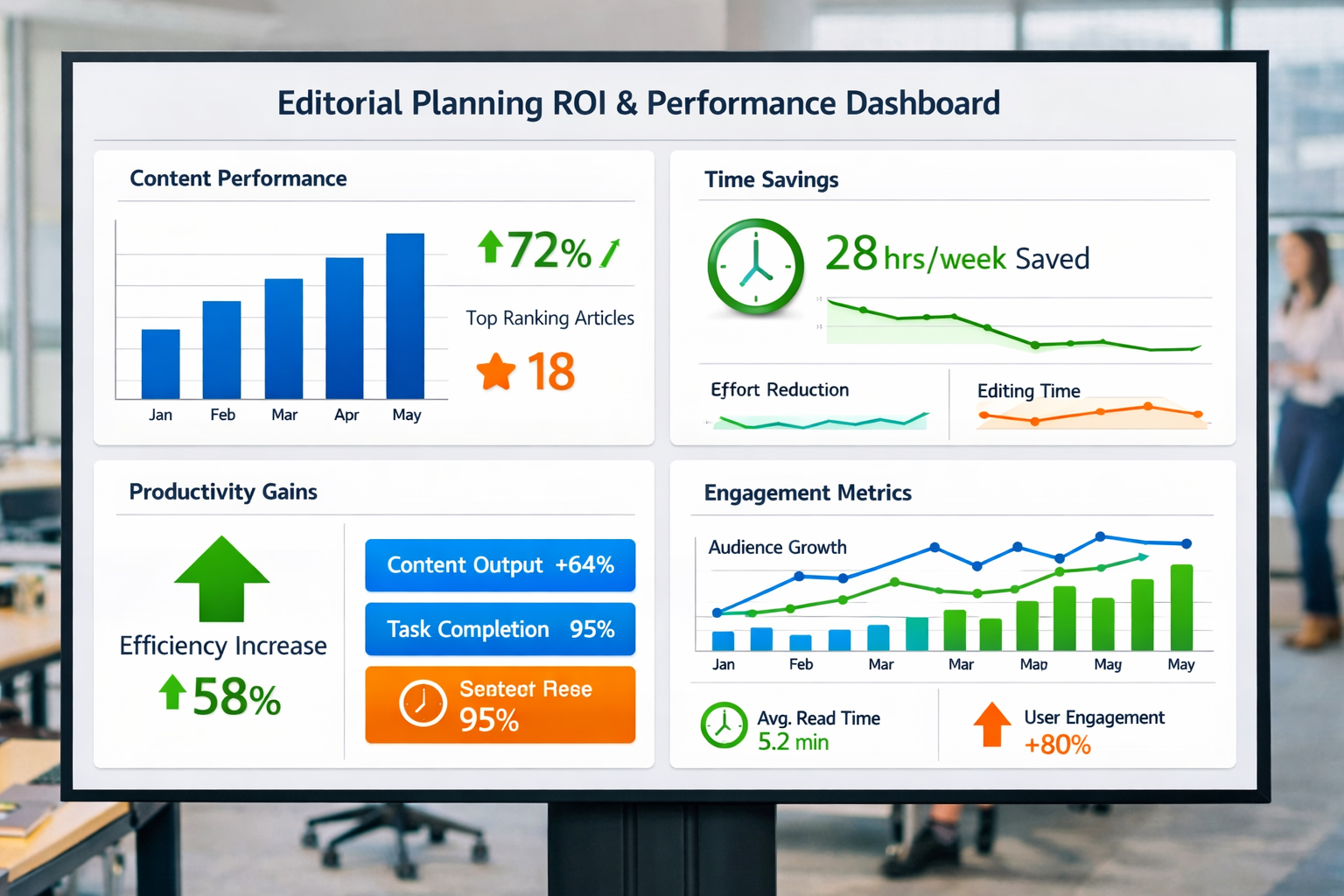
The Return on investment calculation for an editorial plan tool with automation includes various metrics:
Quantitative KPIs
Efficiency metrics:
- Time to Publish Reduction: Average 40-60% improvement
- Content Output Increase: 50-80% more content with the same resources
- Error rate reduction: 70-90% fewer manual errors
- Multi-Platform Reach: 200-300% more touchpoints
Performance improvements:
- SEO rankings: 25-40% better average positions
- Engagement Rates: 15-30% higher engagement rates
- Conversion optimization: 10-25% better content-to-lead conversion
- Brand consistency: 95%+ compliance with brand guidelines
Qualitative benefits
Strategic advantages:
- Improved team morale by focusing on creative tasks
- Scalability for business growth without a proportional increase in resources
- Competitive advantage through faster market response
- Risk Mitigation through automated compliance checks
Conclusion: The future of content planning is automated
A Editorial plan tool with automation In 2026, it will no longer be just a nice-to-have, but rather a strategic necessity for successful content marketing teams. The combination of intelligent automation, data-driven decision making and seamless integration is revolutionizing the way companies implement their content strategies.
The most important success factors for implementation:
• Strategic planning: Gründliche Analyse der aktuellen Prozesse und klare Zieldefinition
• Step-by-step introduction: Pilot projects before full rollout phase
• Team enablement: Comprehensive training and change management
• Continuous optimization: Regular performance reviews and adjustments
Investing in automated editorial planning not only pays off measurable efficiency gains but also allows teams to focus on what really matters: creative, strategic content creationthat creates real added value for target groups.
Next Steps
- Assessment: Evaluate your current content processes and identify automation potential
- Tool evaluation: Test 2-3 leading solutions with free trials
- Business case: Create an ROI calculation based on your specific needs
- Pilot implementation: Start with a small team or project for initial experience
- Scaling: Gradually expand to all content areas of your company
The future of content planning is automated, intelligent and human-centered. Unternehmen, The jetzt in diese Technologien investieren, sichern sich einen nachhaltigen Wettbewerbsvorteil in der digitalen Landschaft von morgen.
KI-Offenlegung: HINWEIS: Bilder wurden mit KI erstellt oder bearbeitet und sind keine realen Abbildungen. Teile der Texte wurden mit Hilfe von KI erstellt und redaktionell von einem Mensch bearbeitet.