
Making your website GDPR compliant: The ultimate guide for 2026
Imagine your website suddenly being fined up to 20 million euros - just because you didn't implement GDPR regulations correctly. This reality affects thousands of companies in the EU every year. The good news? With the right strategy, you can make your website GDPR compliant while increasing the trust of your visitors. In this comprehensive guide, you'll learn everything you need to create a legally compliant website.
Key takeaways
• Understand legal principles: GDPR applies to all websites that process personal data of EU citizens
• Implement cookie consent correctly: Modern consent management systems are essential for compliance
• Implement data protection measures: From the data protection declaration to technical security, all aspects must be taken into account
• Establish continuous monitoring: GDPR compliance is not a one-time process but requires regular reviews
• Use professional support: If requirements are complex, data protection experts should be consulted
What does it mean to make a website GDPR compliant? 

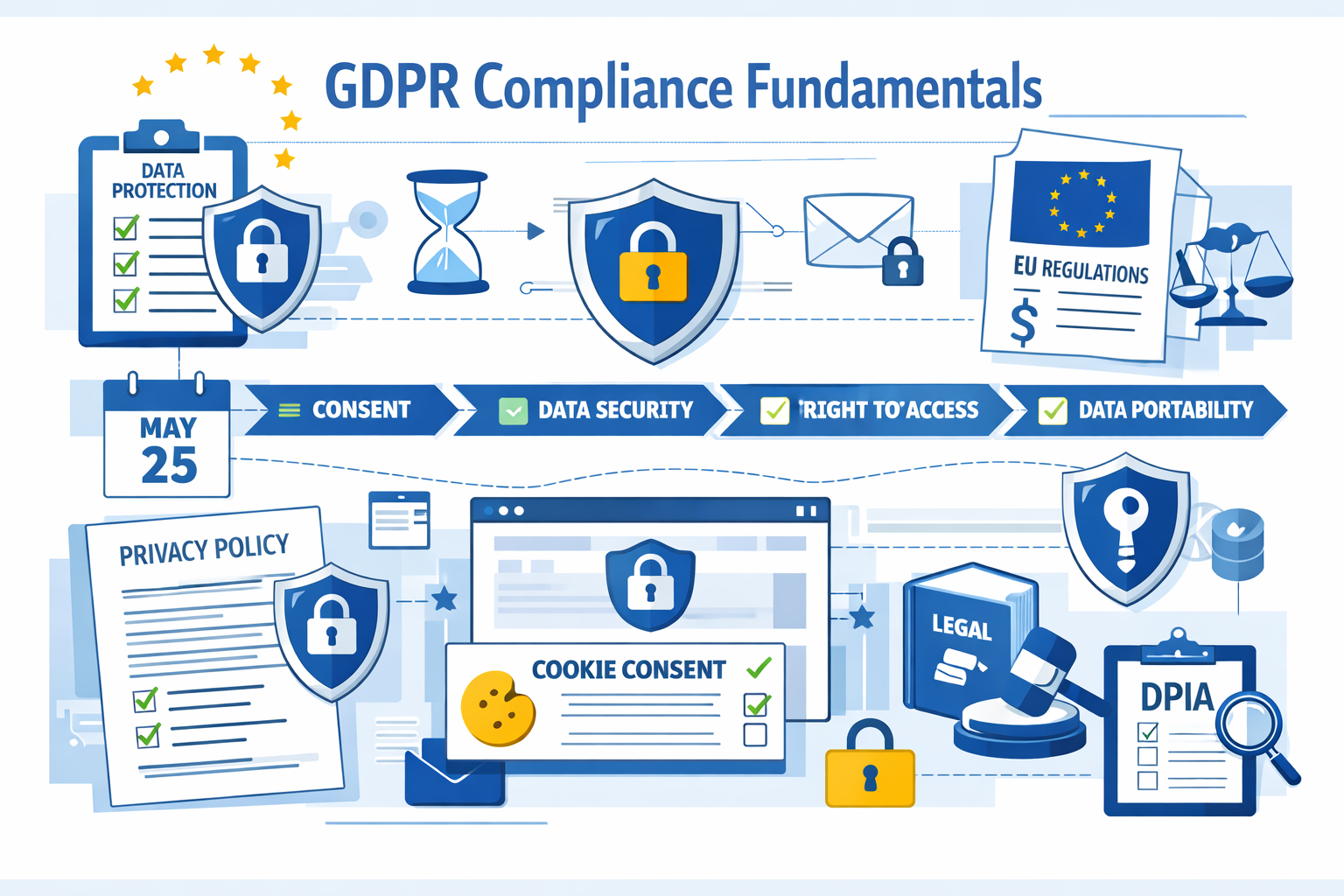
The General Data Protection Regulation (GDPR) has been in effect since May 2018 and has fundamentally changed the way websites handle personal data. Making a website GDPR compliant means meeting all the requirements of the regulation to protect user privacy and avoid legal consequences.
Basic principles of the GDPR
The GDPR is based on seven basic principlesthat every website operator needs to understand:
- Legality, fair processing, transparency
- Earmarking – Collect data only for specified purposes
- Data minimization – Only collect necessary data
- accuracy – Keep data current and accurate
- Memory limitation – Do not store data longer than necessary
- Integrity and confidentiality – Ensure adequate security
- accountability – Be able to demonstrate compliance
Who is affected by the GDPR?
All website operators, which process personal data of EU citizens, must make their website GDPR compliant. This applies regardless of whether:
- The company is based in the EU
- The website is available in German or other languages
- These are commercial or private websites
- Only a little or a lot of data is processed
“The GDPR is not only a legal imperative, but also an opportunity to build trust among users and stand out from the competition.”
Step-by-step instructions: Make your website GDPR compliant
1. Analyze and document data processing
The first step to making your website GDPR compliant is one comprehensive analysis all data processing processes:
What data is collected?
- Contact forms (name, email, phone)
- Newsletter subscriptions
- Comment functions
- Analytics data (Google Analytics, etc.)
- Cookies and tracking technologies
- Payment details for online shops
Create documentation:
- List of processing activities invest
- Determine the legal basis for any data processing
- Define purposes of data processing
- Set storage duration
- Document the recipient of the data
2. Identify legal bases
There must be one for every data processing valid legal basis according to Art. 6 GDPR:
| Legal basis | scope | Examples |
|---|---|---|
| consent | Voluntary consent | Newsletter, cookies, marketing |
| Fulfillment of contract | Necessary for contract processing | Order processing, customer service |
| Legal obligation | Required by law | Fiscal retention |
| Legitimate interest | Own business activity | Website security, fraud prevention |
3. Create and optimize data protection declaration
One complete and understandable data protection declaration is essential to make your website GDPR compliant:
Mandatory information in the data protection declaration:
- Name and contact details of the person responsible
- Purposes and legal basis of data processing
- Recipients or categories of recipients
- Storage period or criteria for determination
- Rights of those affected (information, correction, deletion, etc.)
- Right to withdraw consent
- Right to complain to supervisory authorities
- Information about automated decisions
Tips for a user-friendly data protection declaration:
- Use understandable language
- Logical structure with headings
- Integrate search function
- Update regularly
- Link to be easy to find
Cookie consent and tracking: Make your website GDPR compliant

Understanding the cookie issue
Cookies are small text files, which are stored on the user's device. Since the GDPR and the ePrivacy Directive apply strict rules for the use of cookies:
Categories of cookies:
 Technically necessary cookies
- No consent required
- For basic website functions
- Session management, shopping carts
Analytical cookies
- Consent required
- For website optimization
- Google Analytics, Matomo
Marketing cookies
- Consent required
- For advertising purposes and tracking
- Facebook Pixel, Google Ads
Convenience cookies
- Consent required
- For advanced features
- Language settings, preferences
Implement the cookie consent banner correctly
To make your website GDPR compliant, you need a professional consent management system (CMS):
Cookie banner requirements:
- Appear before cookies are set
- Clear and understandable information
- Granular choices
- Easy revocation of consent
- “Reject” just as prominent as “Accept”
- Documentation of consent
Recommended cookie consent tools:
- Cookiebot – Comprehensive compliance solution
- OneTrust – Enterprise-level data protection
- Usercentrics – German solution with strong support
- Cookiefirst – Cost-effective alternative
- Real cookies banner – WordPress plugin
Use Google Analytics in a GDPR-compliant manner
Google Analytics 4 (GA4) can be used in a GDPR-compliant manner if certain measures are taken:
Configuration for GDPR compliance:
- Order processing contract complete with Google
- IP anonymization activate (automatically in GA4)
- Data retention reduce to minimum
- consent obtain before tracking
- Opt-out option provide
Alternative analytics tools:
- Matomo – Open source, self-hosted
- Plausible – Privacy-first analytics
- Fathom – Simple, privacy-friendly solution
Implement data protection measures and data subject rights
Technical and organizational measures (TOMs)
In order to make your website GDPR compliant, you must appropriate security measures be implemented:
Technical measures:
- SSL encryption for all sides
- Secure passwords and two-factor authentication
- Regular updates of CMS and plugins
- Firewall and intrusion detection
- Backup strategies with encryption
- Access controls and authorization management
Organizational measures:
- Data protection training for employees
- Incident Response Plan for data breaches
- Regular audits and controls
- Order processing contracts with service providers
- Data protection impact assessment if necessary
Implement the rights of those affected
The GDPR grants users comprehensive rightsthat website operators must respect:
The eight rights of those affected:
- Right to information (Art. 13-14 GDPR)
- Transparent data protection declaration
- Proactive information during data collection
- Right to information (Article 15 GDPR)
- Users can request information about their data
- Reply within a month
- Right to rectification (Article 16 GDPR)
- Correction of incorrect data
- Completion of incomplete data
- Right to deletion (Article 17 GDPR)
- “Right to be forgotten”
- Deletion if the legal basis no longer exists
- Right to restriction (Article 18 GDPR)
- Blocking instead of deletion in certain cases
- Right to data portability (Article 20 GDPR)
- Preserve data in structured format
- Direct transfer to other responsible persons
- Right to object (Article 21 GDPR)
- Objection to processing based on legitimate interest
- Objection to direct advertising
- Right regarding automated decisions (Art. 22 GDPR)
- Protection against exclusively automated decisions
Practical implementation of the rights of those affected
Create contact options:
- Dedicated email address (e.g. datenschutz@unternehmen.de)
- Contact form for data protection inquiries
- Name clear contact persons
Establish processes:
- Standardized answer templates
- Internal workflows for inquiries
- Documentation of all requests
- Meet deadlines (1 month response time)
Monitor compliance and keep your website GDPR compliant

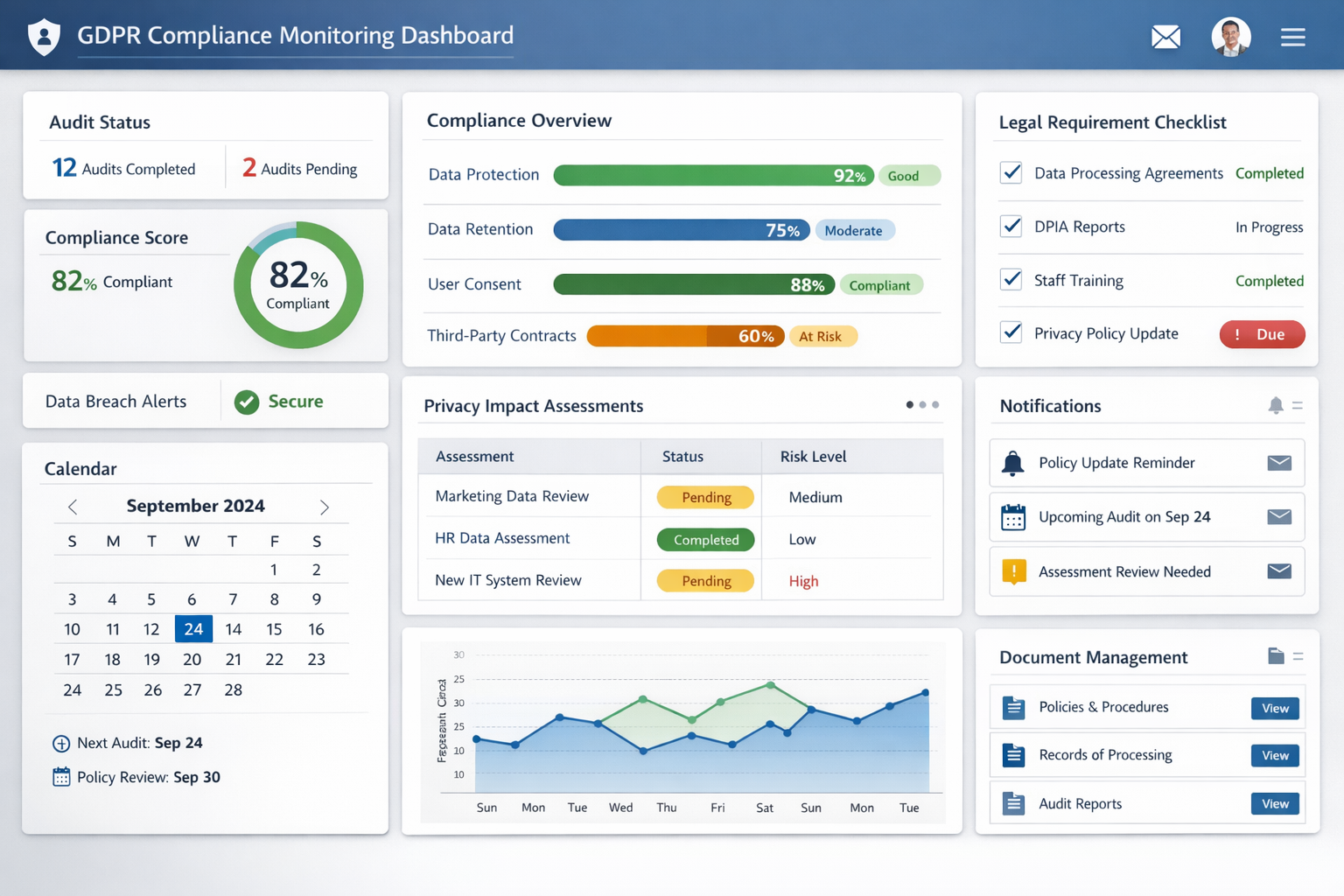
Regular audits and controls
GDPR compliance is not a one-time process, but requires continuous monitoring and adjustment:
Monthly checks:
- Test cookie consent banner
- Check the privacy policy to ensure it is up to date
- Check new plugins/tools for GDPR compliance
- Process requests from those affected
Quarterly audits:
- Complete website analysis with scanning tools
- Review order processing contracts
- Conduct employee training
- Test incident response plan
Annual reviews:
- Complete data protection impact assessment
- Commission external audits
- Take legal developments into account
- Adapt data protection strategy
Tools for GDPR monitoring
Automated scanning tools:
- Cookiebot Scanner – Free website scan
- OneTrust Assessment – Comprehensive compliance check
- GDPR Tracker – Continuous monitoring
- Privacy scan – German solution for data protection audits
Documentation tools:
- GDPR software for list of processing activities
- Consent management dashboards for consent statistics
- Incident management systems for data breaches
Keep an eye on legal developments
The data protection landscape is continually evolving. To keep your website GDPR compliant, you should:
- Specialist publications read regularly
- Regulatory authorities and follow their decisions
- Industry associations and use their guidelines
- Data protection experts consult
- Training and webinars visit
Important sources for updates:
- Federal Commissioner for Data Protection (BfDI)
- State data protection authorities
- European Data Protection Board (EDPB)
- Specialist magazines such as “Privacy in Germany”
- GDPR newsletters and blogs
Avoid common mistakes when making your website GDPR compliant
The biggest compliance pitfalls
Many website owners make similar mistakeswhen trying to make their website GDPR compliant. Here are the most common stumbling blocks:
 Incomplete privacy statements
- Missing information about cookies and tracking
- Outdated information about service providers
- No information on storage duration
- Unclear legal basis
Inadequate cookie consent banners
- Pre-set cookies before consent
- No granular selection possible
- Reject button hidden or difficult to find
- Lack of cancellation option
Insecure data transmission
- Contact forms without SSL encryption
- Unsafe hosting providers
- Lack of encryption when sending emails
- Unprotected admin areas
Neglect of the rights of those affected
- No contact person for data protection inquiries
- Long response times for requests for information
- Missing deletion processes
- Ignoring contradictions
Best practices for lasting compliance
 Develop a proactive data protection strategy
- Think about privacy by design right from the start
- Regular training for everyone involved
- Define clear responsibilities
- Establish continuous improvement
Use professional tools
- Use proven consent management systems
- Implement automated compliance checks
- Use professional data protection software
- Commission external audits
Documentation and verification
- Document all processes carefully
- Store consent in a legally secure manner
- Generate regular compliance reports
- Have an incident response plan ready
Costs and resources for GDPR compliance
Plan investments correctly
The cost of making a website GDPR compliant, vary depending on the size and complexity of the website:
Small websites (up to 50 pages):
- Cookie consent tool: 10-50€/month
- Data protection declaration (lawyer): 500-1,500€
- SSL certificate: 50-200€/year
- Total costs: €500-1,000 initially
Medium websites (e-commerce, blogs):
- Professional CMS: 200-500€/month
- Compliance audit: €2,000-5,000
- Training: €1,000-3,000
- Total costs: €5,000-15,000 initially
Large companies:
- Enterprise solutions: 1,000-5,000€/month
- Data protection officer: €50,000-100,000/year
- External advice: €10,000-50,000
- Total costs: €50,000-200,000 annually
ROI of GDPR compliance
Investing in GDPR compliance pays off:
Costs avoided:
- Fines of up to 20 million euros
- Damage to reputation and loss of trust
- Legal disputes
- Business interruptions
Positive effects:
- Increased customer trust
- Competitive advantages through transparency
- Better data quality and management
- International market development
Conclusion: The path to a GDPR-compliant website
Making a website GDPR compliant is not a sprint, but a marathon. However, investing in comprehensive data protection compliance pays off in the long term - not only through avoiding fines, but also through increased customer trust and better data quality.
Your next steps
Immediate action (this week):
- Website analysis with free scanning tools
- SSL encryption activate (if not already done)
- Cookie consent banner implement
- Privacy Policy check and update
Medium-term goals (next 4 weeks):
- List of processing activities create
- Order processing contracts contract with service providers
- Processes for data subject rights establish
- Employee training carry out
Long-term strategy (next 3 months):
- Compliance monitoring automate
- External audits give an order
- Incident Response Plan develop
- Continuous improvement establish
“Data protection is not an obstacle to digital growth, but rather the basis for sustainable success in the digital age.”
Remember: The GDPR is continually evolving. Stay informed, invest in professional advice when necessary, and view data protection as an opportunity to positively differentiate yourself from the competition.
With the right strategy and the right tools, you can not only make your website GDPR compliant, but also sustainably strengthen the trust of your users. Get started today get started – your customers and your company will thank you.
KI-Offenlegung: HINWEIS: Bilder wurden mit KI erstellt oder bearbeitet und sind keine realen Abbildungen. Teile der Texte wurden mit Hilfe von KI erstellt und redaktionell von einem Mensch bearbeitet.