
Get Local SEO Created: The Ultimate Guide to Local Visibility 2026
Last updated: January 14, 2026
Imagine your shop is on the best street in town - but no one can find you because there is no sign on the door. That's exactly what it feels like when your business can't be found locally online. Have local SEO created is the solution that makes your business visible exactly where potential customers are actively looking for your services: in their immediate surroundings. With 46% of all Google searches now having local relevance, local search engine optimization is no longer a nice-to-have - it is vital for stationary businesses and service providers.
Key takeaways
- Have local SEO created means optimizing your online presence so that customers in your region can immediately find you in local searches
- Almost 80% of users who find local search results take action within a very short time - by calling, visiting or purchasing
- A complete Google Business profile, current reviews and local backlinks are the three most important ranking factors for 2026
- Professional agencies handle complete optimization, while DIY approaches require time and expertise
- Investing in local SEO often pays off faster than traditional SEO because local searches have a higher conversion rate
What does “Have local SEO created” mean exactly?
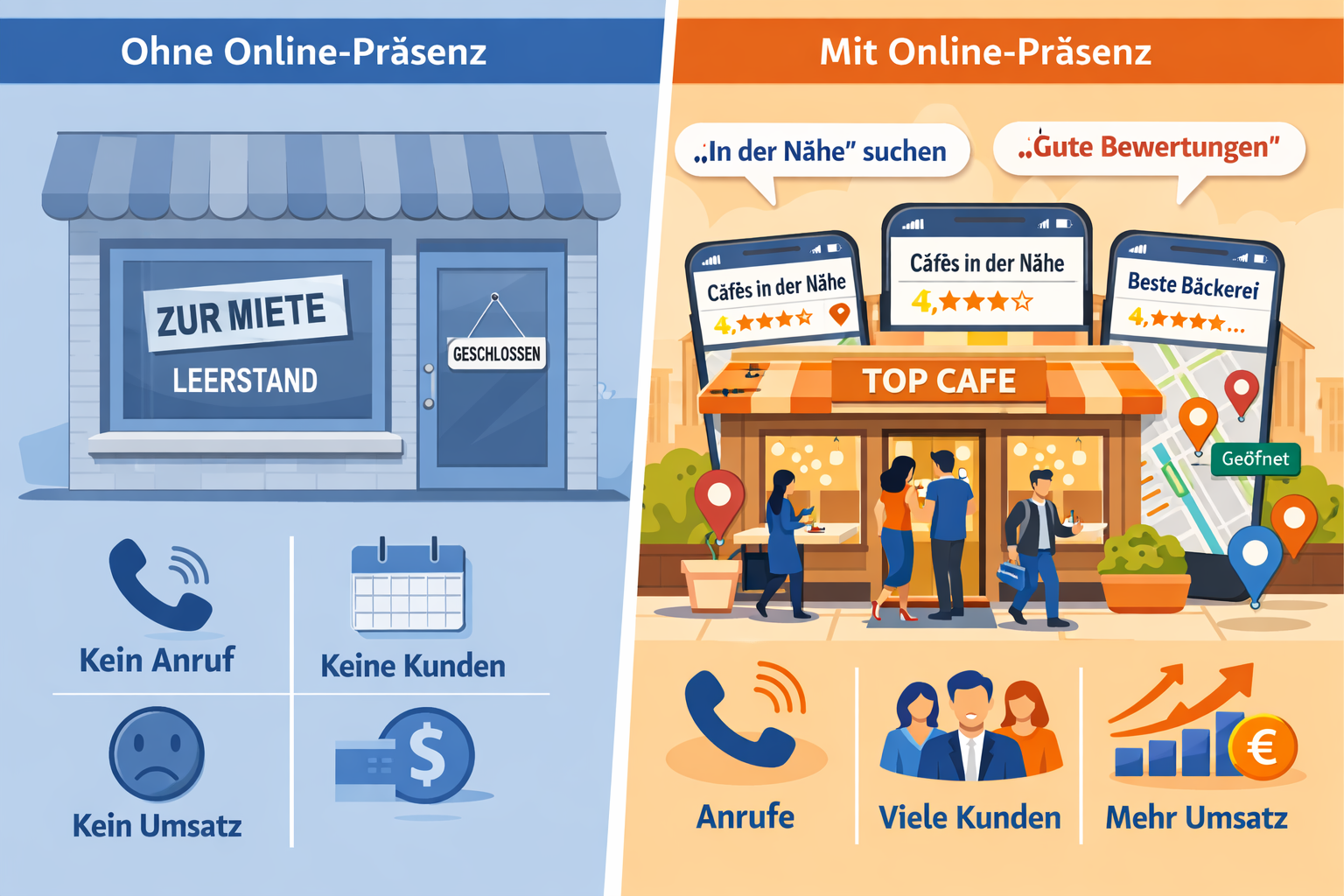
Have local SEO created means hiring a specialized agency or expert to systematically build and optimize your local online visibility. The aim is to bring your company to the top of Google for search queries with a local connection – such as “hairdresser Hamburg” or “pizzeria nearby”.
In contrast to classic search engine optimization, local SEO focuses on geographically limited search results. Optimization covers several areas:
- Google Business Profiles fully set up and continuously maintained
- NAP consistency (name, address, telephone number) across all online directories
- Local backlinks of regional websites, newspapers and business directories
- Review management implement to continuously generate new, positive reviews
- Location-specific keywords integrate into website content, meta data and structured data
- Mobile optimization as 44% of mobile users search for local information at least weekly
The decisive advantage: Local search queries convert into actual purchases or visits much more often than generic searches. Anyone who searches for “dentist Berlin Mitte” usually needs an appointment promptly – and will end up with one of the top 3 results.
Why isn’t regular SEO enough?
Classic SEO aims to rank for thematic keywords, regardless of the searcher's location. Local SEO, on the other hand, uses Proximity signals – Google actively takes into account where the searcher is currently located. A café in Munich will not be shown to a user in Hamburg, even if it has the best SEO in the world.
In addition, completely different ranking factors play a role in local SEO:
- Proximity to the seeker (Proximity)
- relevance the business category
- Notoriety (Prominence) through reviews, mentions and backlinks
One professional local SEO agency understands these differences and optimizes specifically for local ranking signals.
Why should you have local SEO created instead of doing it yourself?
The decision to have local SEO created or to implement it yourself depends on your resources, your time budget and your technical know-how. Professional service providers bring three key advantages: experience, efficiency and continuous adaptation to Google updates.
Time saving is the most obvious advantage. Local SEO requires not just the initial setup, but ongoing maintenance: answering reviews, creating posts in the Google Business profile, building backlinks, updating directory entries. This is often not realistic for business owners who need to focus on their core business.
Technical expertise plays a big role. Topics such as structured data (schema markup), local citations, geo-targeting and optimization for voice search require specialized knowledge. Mistakes can cause Google to classify your business profile as spam or inconsistencies can negatively impact your rankings.
Access to professional tools is another factor. Agencies use paid software for:
- Ranking tracking for local keywords
- Citation management across hundreds of directories
- Competition analysis in the local environment
- Assessment monitoring and management
- Reporting and performance analysis
These tools often cost several hundred euros per month individually - they are standard tools for agencies.
When is the DIY approach worthwhile?
It makes sense to lend a hand if you:
- Very limited budget have and can invest time
- Just a single location need to optimize
- Technically savvy and you like to learn
- Think long term can (results take 3-6 months)
For companies with multiple locations, complex services or in highly competitive industries, professional support is usually the better choice. One Have a professional homepage created is often the first step before local SEO can even take effect.
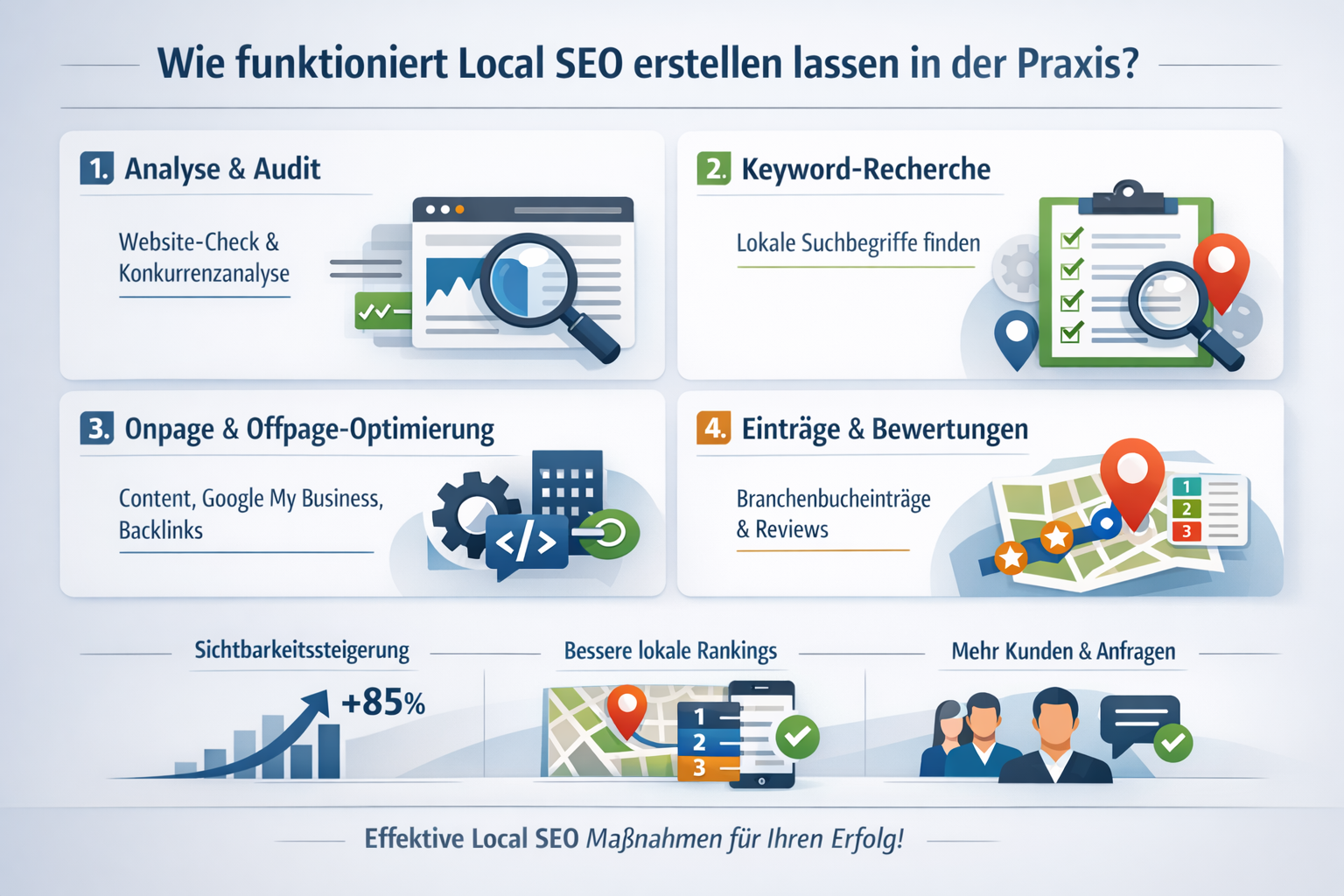
How does local SEO work in practice?
If you want to have local SEO created, you typically go through a structured process that starts with analysis and leads to continuous optimization. Reputable agencies work transparently and explain every step.
Phase 1: Analysis and Strategy (Week 1-2)
The agency starts with one Local SEO Audit, which examines the following areas:
- Inventory your current online presence
- Competitive analysis – who is already ranking for your target keywords?
- Keyword research with a local focus
- Citation audit – where is your company already mentioned?
- Review status – how many reviews do you have, how current are they?
The agency develops one from this tailor-made strategy with concrete goals, schedule and KPIs (Key Performance Indicators).
Phase 2: Basic optimization (weeks 3-6)
Now it's time to implement the basic measures:
Google Business Profile Optimization:
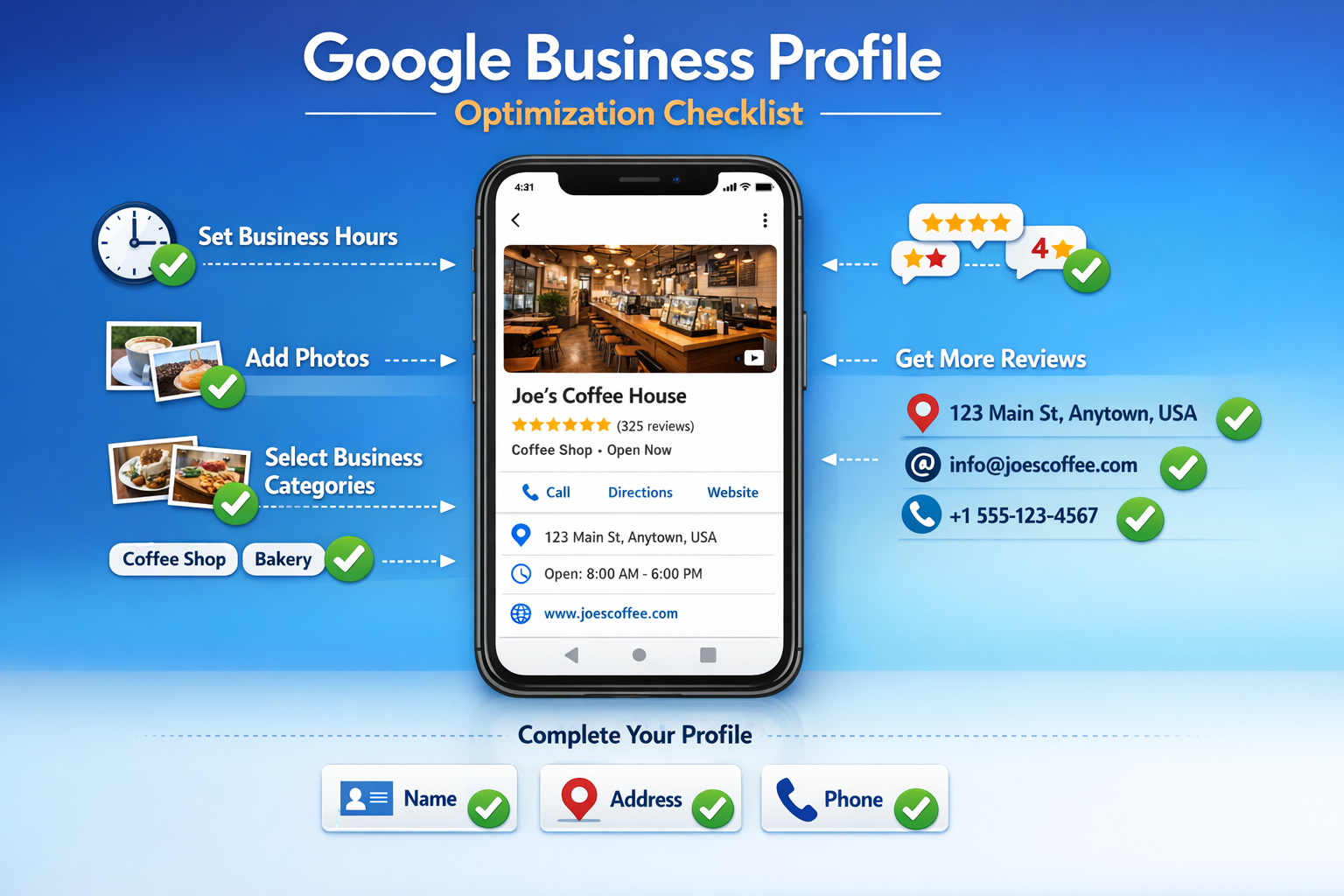
- Complete profile information (opening hours, categories, attributes)
- Upload high-quality photos and videos
- Describe products/services in detail
- Schedule regular posts
- Set up FAQ section
Establish NAP consistency:
- Uniform spelling of name, address, telephone everywhere
- Have old or incorrect entries corrected or deleted
- Implement structured data (Schema.org LocalBusiness) on the website
Website optimization:
- Create location pages for each business location
- Integrate local keywords into title tags, meta descriptions and content
- Ensure mobile optimization
- Optimize loading times (important for mobile users)
For a technically perfect basis, it can make sense to: Have your website professionally created allow.
Phase 3: Building and Growth (Months 2-6)
This phase is about sustainably building authority and visibility:
Citation Building:
- Create entries in relevant business directories
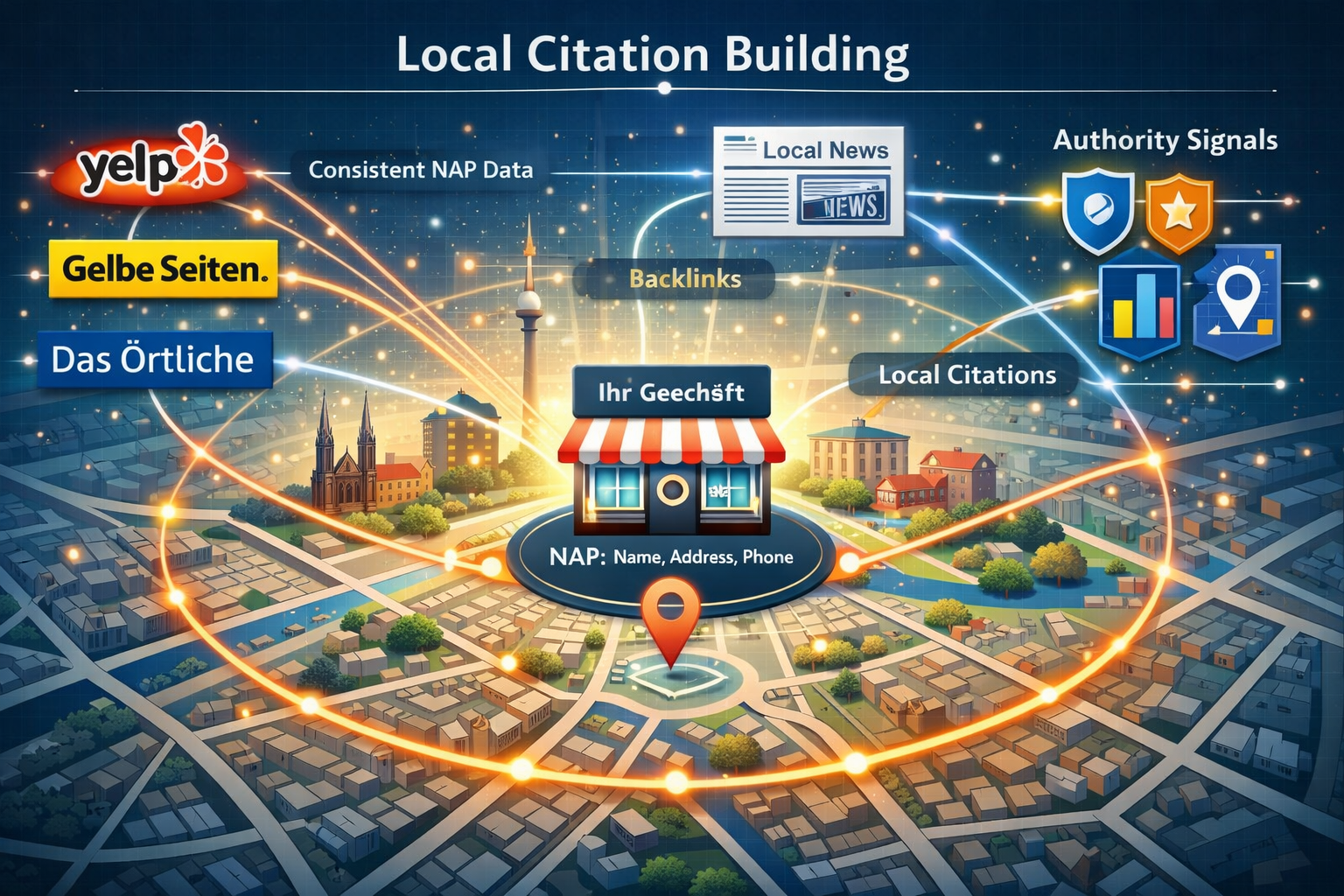
- Maintain local directories (Yellow Pages, Das Örtliche, Yelp).
- Use industry-specific portals
Build local backlinks:
- Partnerships with local businesses
- Sponsoring local events or clubs
- Guest posts in local online magazines
- Generate mentions in local media
Review management:
- Systematically ask satisfied customers for reviews
- Respond professionally to all reviews
- Process negative reviews constructively
Content creation:
- Blog articles with local relevance
- Local landing pages for different districts
- FAQ pages for common local questions
Phase 4: Monitoring and optimization (ongoing)
Local SEO is not a one-time project, but a continuous process:
- Ranking tracking for defined keywords
- Traffic analysis via Google Analytics
- Conversion tracking (calls, directions, website visits)
- Competition monitoring
- Regular reports with clear metrics
Good agencies continually adjust strategy based on data and respond to Google updates or changes in the competitive environment.
How much does it cost to have local SEO done?
The costs for professional local SEO services vary greatly depending on the scope, number of locations and intensity of competition. Here is a realistic overview for 2026:
Pricing models at a glance
| Scope of services | Monthly costs | Suitable for |
|---|---|---|
| Basic package (1 location) | 300-600€ | Small sole proprietorships, startups |
| Standard package (1-3 locations) | 600-1,200€ | Established local businesses |
| Premium package (multiple locations) | 1,200-3,000€ | Branch companies, franchises |
| Enterprise (10+ locations) | 3,000-10,000€+ | Large chains, multi-location businesses |
One-time setup costs are often added and range between €500 and €2,500, depending on the complexity.
What is typically included in the packages?
Basic package usually includes:
- Google Business Profile Optimization
- NAP consistency in top 20 directories
- Monthly reporting
- Basic review management
Standard package expanded by:
- Advanced citation building (50+ directories)
- Content creation (1-2 blog posts/month)
- Local backlink strategy
- Advanced keyword optimization
- Competitive analysis
Premium package additionally offers:
- Multi-location management
- Advanced review management with automation
- Comprehensive content strategy
- Social media integration
- Detailed conversion tracking
- Quarterly strategy adjustments
Be aware of hidden costs
Pay attention to possible additional costs:
- Tool licenses (some agencies charge these separately)
- Paid Citations in premium directories
- Content creation beyond the package
- Website customizationsif technical changes are necessary
- Reputation management tools for review monitoring
Choose an agency that calculates transparently and all costs are clarified in advance. Reputable providers will prepare a detailed offer after an initial consultation.
ROI: When does the investment pay off?
The question about the return on investment is legitimate. Local searches are proven to convert better than generic searches. If your average customer value is €200 and you only gain 5 additional customers per month through local SEO, you have already generated €1,000 in sales - at a cost of €600-800 for a standard package.
Realistic first measurable results after 3-4 months, significant improvements after 6-12 months. Local SEO is a marathon, not a sprint - but the results are sustainable and build on each other.
What factors influence your local SEO rankings in 2026?
Google uses its own algorithm for local search results, which differs from classic organic searches. The three main factors are Relevance, distance and prominence – but the details behind it have evolved significantly in 2026.
Google Business Profile: The most important lever
Your Google Business Profile is the heart of your local SEO strategy. Completeness and topicality are the two decisive factors:
Critical elements:
- Primary and secondary categories choose correctly
- Business hours keep up to date (including public holidays)
- Attributes use (e.g. “wheelchair accessible”, “Wi-Fi available”)
- Photos upload regularly (companies with 100+ photos receive significantly more requests)
- Products/Services describe in detail
- Posts publish at least weekly
- Q&A section actively maintain
Reviews: Freshness beats quantity
According to expert consensus the timeliness of reviews is the most important local SEO factor for 2026. Companies with continuous new reviews can improve their rankings within a few days.
The numbers speak for themselves:
- 53% of users are specifically looking for current, positive experiences
- 51% prioritize high star ratings
- Replying to reviews shows Google active engagement
Review Management Best Practices:
- Systematically ask for reviews after every purchase/service
- On all Reviews respond (positive and negative)
- Use negative reviews as an opportunity to solve problems
- Never buy fake reviews (Google detects this and punishes you)
User engagement signals
Google now actively tracks how users interact with your business profile:
- Dwell Time on your profile
- Click on “Plan route”
- Calls directly from search
- Website visits via the profile
- Photo Views and interactions
The more real users interact with your profile, the more relevant Google considers you. This means: A lively, actively used profile ranks better than a static one, even if the latter is perfectly optimized.
NAP consistency and citations
NAP stands for Name, Address, Phone – and the absolute consistency of this data across all online directories is critical. Google automatically compares hundreds of sources and trusts companies more if their data is identical everywhere.
Avoid common mistakes:
- Different spellings (“Street” vs. “Str.”)
- Old addresses not updated after move
- Different phone numbers in different directories
- Different company names (e.g. with/without legal form)
A professional agency uses citation management tools to keep your data consistent across 100+ directories.
Local backlinks and mentions
Backlinks from local websites signal to Google that your company is actually anchored in the region. Particularly valuable are:
- Local newspapers and news portals
- Chambers of Commerce and Industry
- Local blogs and influencers
- Sponsorship mentions of events or clubs
- Partnerships with other local businesses
Quality beats quantity: One link from the city government website or local newspaper is worth more than 100 links from irrelevant directories.
Mobile optimization is mandatory
With 44% of mobile users searching for local information at least weekly Mobile optimization not optional. Google uses mobile-first indexing – the mobile version of your website is the primary basis for rankings.
Critical Mobile Factors:
- Loading time under 3 seconds
- Click-to-call buttons prominently placed
- Responsive design for all screen sizes
- Readable font sizes without zooming
- Touch-friendly buttons and links
If your website has weaknesses here, you should have one Have a WordPress website created, which is mobile-optimized from the ground up.
Have local SEO created: Agency selection made easy
Choosing the right agency plays a crucial role in the success of your local SEO strategy. Not every provider is equally qualified - here are the criteria you should pay attention to.
Identifying features of reputable agencies
Transparency in methods and reporting:
- Clear explanation of what measures will be carried out
- Regular, understandable reports with real metrics
- No promises like “Top 1 ranking guaranteed in 4 weeks”
- Open communication about risks and timeframes
Proven expertise:
- References and case studies from your industry
- Google Partner status or comparable certifications
- Active presence in the SEO community (blog, conferences)
- Team with specialized local SEO experts
Holistic approach:
- Not just Google Business Profile, but complete strategy
- Integration with your website and other marketing channels
- Consideration of voice search and AI trends
- Long-term strategy instead of quick wins
Red Flags: You should take these warning signs seriously
❌ “We guarantee number 1 on Google” – Reputable agencies do not provide ranking guarantees, as Google rankings depend on hundreds of factors
❌ Non-transparent contractual obligations – Be careful of long minimum terms without exit clauses
❌ No clear KPIs – If the agency cannot define how success is measured, caution is advised
❌ Cheap offers – “Local SEO for €99/month” cannot work if the tool costs alone are higher
❌ No references – Established agencies can demonstrate successful projects
The right questions in the initial consultation
Ask these questions to separate the wheat from the chaff:
- “What specific measures does your service include in the first 3 months?”
- “How do you measure success and how often do I receive reports?”
- “Do you have experience with companies in my industry in my region?”
- “What tools do you use for citation management and rank tracking?”
- “How do you handle Google updates that affect rankings?”
- “What happens to my assets (profiles, accounts) if we end the collaboration?”
A competent agency will answer all questions precisely and understandably - without technical jargon or evasive answers.
Local vs. national agencies
Local agencies They often know the regional market, competitors and local characteristics better. You can offer face-to-face meetings and may already have contacts with local media or partners.
National agencies often bring more experience with different markets, larger teams of specialists and more advanced tool stacks.
The best choice depends on your priorities: If personal contact and regional expertise are important to you, choose local. If you're looking for maximum expertise and scalability, a larger agency may be a better choice.
Avoid common mistakes when creating local SEO
Even if you seek professional help, there are pitfalls you should be aware of. These mistakes can delay or destroy your local SEO success.
Mistake 1: Inconsistent business information
The problem: Your address is written differently on the website than in the Google Business Profile, the phone number on Facebook is different, and an old address appears in business directories.
The result: Google cannot be sure which information is correct and loses trust in your business. Your rankings suffer.
The solution: Create a master file with the exact spelling of all business data and use it consistently everywhere. Have your agency conduct a citation audit and clean up any inconsistencies.
Mistake 2: Neglecting review management
The problem: You collect reviews but don't respond to them - or only to positive ones. Negative reviews remain uncommented.
The result: Potential customers see unaddressed complaints and abandon them. Google considers a lack of interaction as a lack of engagement.
The solution: Implement a process to every Review to respond within 24-48 hours. For negative reviews: thank them, show understanding, offer a solution, continue the discussion offline.
Mistake 3: Keyword stuffing in business names
The problem: Some companies try to stuff their business name in Google Business Profile with keywords: “Müllers Bakery | Baker Berlin Mitte | Fresh Bread Prenzlauer Berg”
The result: Google detects this manipulation and can suspend or severely penalize your profile. The guidelines here are clear.
The solution: Only use your real, registered business name. Keywords belong in the description, categories and posts – not in the name.
Error 4: Multiple profiles for the same location
The problem: Multiple Google Business profiles were accidentally created for the same business, or old profiles continued to exist after a change of ownership.
The result: Duplicate listings confuse Google and dilute your signals. Reviews and interactions are spread across multiple profiles.
The solution: Identify any duplicates and mark them for deletion. Only keep the most complete, up-to-date profile. Your agency can help speed up the process.
Error 5: Missing location pages on the website
The problem: You have multiple business locations, but only one generic “Contact Us” page on the website.
The result: Google cannot map which locations you serve and will rank you lower for location-specific searches.
The solution: Create a separate landing page for each location with:
- Full address and embedded Google Map
- Location-specific opening times
- Local content (e.g. “Our team in Hamburg-Altona”)
- Individual images of the location
- Location-specific reviews
If your website is not suitable for this, you should have one Create and maintain website that supports multi-location SEO.
Mistake 6: Ignoring Voice Search Optimization
The problem: Your content is optimized for typed searches, but not spoken questions.
The result: You're missing out on the growing share of voice search users who ask questions like "Where is the nearest pharmacy with emergency service?" place.
The solution:
- Optimize for question keywords (Who, What, Where, When, How)
- Use natural language in your content
- Implement FAQ sections with conversational answers
- Make sure your Google Business Profile contains all relevant attributes
FAQ: Have the most important questions about local SEO created
How long does it take for local SEO to show results?
The first measurable improvements are typically visible after 3-4 months, significant ranking increases after 6-12 months. The speed depends on the intensity of competition, the initial state and the consistency of the optimization. In less competitive niches, results can occur more quickly.
Can I completely outsource local SEO to an agency?
Yes, most technical and strategic tasks can be outsourced. However, you need minimal personal effort: ask customers for reviews, provide photos, give feedback on the content strategy. The best results come from collaboration between agency and business owner.
What is the difference between Local SEO and Google Ads?
Local SEO aims for organic (unpaid) rankings in local search results and Google Maps. Google Ads are paid ads that provide immediate visibility but incur ongoing costs. Local SEO takes time to build, but then delivers sustainable, free visibility. A combination of both approaches is ideal.
Do I need local SEO if I already have a website?
Yes, definitely. A website alone does not guarantee local visibility. Local SEO optimizes specifically for geographical searches, uses Google Business Profiles and local directories - channels that a normal website does not cover. Many local customers find stores through Google Maps, not organic web searches.
Does local SEO also work for online businesses without a physical location?
Restricted. If you're a service area business (SAB) - meaning you drive to customers instead of them coming to you - you can use local SEO by defining your service area. Pure online businesses without a local connection benefit more from classic SEO than from local SEO.
How many reviews do I need for good rankings?
There is no magic number, but studies show: Companies with 50+ reviews have significantly better rankings than those with fewer than 10. This is more important than the absolute number continuity new reviews and the Response rate. A business with 30 reviews, 10 of which are from the last month, often ranks better than one with 100 reviews, all of which are 2 years old.
Can I optimize my Google Business Profile myself or do I need an agency?
You can do the basic optimization (filling out your profile, uploading photos, choosing categories) yourself. For advanced strategies – citation building, local backlinks, schema markup, multi-location management, continuous monitoring – professional help is usually more efficient and effective.
What happens if I stop working with the agency?
That depends on the contract. Reputable agencies ensure that you retain ownership of all assets (Google Business Profiles, website content, directory listings). Before signing the contract, clarify what will happen when it ends and whether you will retain access to all accounts.
Is local SEO worth it for small businesses with a limited budget?
Absolutely. Local SEO is often the most efficient marketing channel, especially for small, local businesses. The conversion rate of local searches is very high, and you only compete with providers in your region, not globally. Good results can be achieved for individual locations with just €300-600 per month.
How important are social media signals for local SEO?
Social media signals (likes, shares, followers) are not a direct ranking factor for Google. However, social media profiles can appear in local search results, and an active social media presence leads to increased brand awareness, traffic and potentially more backlinks - all factors that indirectly support local SEO.
Can I do local SEO for multiple locations at the same time?
Yes, but it requires a scalable strategy. Each location needs its own Google Business Profile, landing pages and location-specific optimization. Multi-location SEO is more complex and expensive, but easy to implement with the right agency and tools. Franchises and chain stores often use specialized platforms for centralized management.
How do I protect myself from dubious SEO promises?
Be skeptical of guarantees like “#1 in 30 days” or extremely low prices. Ask for references, case studies and transparent explanations of the methods. Reputable agencies work according to Google guidelines (White Hat SEO), set realistic expectations and communicate openly about risks and time frames.
Conclusion: Having local SEO created is an investment in sustainable growth

Having local SEO created is one of the most effective marketing measures in 2026 for local companies, service providers and shops with physical locations. With 46% of all Google searches having local relevance and almost 80% of users taking action after local search results, the question is no longer whether, but how quickly you can optimize your local visibility.
The decision between DIY and professional agency depends on your resources. If you have time, technical know-how and patience, you can implement the basics yourself. For sustainable, scalable results and time savings, there is a specialized one Local SEO agency usually the better choice.
The most important success factors summarized again:
- Google Business Profiles fully optimize and continuously maintain
- Current, authentic reviews systematically collect and answer professionally
- NAP consistency across all online channels
- Local backlinks build relevant, regional websites
- Mobile optimization treat it as an absolute priority
- Location-specific content strategy develop and implement
- Continuous monitoring and adapting to Google updates
- have patience – Local SEO is a marathon, not a sprint
Your next steps
-
Analyze your status quo: Where are you currently? Search for your top local keywords and see where you rank.
-
Define your goals: More calls? More walk-in customers? More website visits? Clear goals help with strategy development.
-
Decisions: DIY or agency? Be honest with yourself about time, budget and expertise.
-
Get offers: Contact 3-5 agencies, ask the right questions and compare services and prices.
-
Start with the basics: Even if you hire an agency, optimize your Google Business Profile today and ask satisfied customers for reviews.
-
Measure and optimize: Define KPIs, track your progress and adjust your strategy based on data.
Local SEO is not a one-time project, but a continuous process. The companies that start today and stick with it will be the winners in their region tomorrow. The question is: when do you start?
SEO Meta Title & Description
Meta Title (58 characters):
Have local SEO created: Guide 2026 | Costs & Tips
Meta Description (157 characters):
Have local SEO created: Complete guide to costs, agency selection & strategies for 2026. Gain more local visibility & customers!
References
[1] Local SEO – https://www.onlinesolutionsgroup.de/magazin/local-seo/
[2] SEO measures – https://www.locally-visible.de/info-artikel/seo-ma%C3%9Fnahme
[3] Local SEO – https://www.drweb.de/local-seo/
[5] Is Seo Still Useful 2026 Al – https://www.seo-nest.de/ist-seo-noch-sinnvoll-2026-al/
[6] Local SEO In 2026 – https://alex-hauk.de/blog/local-seo-in-2026
[7] Seo Freiburg – https://www.rossi-concept.de/post/seo-freiburg
KI-Offenlegung: HINWEIS: Bilder wurden mit KI erstellt oder bearbeitet und sind keine realen Abbildungen. Teile der Texte wurden mit Hilfe von KI erstellt und redaktionell von einem Mensch bearbeitet.