
Manage social media channels centrally: The ultimate guide for 2026
At a time when companies are on average 8-12 different social media platforms are active, the central management of all channels becomes a crucial challenge for business success. Social media channels centrally Controlling is no longer just a nice-to-have, but a strategic necessity that determines the success or failure of digital marketing campaigns.
Key takeaways
• Central administration saves up to 60% of time in daily social media work
• Unified brand management is improved by 85% through central control
• ROI increases of 40-70% are possible through optimized workflows
• Team efficiency increases significantly through shared tools and processes
• Data-based decisions are made possible by central analytics
What does “managing social media channels centrally” mean?
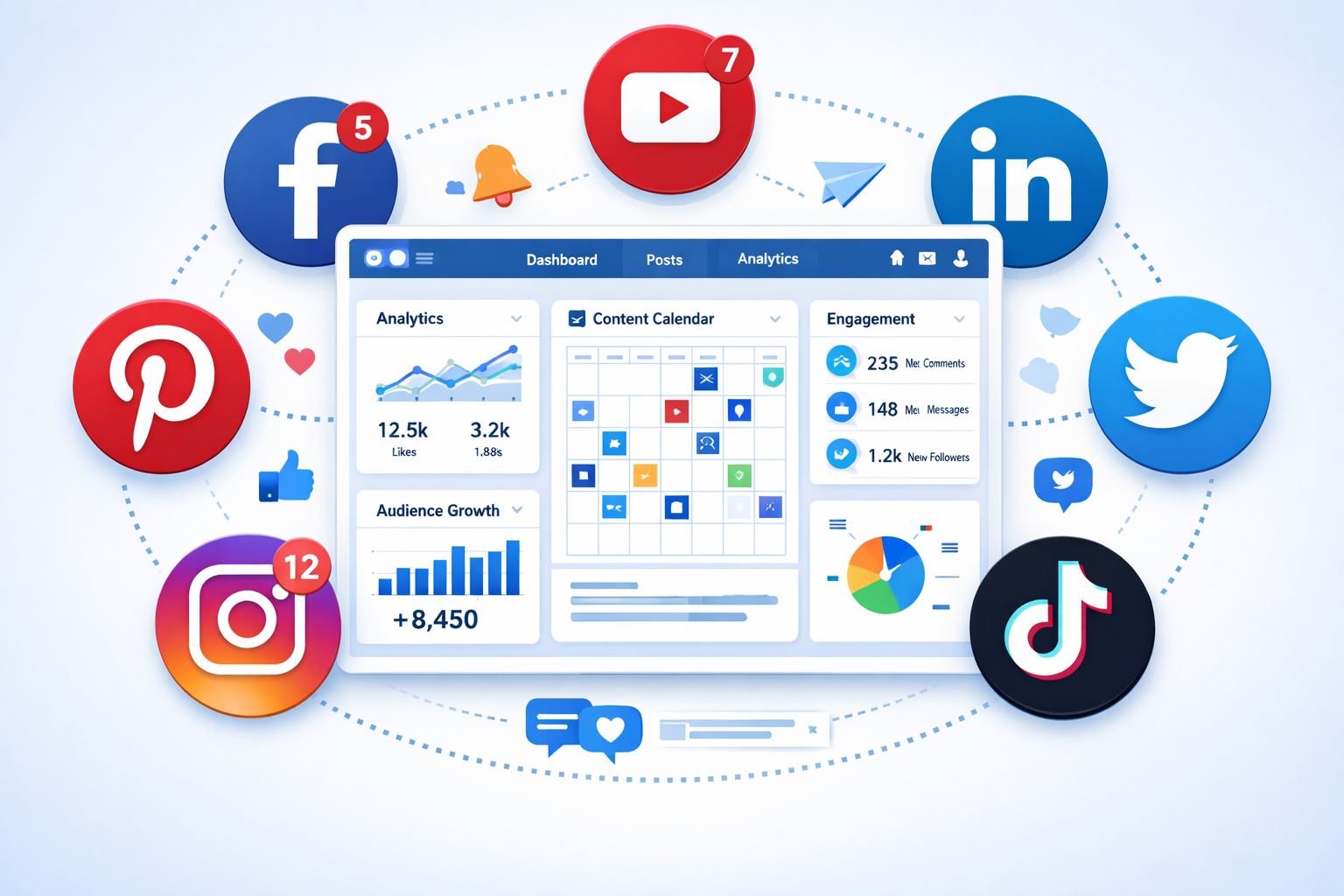
The central management of social media channels describes the strategic approach, Control all of a company's social media activities from a single point. Instead of having isolated teams for Facebook, Instagram, LinkedIn and other platforms, all channels are managed in a coordinated and synchronized manner.
The core components of central social media management
 Unified strategy: All platforms follow a coherent brand strategy and communication line.
 Common tools: A central management system for planning, publishing and analysis.
 Coordinated teams: Clear responsibilities and workflows between different departments.
 Central Analytics: All data comes together in one dashboard for better decision making.
Why is central administration becoming increasingly important?
The fragmentation of the social media landscape has increased dramatically in recent years. New platforms like TikTok, BeReal or Clubhouse are continuously emerging as established channels expand their functions. Without central coordination, the following quickly arise:
- Inconsistent brand messaging
- Double work and waste of resources
- Missed cross-platform synergies
- Confusing data landscapes
“Companies that centrally manage their social media channels achieve 3x higher engagement rates than those with fragmented approaches.” – Social Media Marketing Report 2026
Social@ALL Automations Tool – Post Management with AI
The most important advantages of social media channels centrally managed systems
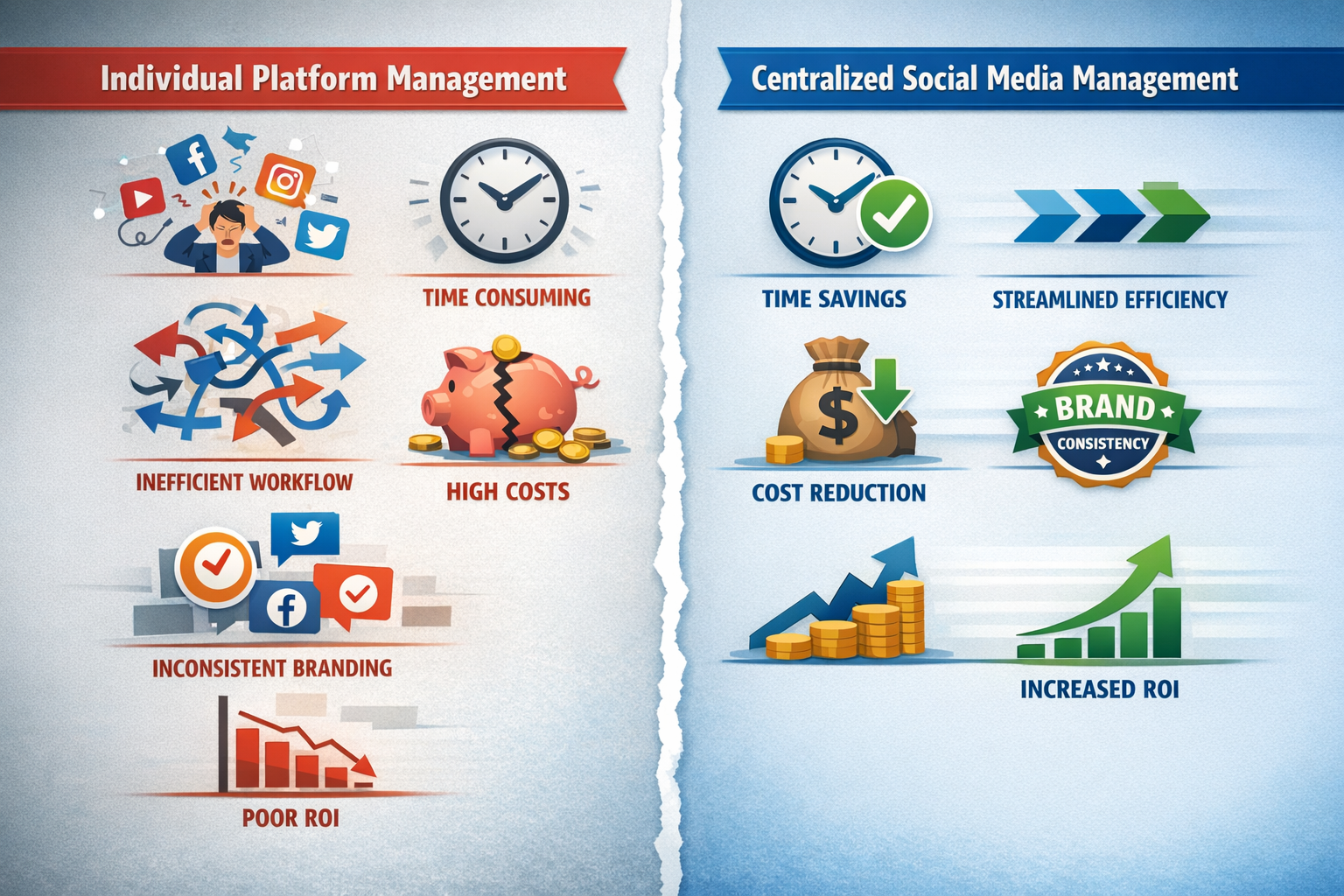
1. Massive time savings and increased efficiency
Central administration eliminates redundant processes and enables Batch processing of content creation and publication. Concrete advantages:
| activity | Traditional | Centrally managed | Time saving |
|---|---|---|---|
| Content planning | 8 hours/week | 3 hours/week | 62% |
| Posting process | 2 hours/day | 30 mins/day | 75% |
| Reporting | 4 hours/month | 1 hour/month | 75% |
| Trend monitoring | 6 hours/week | 2 hours/week | 67% |
2. Consistent brand management and corporate identity
Social media channels centrally Managing ensures that the brand message is communicated consistently across all platforms. This includes:
- Visual consistency: Uniform colors, fonts and design elements
- Tonality: Consistent approach and communication style
- Messaging: Coordinated campaigns and messages
- Timing: Synchronized releases for maximum impact
3. Improved data analysis and ROI measurement
Enable central systems Cross-platform analyticsthat provide valuable insights:
Important KPIs for centrally managed social media channels:
- Reach overlaps between platforms
- Customer journey across multiple touchpoints
- Content performance in platform comparison
- Conversion attribution from various sources
4. Scalability and growth potential
With central systems, companies can integrate new platforms more quickly and expand existing channels more efficiently. The infrastructure grows with the requirements.
Strategic implementation: Set up social media channels centrally
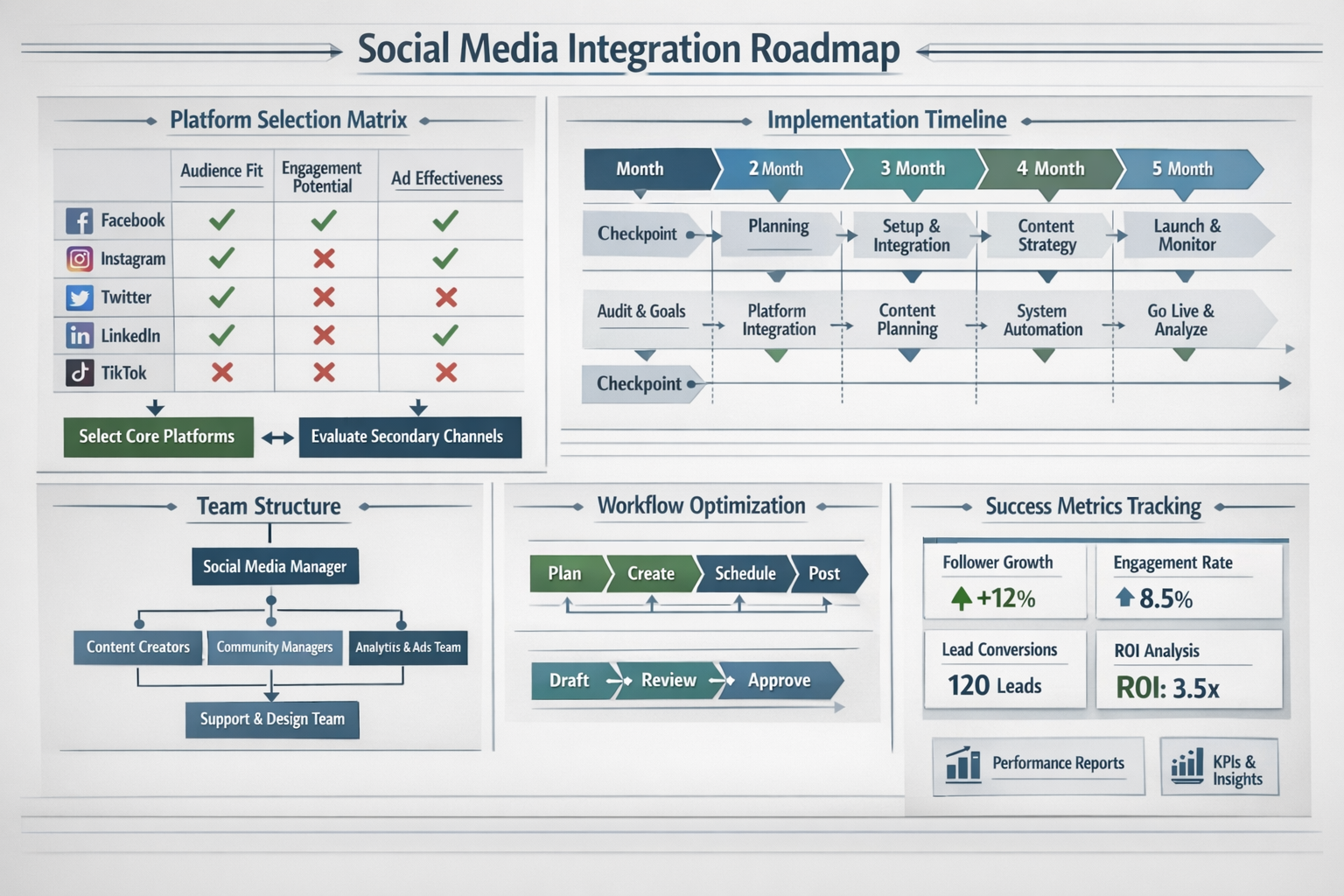
Phase 1: Analysis and inventory
Step 1: Audit of all existing channels
- Inventory of all social media profiles
- Evaluation of current performance
- Identification of redundancies and gaps
Step 2: Stakeholder mapping
- Identify all teams and people involved
- Analysis of current workflows
- Definition of responsibilities
Step 3: Evaluate the tool landscape
- Inventory of tools used
- Assessment of integration options
- Identification of consolidation potential
Phase 2: Strategic planning and goal setting
Defining the central social media strategy:
- Brand positioning set for all channels
- Target group mapping create per platform
- Content categories and define topic clusters
- KPI framework develop for holistic measurement
Example objective for centrally managed channels:
- Reach: +50% Cross-Platform Reach in 12 months
- Engagement: +35% average engagement rate
- Efficiency: -40% time spent with consistent quality
- Conversion: +25% social media attribution to sales
Phase 3: Tool selection and technical implementation
Criteria for selecting central management tools:
| criterion | Weighting | Evaluation factors |
|---|---|---|
| Platform cover | 25% | Supported networks, API quality |
| Usability | 20% | Ease of use, learning curve |
| Analytics | 20% | Reporting depth, custom dashboards |
| collaboration | 15% | Team features, approval workflows |
| integration | 10% | CRM/CMS connection, third-party tools |
| Scalability | 10% | Growth potential, enterprise features |
Top tools for centrally managing social media channels (2026):
 Hootsuite Enterprise
- Supports 35+ platforms
- Advanced Analytics and Custom Reports
- Team collaboration with approval workflows
 Sprout Social
- Excellent usability and design
- Strong CRM integration
- Comprehensive listening features
 Social@ALL AUTOMATION
- Focus on content planning
- Intuitive user interface
- Strong Instagram integration
Phase 4: Establish team structure and processes
Organizational models for central social media management:
Model 1: Centralized team
- A dedicated social media team manages all channels
- Pros: Maximum consistency, efficiency
- Disadvantages: Possible distance from departments
Model 2: Hub and Spoke
- Central team coordinates, departments provide content
- Advantages: Technical expertise + coordination
- Disadvantages: More complex tuning
Model 3: Center of Excellence
- Central strategy development, decentralized implementation
- Pros: Scalability, local customization
- Cons: Consistency challenges
Best practices for successfully centrally managed social media channels
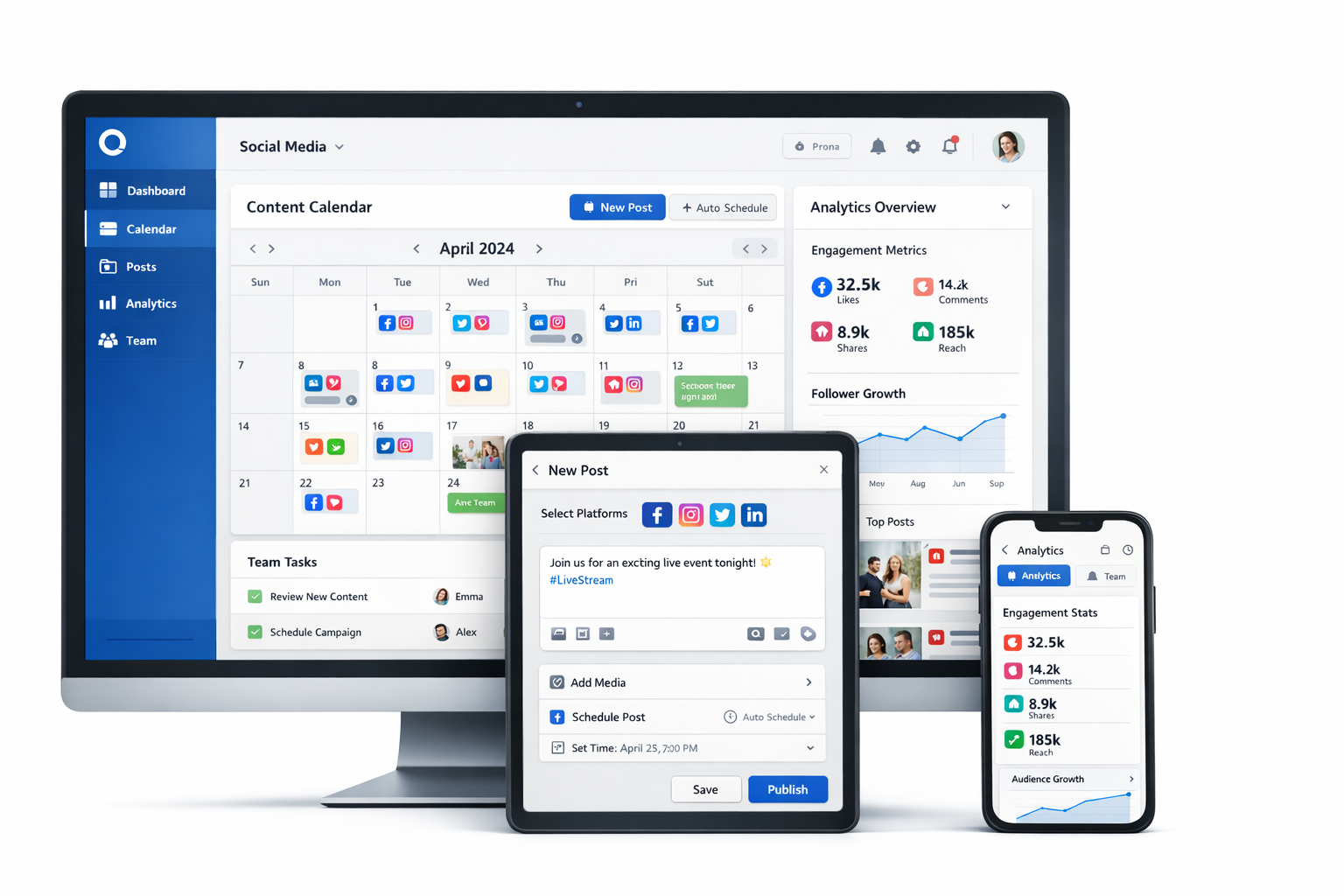
Optimize content strategy
1. Define content categories
- Educational content (40%): Tutorials, how-tos, industry knowledge
- Promotional content (20%): product presentations, offers
- Community content (25%): User-generated content, interaction
- Behind the scenes (15%): Company culture, team insights
2. Platform-specific adjustments
Even with central administration, content must be optimized for the platform become:
| platform | Optimal posting time | Content format | Hashtag strategy |
|---|---|---|---|
| Tue-Thurs, 8-10 a.m | Professional Articles | 3-5 relevant tags | |
| Mon-Fri, 11 a.m.-1 p.m | Visual Stories | 10-15 mix tags | |
| Wed-Fri, 9-10 a.m | Video + text | 2-3 specific tags | |
| TikTok | Tue-Thurs, 6-8 p.m | Short form video | 3-5 trend tags |
Implement workflow optimization
Standard workflow for centrally managed channels:
- Ideation (Monday): Brainstorming and topic planning
- Creation (Tuesday-Wednesday): Content creation and production
- Review (Thursday): Quality control and approvals
- Scheduling (Friday): Scheduling and publication
- Monitoring (Daily): Community Management and Engagement
- Analysis (Monthly): Performance review and optimization
Crisis management and compliance
Central administration facilitates quick reactions:
- Uniform crisis communication across all channels
- Quick deactivation problematic content
- Coordinated mitigation in negative events
- Compliance monitoring for regulated industries
"In times of crisis, centrally managed social media channels are worth their weight in gold. Response times are reduced from hours to minutes." – Crisis Communication Expert, 2026
Common challenges and solutions
Challenge 1: Resistance to change
Problem: Teams want to keep their usual tools and processes.
Solution:
- Change Management with clear communication of the benefits
- Step-by-step introduction instead of a big bang approach
- Training and support for everyone involved
- Quick wins demonstrate early success
Challenge 2: Complexity of integration
Problem: Different systems and APIs need to work together.
Solution:
- Professional implementation by experts
- Pilot project Start with selected channels
- Backup strategies for critical failures
- Regular updates and plan maintenance
Challenge 3: Data protection and compliance
Problem: Central systems must meet high security standards.
Solution:
- GDPR compliant Tool selection
- Access rights management implement
- Audit trails for all activities
- Regular security reviews carry out
Future trends: Where is central social media management heading?
Artificial intelligence and automation
2026 and beyond AI-powered features will revolutionize centralized management:
- Automated content creation based on performance data
- Predictive Analytics for optimal posting times
- Sentiment Analysis for proactive community management
- Dynamic personalization for different target groups
Voice and audio content integration
With the rise of Audio platforms like Clubhouse and Spotify, the integration of voice content into central systems is becoming more important.
Metaverse and Virtual Reality
Social media channels centrally to manage will also VR platforms and must include metaverse activities.
Conclusion: The path to successfully centrally managed social media channels
The central administration of social media channels is no longer an option, but a necessity for companies that want to be successful in the digital age. The benefits – from dramatic time savings to improved brand management – far outweigh the initial implementation challenges.
Your next steps:
- Conduct a comprehensive audit your current social media activities
- Define clear goals for central administration
- Evaluate appropriate tools based on your specific requirements
- Start with a pilot project for selected channels
- Invest in change management and team training
The companies that Social media channels centrally manage will have a decisive competitive advantage in 2026 and beyond. The best time to start is now - because every day with fragmented systems is a day lost for efficiency and growth.
KI-Offenlegung: HINWEIS: Bilder wurden mit KI erstellt oder bearbeitet und sind keine realen Abbildungen. Teile der Texte wurden mit Hilfe von KI erstellt und redaktionell von einem Mensch bearbeitet.