
Web Design for Real Estate Agents: The Ultimate Guide to a Successful Online Presence in 2026
At a time when 95% of all property seekers start their research online, this is crucial Web design for real estate agents about success or failure in the highly competitive real estate market. A professional website is no longer just a digital business card - it is the most important sales tool for modern real estate professionals.
The real estate industry has fundamentally changed. Potential buyers and sellers today expect a seamless digital experience, high-quality visualizations and instant access to relevant information. Brokers who do not meet these expectations lose valuable leads to the competition every day.
Key takeaways
• First impressions count: 94% of users form an opinion about a website within 0.05 seconds
• Mobile optimization is essential: Over 60% of property searches are done on mobile
• Local SEO matters: 46% of all Google searches are local
• Trust through design: Professional web design increases credibility by up to 75%
• Conversion rate optimization: Well-designed real estate websites achieve 3-5x higher inquiry rates
Why professional web design is essential for real estate agents
The digital transformation of the real estate industry
The real estate industry is experiencing a digital revolution. Web design for real estate agents is no longer optional, but essential for survival. Modern customers obtain extensive information online before even contacting a broker.
Current market data shows:
 97% of all property seekers use online platforms
- 68% start searching on mobile devices
- 15 seconds – that’s how long agents have to make a first impression
- 40% higher completion rates with a professional online presence
 97% of all property seekers use online platforms
 68% start searching on mobile devices
 15 seconds – that’s how long agents have to make a first impression
 40% higher completion rates with a professional online presence
Creating trust through visual impression
"People buy from people they trust. In the digital age, trust comes first through professional design."
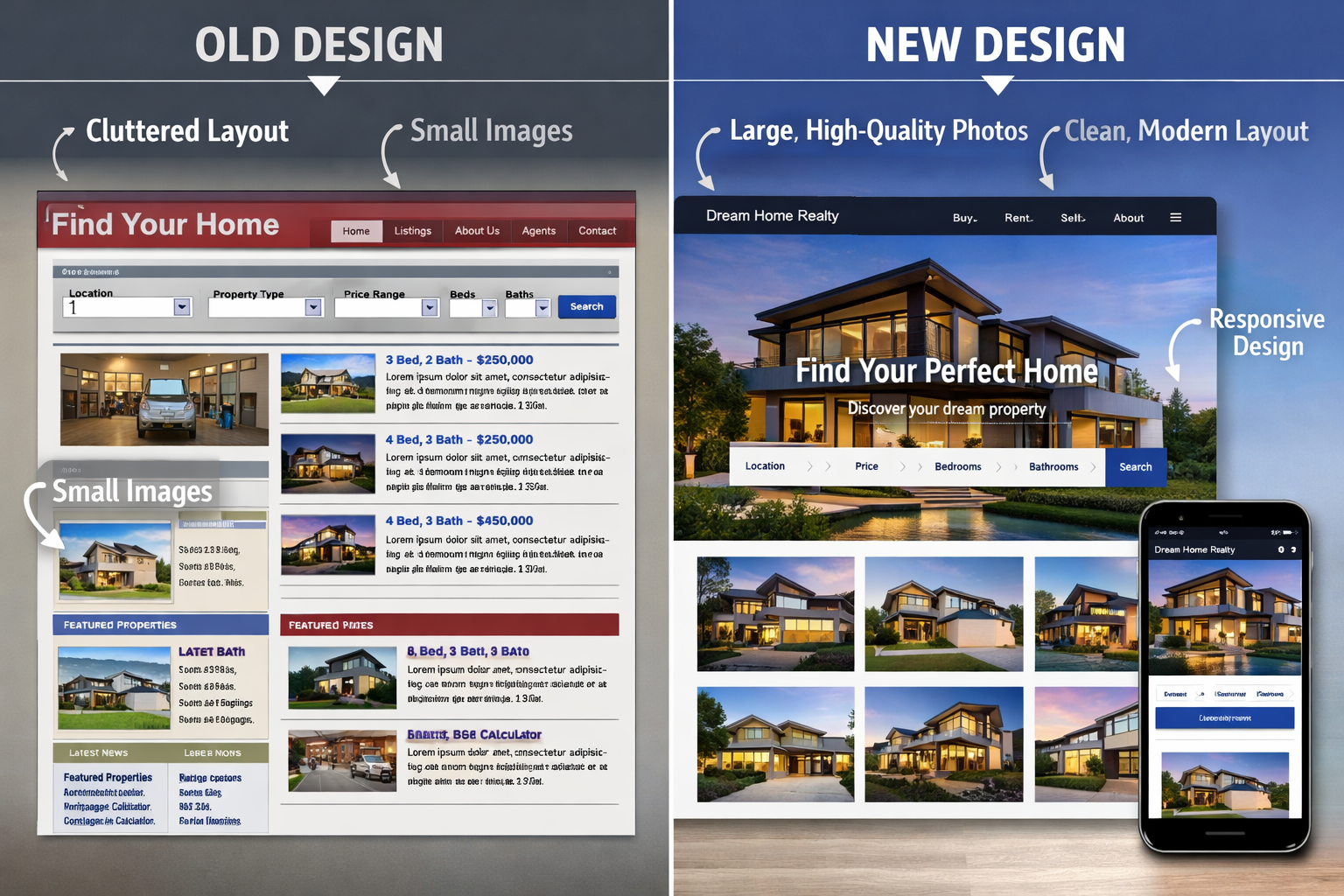
A well-thought-out website conveys competence, seriousness and professionalism. Potential customers unconsciously evaluate the quality of the service based on the website. Outdated or unprofessional websites signal a lack of modernity and can deter potential clients.
Trust-building elements include:
- High quality real estate photography
- Clear contact information and opening hours
- Customer reviews and success stories
- Professional broker portraits
- Certificates and awards
Competitive advantages through digital excellence
Real estate agents with outstanding websites clearly differentiate themselves from the competition. You attract more qualified leads, shorten sales cycles and earn higher commissions. Web design for real estate agents becomes a decisive competitive factor.
Basic design principles for real estate websites
Ease of use as top priority
User Experience (UX) is at the center of successful web design for real estate agents. The website must be intuitive to navigate and allow visitors to quickly find the information they need.
Core Usability Principles:
| principle | Description | Implementation |
|---|---|---|
| clarity | Clear navigation and structure | Maximum of 7 main menu items |
| consistency | Uniform design on all pages | Corporate Design Guidelines |
| speed | Fast loading times under 3 seconds | Image optimization, CDN |
| accessibility | Barrier-free design | WCAG 2.1 standards |
Visual hierarchy and layout structure
A well-thought-out visual hierarchy guides visitors specifically through the website. Web design for real estate agents must place the most important information prominently and create a logical flow of information.
Proven layout strategies:
- F pattern layout: Users scan in F-shape
- Use whitespace: Let content breathe
- Call to action buttons: Noticeable but not intrusive
- Imagery: Create emotional connection
Color psychology in the real estate industry
Colors influence emotions and purchasing decisions. Real estate agents should choose color schemes that convey confidence, stability and luxury.
Recommended color palettes:
- Shades of blue: trust, professionalism, stability
- Earth tones: Warmth, naturalness, security
- White/Grey: Elegance, modernity, clarity
- Gold accents: Luxury, exclusivity, value
 Shades of blue: trust, professionalism, stability
 Earth tones: Warmth, naturalness, security
 White/Grey: Elegance, modernity, clarity
 Gold accents: Luxury, exclusivity, value
Essential features for real estate agent websites
Property search and filter functions
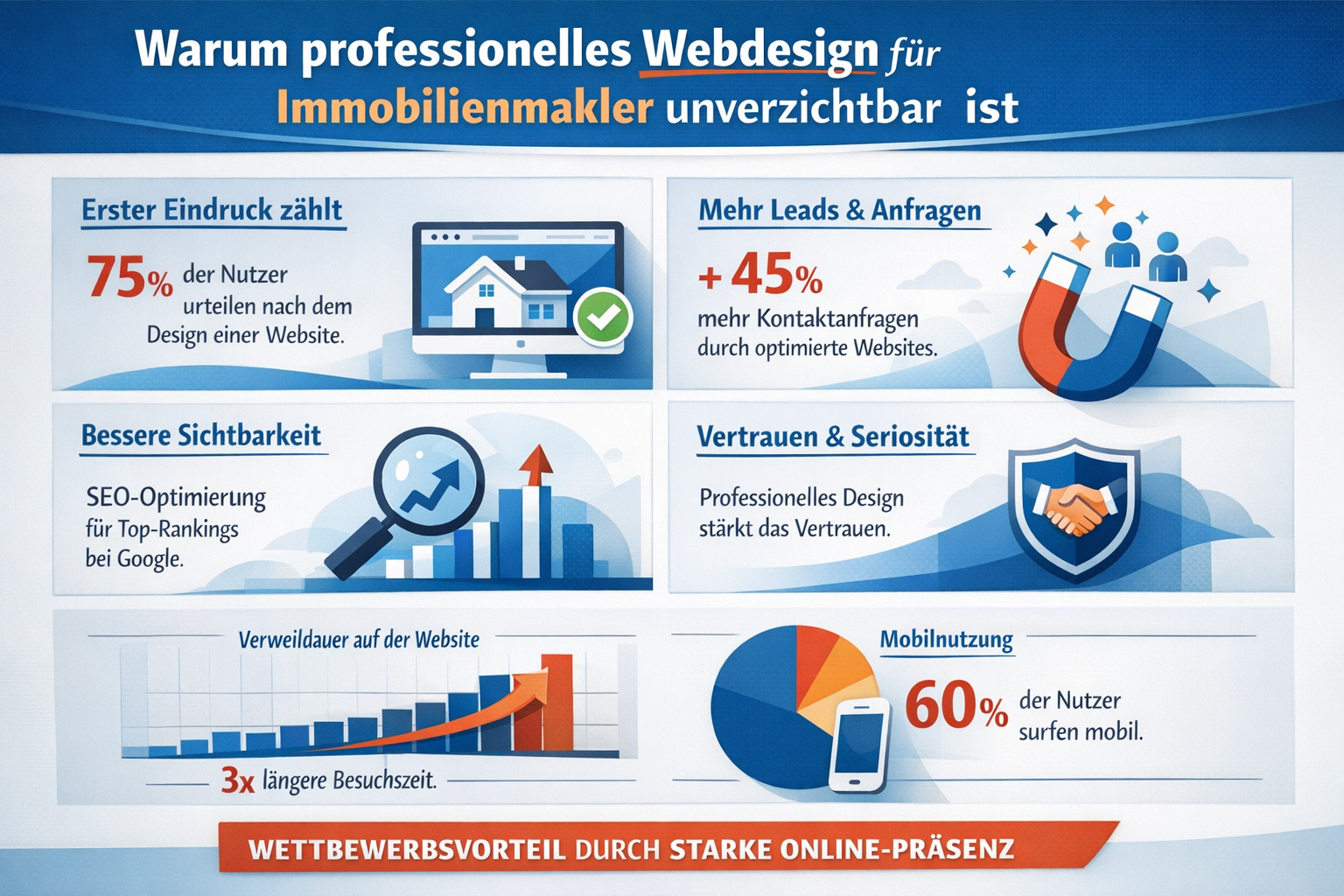
At the heart of every broker website is a powerful search function. Visitors must be able to filter quickly and precisely for their desired properties.
Essential search filters:
- Location: Zip code, district, radius search
- Property type: apartment, house, business
- Price range: From-To slider
- Size: Living/land area
- Number of rooms: Flexible selection
- Special features: balcony, garden, garage
High quality image galleries and virtual tours
Visual content sells real estate. Web design for real estate agents must present images optimally and create immersive experiences.
Modern forms of presentation:
- 360° tours: Complete spatial coverage
- Drone photography: Outdoor area and surroundings
- Interactive floor plans: Clickable room plans
- Video tours: Emotional real estate presentation
Lead generation and contact forms
Every interaction is a lead generation opportunity. Strategically placed contact options maximize the conversion rate.
Effective lead magnets:
- Newsletter registration: Market reports, new offers
- Callback service: Immediate customer contact
- Property valuation: Free initial assessment
- Checklists: Buying/Selling Guides
Integration of reviews and testimonials
Social proof significantly increases trust. Positive customer reviews should be prominently displayed on the website.
Proven Testimonial Strategies:
- Video testimonials: Authentic customer testimonials
- Google reviews: Direct import of current reviews
- Success stories: Detailed case studies
- Awards: Industry certificates and awards
SEO optimization for real estate agent websites
Local search engine optimization
Web design for real estate agents must integrate local SEO strategies. Most real estate searches are regional and require targeted local optimization.
Local SEO Essentials:
Google My Business optimization Local keywords ('real estate agent Munich') Collect and manage customer reviews Local directory entries Mobile optimization for local searches Content marketing for real estate professionals
High-quality content positions brokers as experts and sustainably improves search engine rankings.
Successful content formats:
- Market analysis: Current price developments
- District guides: Demonstrate local expertise
- counselor: Buying/Selling Tips
- Trend reports: Future of the real estate market
Technical SEO basics
The technical basis of the website must be designed to be search engine friendly. Web design for real estate agents requires special attention in technical optimization.
Technical optimization measures:
- Page Speed: Less than 3 seconds loading time
- Mobile first: Responsive design
- HTTPS: SSL encryption
- XML sitemap: Full indexing
- Schema markup: Structured data
Keyword strategies for the real estate industry
A well-thought-out keyword strategy significantly increases visibility in relevant search queries.
Keyword categories:
- Transactional: “Buy a house in Munich”
- Informational: “Real estate prices 2026”
- Local: “Real estate agent Maxvorstadt”
- Long tail: “3-room apartment in old building in Munich”
Costs and budget planning for web design projects
Investment framework for different website types
The costs for Web design for real estate agents vary considerably depending on the scope and requirements. Realistic budget planning is crucial for the success of the project.
Cost overview by website category:
| Website type | investment | Features | Target group |
|---|---|---|---|
| Basic website | 2,000 – 5,000 € | Basic functions, template design | Individual brokers, startups |
| Default website | 5,000 – 15,000 € | Custom design, CRM integration | Established brokers |
| Premium website | 15,000 – 40,000 € | Fully equipped, individual development | Brokerage offices, franchises |
| Enterprise solution | €40,000+ | Complex systems, multi-location | Large real estate companies |
Consider ongoing operating costs
In addition to the development costs, there are ongoing expenses for hosting, maintenance and updates.
Annual follow-up costs:
- Hosting & Domains: 200 – 800 €
- Maintenance & Updates: 1,000 – 3,000 €
- SEO & marketing: 2,000 – 10,000 €
- Security & Backups: 300 – 1,000 €
ROI calculation for website investments
A professional website will quickly pay for itself through increased lead generation and better conversion rates.
ROI factors:
- Lead Boosting: 200-400% more qualified inquiries
- Conversion improvement: 3-5x higher completion rates
- Time saving: Automated processes
- Brand image: Higher commission rates enforceable
Financing options and payment models
Various financing models also enable smaller brokerage offices to have access to professional web design.
Flexible payment options:
- One-off payment: Discounts for advance payment
- Installment payment: Spread over 6-24 months
- Leasing models: Monthly fixed costs
- Performance based: Performance-related compensation
Choosing the right web design partner
Criteria for agency selection
Choosing the right partner determines the success or failure of the web design project. Web design for real estate agents requires specific industry knowledge.
Important selection criteria:
Demonstrate real estate expertise Show portfolio of broker websites Demonstrate SEO knowledge Demonstrate technical competence Communication and accessibility Create realistic schedules Transparent pricing Offer maintenance and support Red flags in provider evaluation
Real estate agents should take certain warning signs seriously when selecting an agency.
Recognize warning signs:
- Unrealistic promises: “Top rankings in 2 weeks”
- No references: Missing examples of success
- Non-transparent prices: Hidden costs
- Poor communication: Delayed responses
- Outdated technologies: Flash, old CMS systems
 Unrealistic promises: “Top rankings in 2 weeks”
Project process and milestones
A structured project process ensures implementation on time and within budget.
Typical project progression:
-
Briefing & conception (week 1-2)
- Requirements analysis
- Target group definition
- Define the scope of functions
-
Design & Prototyping (Week 3-5)
- Create wireframes
- Design drafts
- Feedback loops
-
Development & Integration (Weeks 6-10)
- Frontend programming
- Backend development
- CMS integration
-
Testing & Launching (Week 11-12)
- Quality assurance
- Performance testing
- Go-live accompaniment
Build long-term partnerships
Successful websites require continuous support and optimization. A long-term partnership ensures sustainable success.
Advantages of long-term cooperation:
- Continuous optimization: Data-driven improvements
- Regular updates: Security and functionality
- Performance monitoring: Proactive problem solving
- Strategic advice: Take market developments into account
 Continuous optimization: Data-driven improvements
 Regular updates: Security and functionality
 Performance monitoring: Proactive problem solving
 Strategic advice: Take market developments into account
Future trends in web design for real estate agents
Artificial intelligence and chatbots
AI technologies are revolutionizing customer service in the real estate sector. Web design for real estate agents must anticipate these developments.
AI applications in practice:
- Intelligent chatbots: 24/7 customer support
- Smart search: AI-based property search
- Automatic evaluation: Algorithm-supported price determination
- personalization: Individual content delivery
Virtual and augmented reality
Immersive technologies are creating completely new viewing experiences and are becoming the standard in the premium segment.
VR/AR innovations:
- Virtual reality tours: Full property inspection
- AR furniture: Virtual setup of empty rooms
- Construction progress visualization: Experience project development
- Environment simulation: Explore the neighborhood
Sustainability and green design
Environmental awareness also shapes web design. Sustainable websites reduce carbon emissions and appeal to environmentally conscious customers.
Sustainable web design:
- Energy efficient hosting: Green data centers
- Optimized media: Reduced data transfer
- Minimalist design: Less resource consumption
- Sustainability features: CO2 calculator, energy certificates
Voice search optimization
Voice-activated searches are becoming increasingly important and require adapted SEO strategies.
Voice SEO strategies:
- Natural language: Conversational keywords
- FAQ optimization: Direct answers to questions
- Local optimization: “Real estate agents near me”
- Mobile priority: Voice search is primarily mobile
Conclusion: The path to a successful real estate agent website
Web design for real estate agents is a strategic investment that determines long-term business success. In an increasingly digitalized market, real estate professionals can no longer afford a weak online presence.
The most important success factors summarized:
Immediate action steps
Phase 1: Analysis and Planning (Week 1-2)
- Evaluate current website performance
- Conduct competitor analysis
- Define target group and requirements
- Set budget and schedule
Phase 2: Partner selection (week 3-4)
- Get at least 3 offers
- Check references and portfolios
- Conduct initial discussions
- Negotiate contract terms
Phase 3: Monitor implementation (weeks 5-16)
- Regular project reviews
- Communicate feedback promptly
- Accompany quality assurance
- Coordinate launch preparation
Long-term success strategy
A successful real estate agent website is never “finished.” Continuous optimization, regular content updates and technical maintenance ensure sustainable success.
Monthly optimization tasks:
- Evaluate website analytics
- Monitor SEO performance
- Publish new content
- Carry out technical updates
Investment in the future
Professional Web design for real estate agents is not an expense, but an investment in the future of the company. The digital transformation of the real estate industry is continuously accelerating - those who act now will secure decisive competitive advantages.
"The best time to optimize a website was a year ago. The second best time is now."
Brokers who still rely on outdated or unprofessional websites in 2026 not only risk losing sales, but also their entire market position. Building an outstanding online presence takes time, expertise and investment – but the return on investment justifies every dollar invested.
The real estate industry is not waiting. Customers today expect digital excellence, and only agents with professional websites will be able to meet these expectations. The decision for first-class Web design for real estate agents is a decision for sustainable business success.
KI-Offenlegung: HINWEIS: Bilder wurden mit KI erstellt oder bearbeitet und sind keine realen Abbildungen. Teile der Texte wurden mit Hilfe von KI erstellt und redaktionell von einem Mensch bearbeitet.