
Agency for a homepage: The complete guide for 2026

Last updated: January 14, 2026
One Agency for a homepage creates professional websites with customized design, technical implementation and ongoing support. In contrast to DIY kits, agencies deliver individual solutions that are tailored to business goals, start with SEO optimization and are supported over the long term.
Anyone who needs a website in 2026 is faced with an important decision: DIY with a modular system or hire a professional agency? The answer depends on budget, time frame and goals - but one thing is clear: a well-made homepage is more important now than ever. It is often the first point of contact with potential customers and decides in seconds whether they trust or leave.
Key takeaways
- Professional agencies offer tailor-made websites with individual strategies, modern design and technical expertise instead of standardized templates
- Costs vary greatly: Simple business websites start from 2,000-5,000 euros, while extensive e-commerce platforms can cost 10,000-50,000+ euros
- Full service becomes standard: Most agencies in 2026 offer complete packages of design, development, SEO, hosting and ongoing maintenance
- AI integration is essential: Personalization, automated SEO optimization and voice search compatibility are part of modern agency services[1]
- Subscription models replace one-off payments: Flexible subscription pricing with monthly installments and ongoing support is becoming the preferred form of billing[1]
What exactly does an agency do for a homepage?
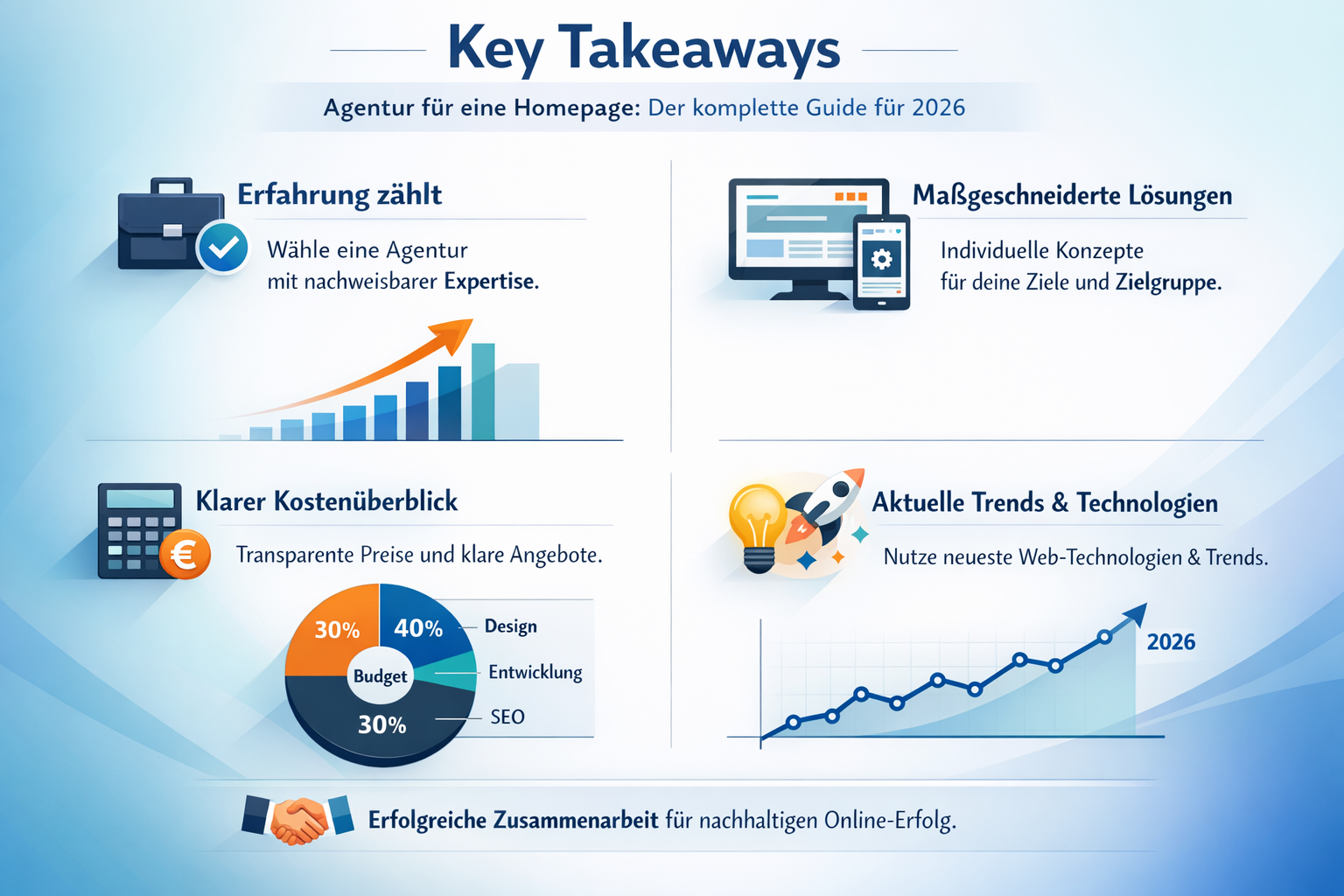
One Agency for a homepage takes over the complete conception, design and technical implementation of a website - from the initial idea to the finished online presence and beyond. This includes strategic consulting, individual design, programming, content creation and technical optimization.
Core services of modern web agencies
Strategic planning
Before a single pixel is designed, the agency analyzes the business model, the target group and the competitive situation. This creates a concept that defines which functions the website needs and how visitors should be guided through the page.
Design and user experience
This is where the visual elements are created: color scheme, typography, layout and imagery. Professional agencies first create wireframes (structural sketches) and then detailed design mockups showing what the finished website will look like.
Technical development
The designs are converted into functional code. This includes:
- Responsive design for all screen sizes
- Content management system (CMS) integration
- Database connection
- Form functions and contact options
- Interfaces to other tools (CRM, newsletter, etc.)
SEO optimization
Modern agencies incorporate search engine optimization directly into the development process. This includes technical SEO (loading times, mobile optimization, structured data) and content SEO (keyword research, optimized texts, meta descriptions). AI-powered tools for automated on-page optimization, content analysis and technical checks will become standard in 2026[1].
Content creation
Many agencies also offer copywriting, photography or video production. At least they help structure existing content and provide recommendations for missing content elements.
Full-service approach will dominate in 2026
The trend is clearly towards comprehensive care. Agencies like IronShark and netgrade show how design, development, SEO and ongoing support are combined in a single partnership[2]. This saves customers from having to coordinate multiple service providers and ensures smooth processes.
Specialized agencies are increasingly positioning themselves as innovation leaders in niches such as AI integration, augmented reality or sustainable web solutions in order to stand out from the competition and open up new markets[1].
For companies that... Have a professional homepage created This means: An agency is not just a service provider for a single project, but also becomes a long-term partner for the digital presence.
Why hire an agency for a homepage instead of doing it yourself?
A professional agency delivers customized solutions tailored to specific business goals, saving time in the long run and avoiding costly rookie mistakes in design, technology and SEO. Modular systems are suitable for simple projects, but quickly reach their limits when it comes to more complex requirements.
Time is money – and so is expertise
The time factor
Creating your own website can easily take 50-100 hours or more without any prior knowledge. These are hours that are missing from your own business. An agency has processes, templates and experience that dramatically shorten the time frame - typically 4-12 weeks from brief to launch.
Technical complexity
What looks simple is often difficult:
- GDPR-compliant cookie banners and data protection
- Accessibility according to WCAG standards (required by law from 2025)
- Performance optimization for fast loading times
- Security measures against hacking
- Mobile optimization for all devices
Agencies know these requirements and implement them correctly right from the start. Anyone with Cookie banner GDPR or Make your website GDPR compliant busy, you quickly realize: this is a separate field of expertise.
Professional design vs. template look
Individual brand identity
Building block templates often look like building blocks. Visitors recognize standard designs and subconsciously associate them with “cheap” or “unprofessional”. An agency creates a unique design that fits the brand and is remembered.
Conversion optimization
Agencies know where buttons should be placed, how forms should be designed and which elements create trust. These are details that can make the difference between a 2% and 8% conversion rate - with 1,000 visitors per month that means 60 instead of 20 inquiries.
SEO right from the start
Technical foundation
Search engines evaluate hundreds of factors. A professional agency builds the website so that it ranks well right from the start:
- Clean code structure
- Optimized loading times (under 3 seconds)
- Mobile-first design
- Structured data for rich snippets
- Internal linking structure
With 50% of all search queries expected to be voice searches by 2026[1], websites must also be optimized for conversational interfaces - an area in which agencies have specialized expertise.
Long-term visibility
Correcting SEO mistakes at the beginning is much more time-consuming than doing it right right away. agencies with Local SEO Expertise knows exactly which optimizations are important for regional companies.
When is DIY still worthwhile?
Modular systems are useful for:
- Very small budgets (under 1,000 euros)
- Simple business card websites without e-commerce
- Hobby projects or tests
- Personal blogs without commercial goals
An agency is the better choice for:
- Business-critical websites designed to generate revenue
- E-commerce stores
- Complex functions (booking systems, member areas, etc.)
- Professional branding
- Time pressure and lack of know-how
For specialized industries such as Web design for craftsmen or Web design for SMEs Agencies offer industry-specific solutions that are tailored to typical requirements and target groups.
How much does an agency cost for a homepage in 2026?
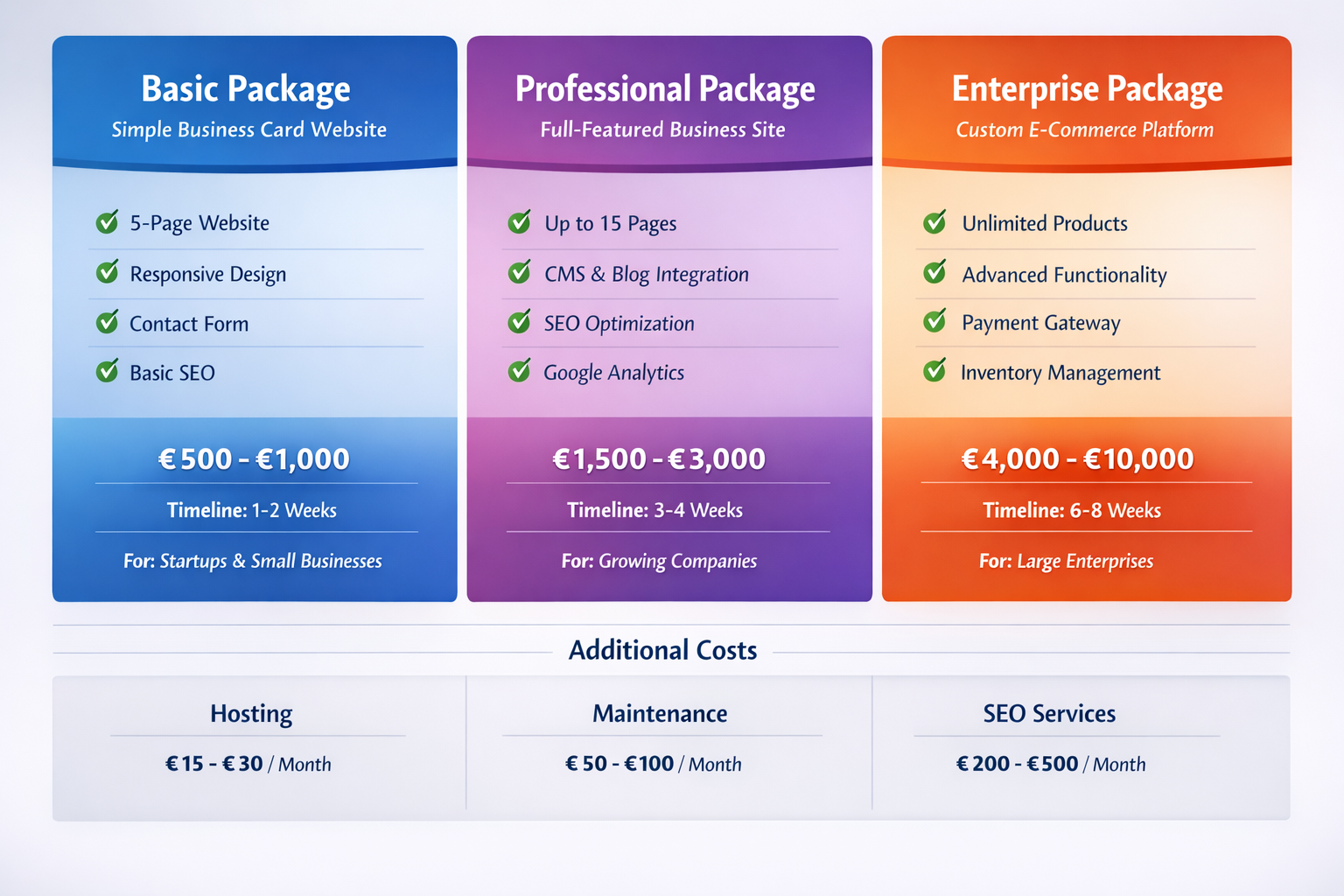
The costs for a professional homepage through an agency in 2026 will be between 2,000 euros for simple business websites and 50,000+ euros for extensive e-commerce platforms. Subscription models with monthly installments between 150-800 euros are increasingly becoming the preferred alternative to one-off payments[1].
Pricing overview by website type
| Website type | One-off costs | Monthly subscription | Typical services |
|---|---|---|---|
| Business card website | €2,000-5,000 | 150-300 € | 3-5 pages, basic design, contact form, mobile-optimized |
| Business website | 5,000-15,000 € | 300-600 € | 10-20 pages, custom design, CMS, SEO basis, blog function |
| E-commerce store | 10,000-50,000 € | 500-1,500 € | Product catalog, payment systems, inventory management, marketing tools |
| Enterprise solution | €50,000+ | €1,500+ | Individual development, interfaces, multi-language, support |
What influences the price?
Scope and complexity
- Number of pages and subpages
- Individual functions (booking system, configurator, etc.)
- Number of language versions
- Integration with existing systems (CRM, ERP, etc.)
Design effort
- Template customization vs. completely custom design
- Number of design iterations
- Custom illustrations or photography
- Animation and interaction elements
Content creation
- Text creation by the agency (50-150 € per page)
- Professional photography (€500-3,000 per shoot)
- Video production (€1,000-10,000+ depending on scope)
Technical requirements
- Performance optimization for very fast loading times
- Accessibility according to WCAG 2.1 AA standard
- Advanced security measures
- Special Hosting Requirements
Don't forget ongoing costs
Hosting and domain
- Shared hosting: €5-20 per month
- Managed WordPress hosting: €20-100 per month
- Dedicated servers: €100-500+ monthly
Maintenance and updates
- Basic maintenance: €50-150 per month
- Comprehensive support: €200-800 per month
- Security updates, backups, performance monitoring
SEO and marketing
- Ongoing SEO support: €500-2,000 per month
- Content marketing: €300-1,500 per month
- Website speed optimization: one-off €500-2,000
Subscription models: The new standard
In 2026, more and more agencies will offer flexible subscription models that bundle all services in one monthly rate[1]:
Benefits for customers:
- Not a high initial investment
- Predictable monthly costs
- Continuous updates and improvements
- Ongoing support included
- Can be canceled flexibly (usually 3-12 months minimum term)
Typical subscription package (€399 per month):
- Website creation and launch
- Hosting and domain
- Monthly updates and security checks
- Basic SEO optimization
- 2-4 hours of content changes per month
- Email support
Avoid hidden costs
Pay attention to these points in the offer:
- Are revisions included? How many?
- Who supplies texts and images – agency or customer?
- Is training for the CMS included?
- What happens after the launch? Is there a guarantee period?
- Do you own the rights to the design and code?
Common additional costs:
- Stock photos or royalties: €50-500
- Premium plugins or themes: €50-300 annually
- SSL certificate: often free, premium versions €50-200 annually
- GDPR tools (cookie banners, etc.): 0-200 € annually
For startups with a limited budget, specialized ones offer Web agencies for startups often customized packages with staggered payments.
How do I find the right agency for my homepage?
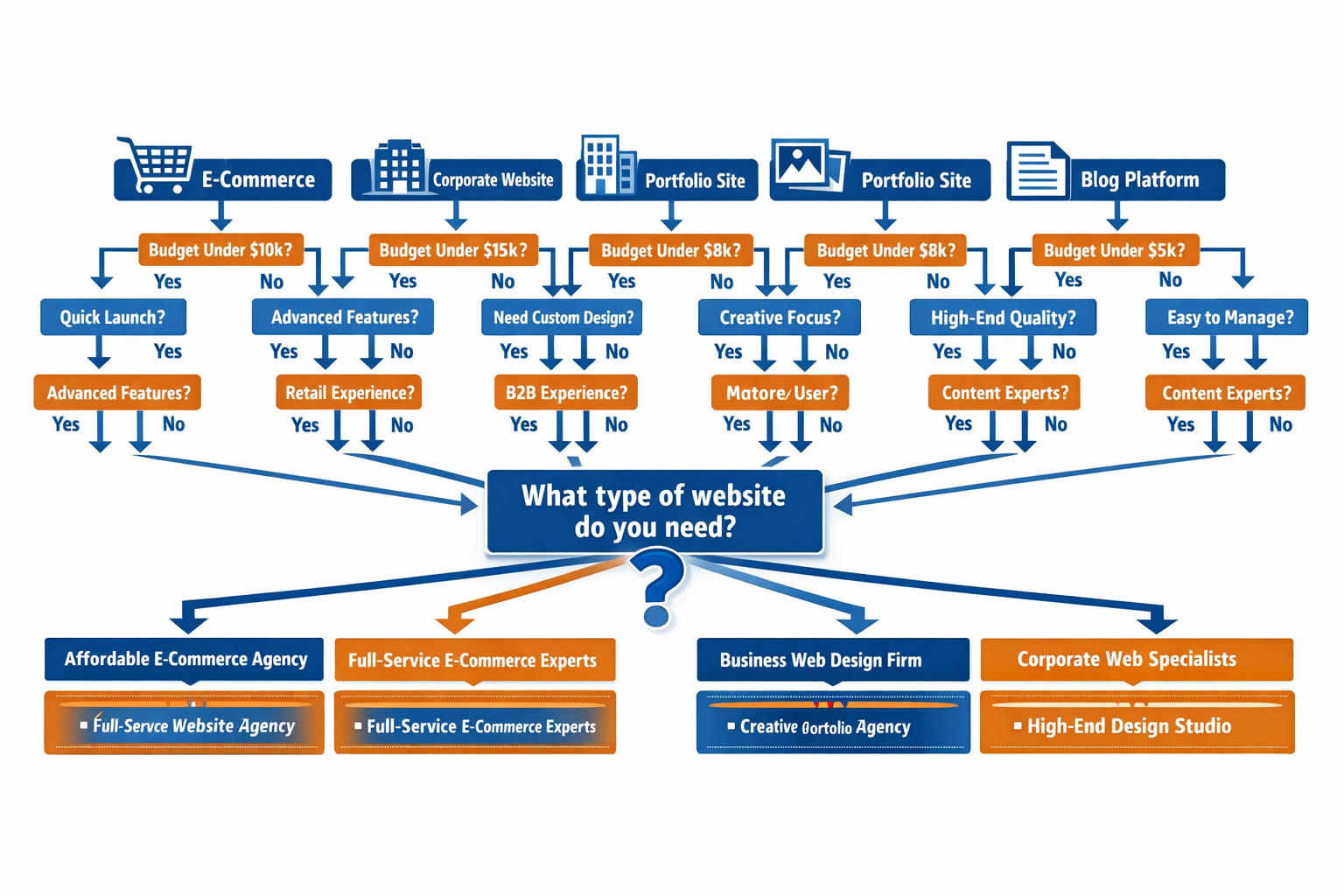
You can find the right agency by clearly defining your requirements, checking your portfolio and references, evaluating communication in the initial meeting and comparing at least 3-5 offers. Specialization in your industry and project size is more important than the size of the agency.
Step 1: Define requirements
Before you even talk to agencies, clarify for yourself:
Project scope
- What type of website do you need? (Business card, shop, portal, etc.)
- How many pages approximately?
- Which functions are absolutely necessary?
- Is there an existing website that needs to be replaced?
Budget and time frame
- What can you realistically invest?
- When should the website go live?
- Is there flexibility on both points?
Own resources
- Do you have texts and images or does the agency need to provide them?
- Who will maintain the website after launch?
- Is there internal technical expertise?
Step 2: Research and pre-selection
Where can you find suitable agencies?
- Google search for “homepage agency” + your city
- Business directories and rating platforms
- Recommendations from the network
- Portfolio platforms like Behance or Awwwards
First filter criteria:
- Does the portfolio suit your style and requirements?
- Does the agency have experience in your industry?
- Is the size correct? (Small agencies for personal support, large ones for complex projects)
- Is the agency regional or remote? (Depending on preference)
One Web design agency with proven expertise in your segment brings valuable industry know-how.
Step 3: Check portfolio and references
What you are looking for in the portfolio:
- Quality of design – does it appeal to you?
- Diversity of projects – does this show flexibility?
- Technical implementation – do the example websites work well?
- Currentness – are the works modern or outdated?
Use references correctly:
Don’t just ask “Were you satisfied?”, but specifically:
- How was communication during the project?
- Were deadlines met?
- How does the support work after the launch?
- Would you hire the agency again?
- What didn't go well?
Step 4: Initial consultation and chemistry check
The first conversation shows a lot about how we work:
Good signs:
- The agency asks a lot of questions about your business and goals
- Challenges and possible solutions are discussed
- You get honest feedback, even if it's uncomfortable
- Communication is clear and understandable (no technical jargon)
- There is a designated contact person
Warning signs:
- Immediate offer without deeper analysis
- Unrealistic promises (“first place on Google guaranteed”)
- Unclear pricing structure or hidden costs
- Poor accessibility or slow responses
- Pressure to make quick decisions
Step 5: Compare offers
What a good offer contains:
- Detailed service description
- Clear breakdown of costs
- Schedule with milestones
- Number of correction loops
- Responsibilities (who delivers what?)
- Payment methods
- Rights of use and ownership
Comparison criteria:
Don't just look at the price. Rate:
- Scope of services (comparing apples with apples)
- Experience and expertise
- Communication and sympathy
- Availability and response time
- Additional services such as training or support
Specialization can be crucial
A specialized agency is worthwhile for certain industries:
- Web design for lawyers knows legal requirements
- Web design for real estate agents brings real estate-specific features
- Website for doctors takes data protection into account in healthcare
Checklist: Recognize the right agency
✅ Portfolio shows quality and diversity
✅ Positive, verifiable references
✅ Clear, understandable communication
✅ Detailed, transparent offer
✅ Expertise in relevant areas (SEO, GDPR, etc.)
✅ Fixed contact person
✅ Realistic promises and timelines
✅ Fair pricing with no hidden costs
✅ Sympathy and good gut feeling
What services should a modern agency offer for a homepage in 2026?
In 2026, a future-proof homepage agency will offer, in addition to classic design and development, AI-supported personalization, voice search optimization, automated SEO tools, continuous maintenance and strategic advice on digital transformation[1]. The managed services approach with ongoing optimization is increasingly replacing pure project management.
Mandatory services: The foundation
Responsive design
Every modern website must function perfectly on all devices – from smartphones to tablets to desktops. This is no longer an extra, but an absolute basic requirement.
Content Management System (CMS)
You need the ability to change content yourself without contacting the agency every time. WordPress, TYPO3 or other CMS should be standard, including training on how to use it.
Basic SEO
Technical SEO (clean code, fast loading times, mobile optimization) must be integrated from the start. This includes:
- Meta tags and descriptions
- Structured data (schema markup)
- XML sitemap
- Robots.txt
- Optimized images
GDPR compliance
Legally compliant data protection declarations, cookie banners, SSL encryption and secure forms are mandatory, not optional.
Accessibility
Legally required for many websites since 2025 - the agency should be able to implement WCAG 2.1 AA standards.
Extended services: The added value
AI-powered personalization
Modern agencies use AI to customize website content, layouts and functionality based on individual user behavior. This significantly increases engagement and conversion rates[1].
Voice search optimization
With 50% of all search queries expected to be voice searches by 2026[1], websites must be optimized for conversational queries. This particularly affects healthcare, public institutions and e-commerce.
Automated SEO tools
AI-supported tools for on-page optimization, content analysis, technical checks, automatic image compression and loading time optimization significantly reduce manual effort[1].
Performance optimization
Loading times under 3 seconds are critical for SEO and user experience. Specialized Website speed optimization should be part of the offer.
Conversion optimization
A/B testing, heatmaps, user journey analysis and continuous conversion rate improvement are all part of professional agencies.
Post-launch support: The difference
Maintenance and updates
Regular updates of CMS, plugins and themes are essential for security and functionality. Good agencies offer:
- Weekly or monthly updates
- Automatic backups
- Security monitoring
- Performance checks
- Uptime monitoring
Content maintenance
Many agencies offer hourly quotas for ongoing changes:
- New pages or blog articles
- Image exchange
- Text updates
- Small design adjustments
SEO support
Ongoing search engine optimization with:
- Keyword monitoring
- Ranking tracking
- Content optimization
- Link building
- Technical optimizations
Analytics and reporting
Regular reports on:
- Visitor numbers and traffic sources
- User behavior and conversion rates
- SEO performance
- Technical problems
Strategic Consulting: The Future
Modern agencies are increasingly positioning themselves as strategic partners[1]:
Digital transformation
Advice on how the website fits into the overall digital strategy – from social media to email marketing.
AI integration
Recommendations and implementation of AI tools for chatbots, personalization or content generation.
sustainability
Advice on environmentally friendly web design (green hosting, optimized code for less energy consumption).
Scalability
Planning how the website can grow with the company without completely redeveloping it.
Specialized services
Depending on the industry, specific services may be important:
E-commerce
- Product database management
- Payment system integration
- Merchandise management connection
- Conversion tracking
Local business
- Google My Business Optimization
- Local SEO strategies
- Location pages for multiple branches
B2B
- Lead generation and CRM integration
- Gated content and download areas
- Complex product configurators
Agency partnerships and networks
Top agencies work with specialized partners to offer holistic solutions without requiring clients to coordinate multiple service providers[3]:
- Content marketing experts
- Photographers and videographers
- SEO specialists
- Social media manager
- Hosting provider
This enables one-stop shopping for all digital needs.
How does working with an agency for a homepage work?
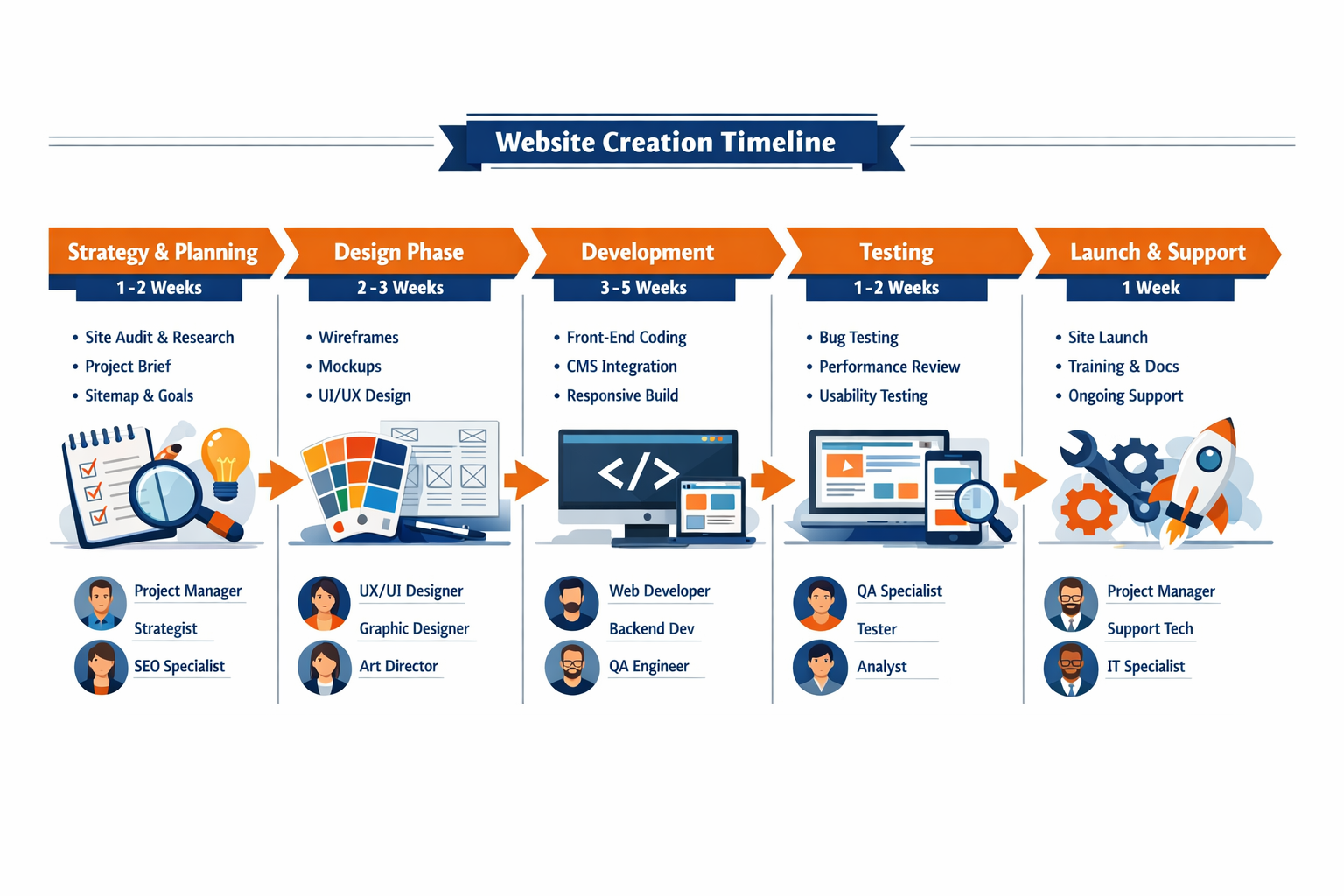
The collaboration typically follows a structured 5-phase process: briefing and strategy (1-2 weeks), design phase (2-4 weeks), development (3-6 weeks), testing and optimization (1-2 weeks), as well as launch and post-launch support. The entire process takes an average of 8-16 weeks for a business website.
Phase 1: Briefing and strategy development
Kickoff meeting
The project starts with a detailed conversation in which the agency gets to know your business, your goals and your target group. Typical questions:
- What makes your company unique?
- Who are your main customers?
- What should visitors do on the website?
- Which websites do you like (and why)?
- Are there any competitor websites for reference?
Strategy document
The agency creates a concept that specifies:
- Sitemap (structure of all pages)
- User journeys (how visitors navigate through the site)
- Functional requirements
- Content strategy
- SEO basics
Your tasks:
- Provide all necessary information
- Provide feedback on the strategy document
- Provide any existing materials (logo, images, texts)
Duration: 1-2 weeks
Phase 2: Design phase
Wireframes
First, simple structural sketches are created that show where which elements are placed - without colors or final graphics. This helps validate the structure before investing a lot of design work.
Design mockups
Based on approved wireframes, the agency creates detailed designs for the most important pages (homepage, typical subpage, contact page). These show:
- Color scheme
- typography
- Image style
- Layout details
- Interaction elements
Feedback loops
Typically 2-3 rounds of revisions are included in the offer. Give specific feedback:
- ✅ “The blue tone seems too cool for our brand”
- ❌ “I don’t like it”
Your tasks:
- Timely, concrete feedback
- Make decisions (don’t put them off endlessly)
- Possibly involve stakeholders
Duration: 2-4 weeks
Phase 3: Development
Frontend development
The approved designs are converted into working code:
- HTML/CSS for structure and appearance
- JavaScript for interactions
- Responsive adjustments for all screen sizes
Backend integration
The CMS is set up and connected to the frontend:
- Define content areas
- Programming form functions
- Create database structures
- Set up interfaces to other tools
Content insertion
Depending on the agreement, the agency or you enter the content yourself. If you do it, the agency usually gives training.
Your tasks:
- Deliver final texts and images
- Check intermediate statuses on staging servers
- Provide feedback on functionality
Duration: 3-6 weeks
Phase 4: Testing and optimization
Quality assurance
The agency systematically tests:
- Functionality of all features
- Display in different browsers
- Mobile views on real devices
- Form Submissions
- Loading times and performance
- SEO basics (meta tags, structured data)
- GDPR compliance
User Acceptance Testing (UAT)
You get access to the final version on a test server and check everything thoroughly. This is your last chance to make changes before launch.
Final adjustments
Minor bugs and optimizations will be fixed. Larger change requests that were not in the original scope may incur additional costs.
Your tasks:
- Thorough testing of all functions
- Make a list of problems or wishes
- Give final approval
Duration: 1-2 weeks
Phase 5: Launch and post-launch
Go live
The website is transferred to the live server:
- Domain conversion
- Activate SSL certificate
- Set up analytics and tracking
- Redirects from old website (if available)
- Submit sitemap to Google
Monitoring
In the first few days after the launch, the agency monitors particularly intensively:
- Functionality
- Loading times
- Broken links
- Traffic and user behavior
training
The agency shows you how to use the CMS:
- Edit pages
- Create blog articles
- Upload and embed images
- Manage forms
Guarantee period
Typically there is a 1-3 month guarantee for bug fixes. Regular maintenance then begins (if booked).
Duration: 1 week + ongoing
Communication during the project
Regular updates
Professional agencies will update you on progress weekly or at each milestone.
Project management tools
Many people use tools like Trello, Asana or Basecamp, where you can see the status at any time.
Fixed contact person
You should have a specific person answering your questions - not someone different every time.
Avoid common pitfalls
Content delays
The most common reason for project delays is missing texts and images from the customer. Plan enough time for this or book content creation with the agency.
Scope creep
“Could we quickly…” – additional requests during the project can go beyond time and budget. Document changes in writing and clarify the effects.
Too many cooks
If too many people have a say, things get chaotic. Define clear decision-making paths.
Unrealistic deadlines
A good website takes time. Pressure leads to compromises in quality.
For companies that... Have a WordPress website created If you want to, the process is similar, but often a little faster, since WordPress, as an established CMS, has many standard functions.
Frequently Asked Questions (FAQ)
How long does it take to have an agency create a homepage?
A simple business website typically takes 6-10 weeks, a more extensive website with custom features takes 12-16 weeks, and complex e-commerce platforms can take 4-6 months. The biggest time factor is often the content delivery by the customer.
Can I edit my website myself later?
Yes, with a content management system (CMS) like WordPress you can change text, images and pages yourself. The agency should give you training and provide documentation. For more complex changes to the design or functionality, you still need the agency.
What is the difference between an agency and a freelancer?
Agencies have multiple specialists (designers, developers, SEO experts) on the team, which means more diverse expertise and representation during vacation/illness. Freelancing is often cheaper and more flexible, but you are dependent on one person. Freelancers can be sufficient for small projects, but agencies are safer for complex projects.
Will I own the website once it's finished?
This should be clearly regulated in the contract. Normally you own all content and get usage rights to the code and design. Some agencies reserve rights if you work with subscription models. Clarify this before signing the contract.
What happens if I am not satisfied with the result?
Reputable agencies work with milestones and approvals. You see designs and interim statuses before further development takes place. Most contracts contain a certain number of rounds of revisions. If you are fundamentally dissatisfied despite adhering to the brief, it becomes difficult - that's why the choice of agency is so important.
Do I need technical knowledge to work with an agency?
No, a good agency will explain everything in understandable language and guide you through the process. You have to know your business and your goals – the agency will take care of the technology.
How much personal contribution do I have to contribute?
At a minimum, you will be required to provide briefing information, provide feedback on designs, and make decisions. Depending on the package, also provide text and images. Plan on 5-15 hours of your time across the entire project, plus possibly content creation.
Can the agency also take care of social media and marketing?
Many agencies offer full service, which also includes social media, content marketing, SEO and online advertising. Some specialize only in web design and work with partners for other areas.
What if the agency goes bankrupt during the project?
A risk that particularly exists with very small agencies. Pay attention to financial stability, demand interim results and access to all work results. With subscription models, you should have ownership of the code and design even if you cancel.
How often should a website be redone?
A complete relaunch typically makes sense every 3-5 years as design trends, technologies and user expectations change. However, with continuous maintenance and gradual updates, a well-built website can stay current for longer.
Can I change agency if I am dissatisfied?
Yes, if you own the code and theme. A new agency can take over the existing website and further develop it. This can be more difficult with proprietary systems or subscription models - all the more reason to rely on open standards like WordPress.
What is more important: design or functionality?
Both are important and should not be played off against each other. Beautiful design without function frustrates users, good function with poor design deters users. Professional agencies balance both and understand that design must be functional.
Key takeaways
- An agency for a homepage offers much more than just design – from strategy to technical implementation to ongoing optimization and support
- Costs vary greatly Depending on the scope of the project: €2,000-5,000 for simple websites, €10,000-50,000+ for e-commerce, with increasingly popular subscription models starting at €150 per month
- The right agency choice is based on portfolio quality, industry experience, communication and chemistry – not just the lowest price
- Modern agencies integrate 2026 AI-powered personalization, voice search optimization and automated SEO tools as standard services
- The project process follows a structured 5-phase process from briefing to launch, which takes 8-16 weeks for typical business websites
- Post-launch support with continuous maintenance, updates and optimization becomes the standard instead of the exception
- Specialization pays off – Agencies with an industry focus bring valuable specific know-how
- Content delivery by the customer is the most common reason for project delays - plan enough time or book content creation
- Property rights code and design should be clearly regulated in the contract before the start of the project
- Full-service approach dominates – the best agencies offer design, development, SEO, hosting and marketing from a single source
Conclusion: Investment in professional presence
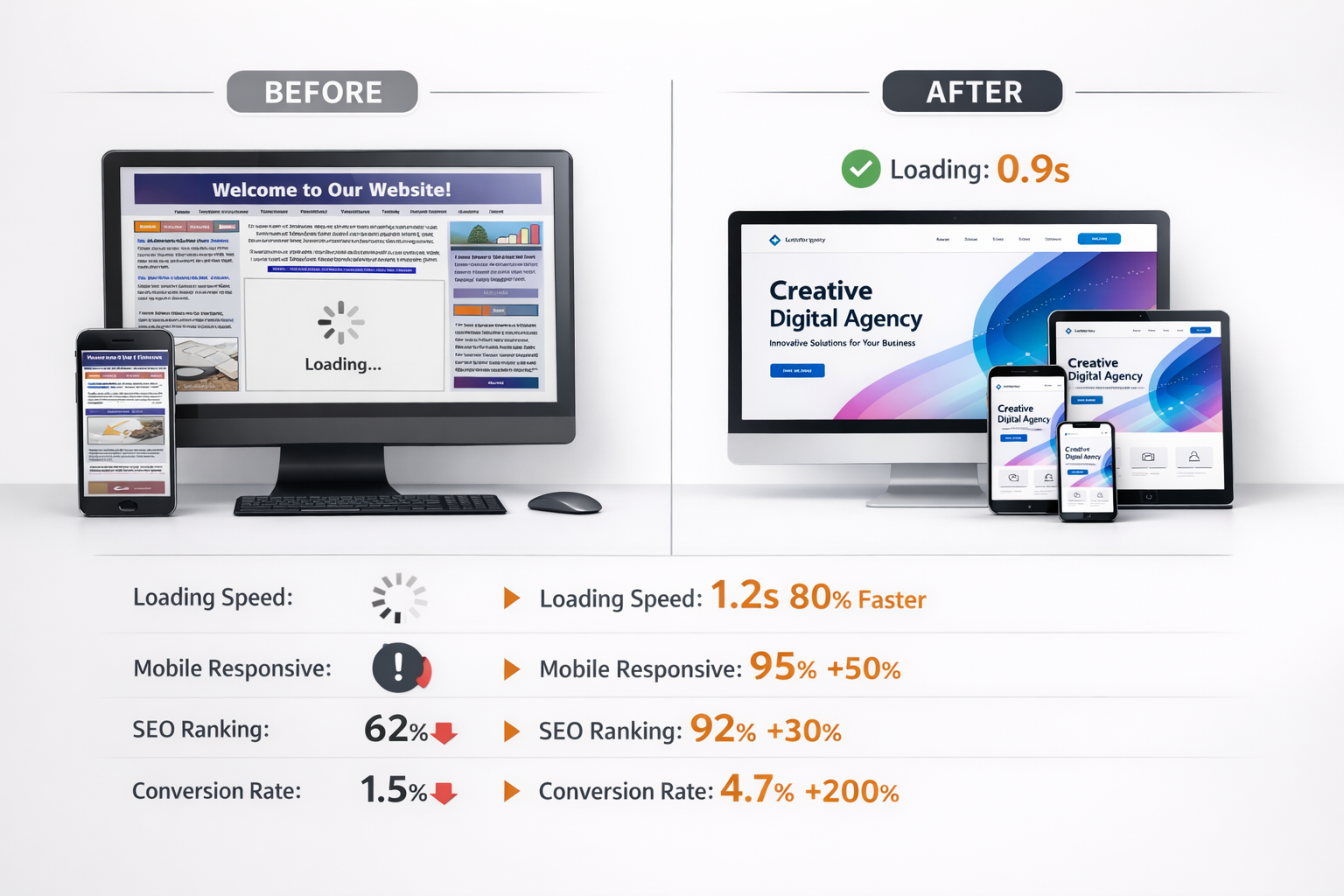
In 2026, commissioning a professional agency for a homepage is more than ever a strategic investment, not just a cost factor. Digital presence is the most important marketing channel for most companies - and a well-made website pays back many times over through better conversion rates, higher visibility and more professional branding.
The developments in 2026 clearly show: Websites are becoming more complex, requirements are increasing (GDPR, accessibility, performance), and new technologies such as AI personalization and voice search are becoming standard. It's too much for most companies to handle this themselves - and that's completely okay. There are professionals for that.
Your next steps
1. Define your requirements
Take time to write down:
- What does the website want to achieve?
- Which functions are absolutely necessary?
- What is your realistic budget?
- When should the website go live?
2. Research 3-5 suitable agencies
Look at portfolios, read reviews, and pay attention to specializations that fit your industry. Use that Web design agency Overview as a starting point.
3. Conduct initial discussions
Talk to your top candidates and pay attention not only to expertise, but also to communication and chemistry. The collaboration will last several months - the relationship has to be right.
4. Compare offers thoroughly
Look beyond price to scope, process, timeline and post-launch support.
5. Start with clear agreements
A detailed contract protects both parties and avoids misunderstandings.
Finding the right agency takes time - but the investment is worth it. A professional homepage is not a project that you just do, but rather the basis for your digital success in the coming years.
If you're ready to take the next step and build your professional online presence, start with a non-binding consultation with a specialist Agency for a homepage. Investing in professional expertise always pays off in the long term.
References
[1] Web Design Agency – https://www.locally-visible.de/info-artikel/agency-fur-webdesign
[2] Web Development Agency – https://www.hauptstadt-homepage.de/general/agentur-fuer-webentwicklung/
[3] Learn Grow Think Forward Our Agency Update 2026 – https://medialab-kn.de/lernen-growing-weiterdenken-unser-agentur-update-2026/
KI-Offenlegung: HINWEIS: Bilder wurden mit KI erstellt or bearbeitet und sind keine realen Abbildungen. Teile der Texte wurden mit Hilfe von KI erstellt und redaktionell von einem Mensch bearbeitet.