
Create social media: The complete guide for companies in 2026
Last updated: January 7, 2026
Imagine spending 15 hours a week creating social media posts, only to find that your competition is getting significantly more reach with professional content. The solution? Have social media created from experts who know how to really perform successfully on Instagram, LinkedIn and Co. in 2026.
Having social media created means that specialized agencies or freelancers take over the complete content creation, planning and publication for your social media channels. This not only saves time, but also brings professional quality, strategic know-how and measurable results that are often difficult to achieve internally.
Key takeaways
- Have social media created saves companies an average of 15-20 hours per week and delivers professional content quality
- In 2026, professional agencies will use AI-powered tools for efficient content production and data-based strategies
- Costs vary between €500 (basic packages) and €5,000+ per month (full service) depending on the scope of services
- The right agency combines strategic thinking, creative implementation and measurable performance optimization
- Long-term partnerships with content creators and systematic processes will replace ad hoc posting in 2026[1][5]
What does “having social media created” mean exactly?
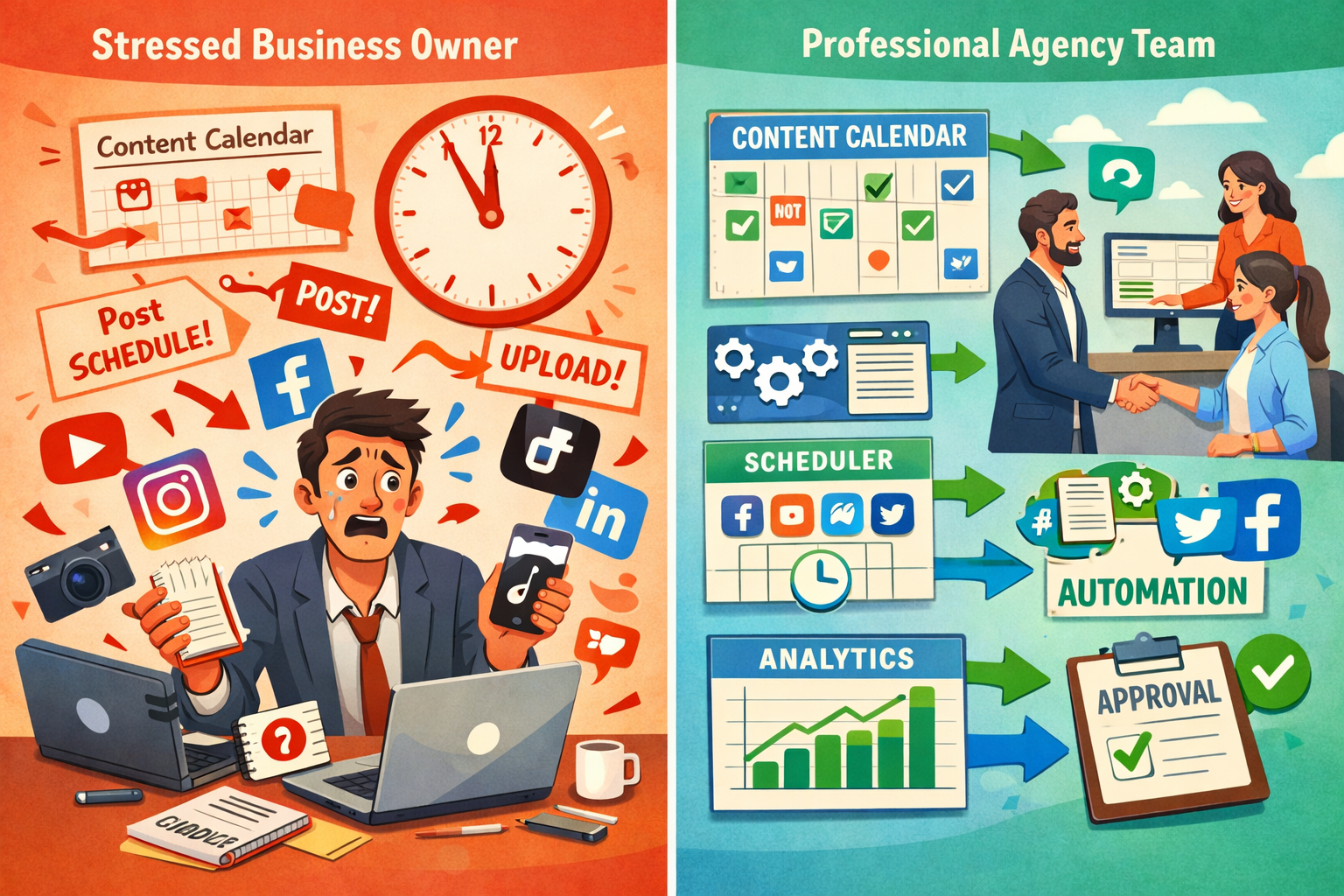
Having social media created means that external professionals build and manage your entire social media presence. This includes content strategy, image and video creation, texts, posting planning and community management – all from a single source.
Specifically, specialized service providers take on the following tasks:
- Strategy development: Analysis of your target group, competitors and platform selection
- Content production: Creation of graphics, videos, texts and stories
- Editorial planning: Structured planning with Social media planner tools
- publication: Time-optimized posting across all relevant channels
- Community management: Responding to comments and messages
- Analysis & Reporting: Monthly performance evaluation with optimization suggestions
Important to know: In 2026, successful agencies will rely on systematic processes instead of individual posts. It's about repeatable formats and data-based strategies, not gut feeling[5].
Who is it worth having social media created for?
Outsourcing makes particular sense for:
- SMEs without a marketing team: When no one internally has time or expertise
- Growing companies: Who want to appear professionally but don't need a full-time team yet
- Specialized B2B companies: Who have to prepare complex content in an understandable way
- Local shops: The Recruiting employees via social media want to operate
- Time-critical founders: Who need to concentrate on their core business
It's not ideal, if you have very specific niche knowledge that is difficult to convey, or if your budget is less than €300 per month - then DIY solutions are included AI social media tools often more useful.
Why have social media created instead of doing it yourself?
The main reasons are time, quality and ROI. Professional service providers bring specialized expertise that would take years to build internally and consistently deliver high-quality content.
Time savings and efficiency
An average social media post takes 45-90 minutes from idea to publication. With 5 posts per week, that's 4-8 hours - without community management, analysis or strategy work.
Professional providers work with:
- Batch production: 20-30 posts are created in one session
- Template systems: Reusable designs speed creation
- automation: Social media automation tools take over posting and monitoring
- Established workflows: Tried and tested processes avoid duplication of work
In 2026, leading agencies will use AI as a co-worker for content creation, data analysis and automation, which will accelerate production by another 40-60%[3][6].
Professional quality and expertise
External professionals know current trends, algorithm updates and best practices for each platform. You know that Instagram 2026 favors carousel posts, LinkedIn pushes video content, and TikTok relies on authenticity[2][4].
Quality advantages include:
- Professional design with current tools (Canva Pro, Adobe Suite)
- Copywriting that fits the target group and converts
- Platform-specific formats (Reels, Stories, LinkedIn articles)
- Brand-consistent communication across all channels
Common mistake when doing it yourself: Many people just post “something” without a strategy because it has to happen quickly. This leads to inconsistent quality and confuses the target group.
Measurable results and ROI
Professional providers work data-based. You track what works and continually optimize it. This means specifically:
- A/B testing: Different post variants are being tested
- Performance analysis: What content generates engagement, reach, conversions?
- Audience insights: Demographic data and behavioral analysis
- Competition monitoring: What makes the competition better?
In 2026, successful agencies will deliver not just posts, but processes and measurable improvements. They make teams faster and more confident because they rely on repeatable formats[5].
How does the process work when creating social media?
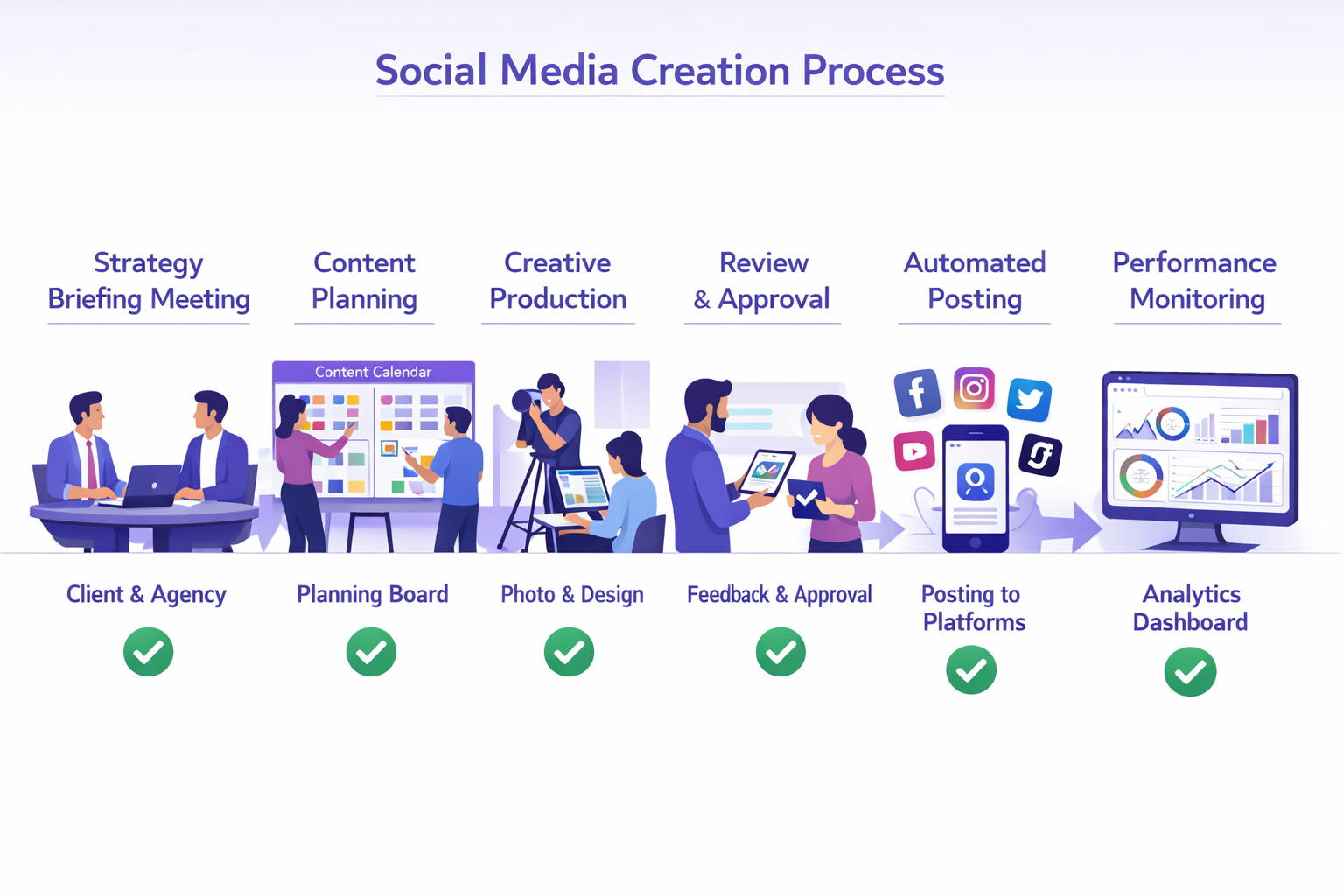
The typical process starts with a strategy workshop, followed by content planning, production and continuous optimization. Good agencies work transparently with monthly reporting cycles.
Phase 1: Strategy and briefing
At the beginning there is a detailed briefing discussion (1-2 hours) in which the following is clarified:
Strategic fundamentals:
- Company goals and marketing goals
- Target group definition (personas, pain points, platform preferences)
- Competition analysis and positioning
- Tonality and brand values
- Budget and time frame
Technical details:
- Access to existing accounts
- Corporate Design Guidelines
- Image and video material
- Release processes
The agency then develops a social media concept with concrete KPIs (e.g. +30% followers in 6 months, 5% engagement rate) and an initial content plan.
Phase 2: Content planning and editorial plan
Based on the strategy, the agency creates an editorial plan, usually 4-6 weeks in advance. Modern agencies use specialized ones for this Social media management software.
A good editorial plan contains:
- Post topics with concrete messages
- Visual concepts (photo, graphics, video)
- Posting times (based on audience activity)
- Platform mapping (what goes where?)
- Hashtag strategy
- Call-to-actions
Content mix rule for 2026: 40% educational content, 30% entertaining, 20% promotional, 10% user-generated content – this distribution works well across platforms[7].
Phase 3: Production and release
The actual content creation is carried out professionally and efficiently:
- Graphic design: Templates are adapted to your branding
- Copywriting: Texts are formulated to suit the target group
- Video production: Short clips for Reels, Stories, TikTok
- Quality control: Internal check before release request
Release process: You receive the posts in advance (usually as a PDF or in a sharing tool) and can give feedback. Professional providers allow 2-3 days for corrections.
Tip: Define clear release deadlines. If posts are not approved on time, the entire plan is postponed.
Phase 4: Publishing and Community Management
After approval, the agency takes over the posting - usually automatically Multi-channel posting tools, which manage all platforms centrally.
Ongoing support included:
- Time-optimized posting (if your target group is online)
- Monitoring comments and messages
- Community management (responses, moderation)
- Crisis management for negative feedback
- Hashtag and trend monitoring
In 2026, leading agencies will focus on long-term creator partnerships instead of one-off posts. This creates trust and credibility among the target group[1].
Phase 5: Analysis and optimization
The agency provides monthly (or quarterly) performance reporting:
Important metrics:
- Reach and impressions
- Engagement rate (likes, comments, shares)
- Follower growth
- Click-through rate for links
- Conversions (website visits, inquiries, purchases)
Based on the data, the strategy is continuously adjusted. What performs well gets amplified. What flops is eliminated or revised.
How much does it cost to create social media?
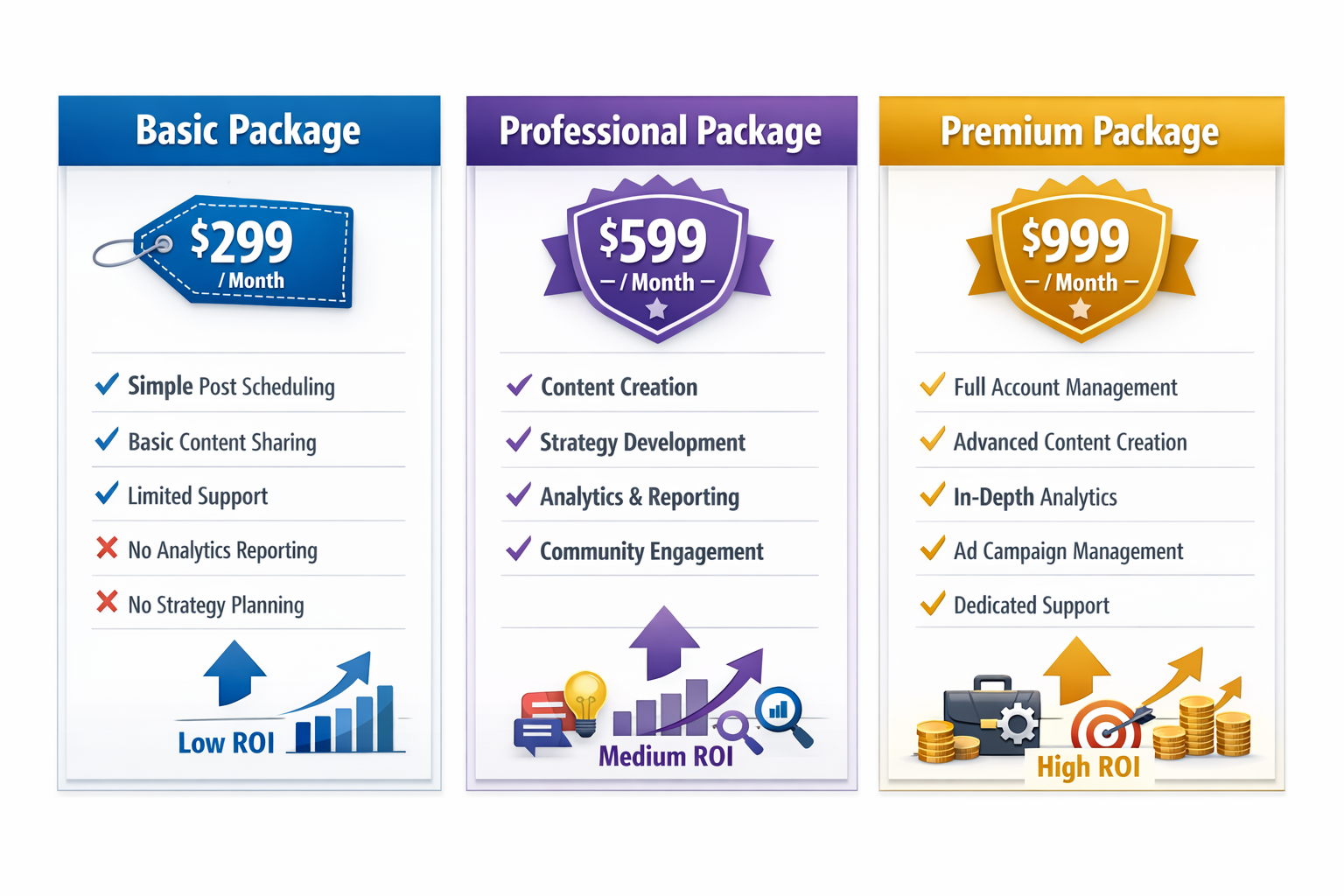
The prices vary greatly depending on the scope of services, number of platforms and agency type. Typical monthly costs range between €500 for basic packages and €5,000+ for full-service support.
Pricing models at a glance
| Package type | Monthly price | Services | Suitable for whom? |
|---|---|---|---|
| base | 500-1,000€ | 8-12 posts/month, 1-2 platforms, standard graphics | Small business, getting started |
| standard | 1,000-2,500€ | 15-20 posts/month, 2-3 platforms, community management, monthly reporting | SMEs with growth ambitions |
| professional | 2,500-5,000€ | 25-40 posts/month, all relevant platforms, video content, ads management, weekly reporting | Established companies |
| Enterprise | €5,000+ | Unlimited content, full service, dedicated team, influencer collaborations, 24/7 support | Large companies, brands |
Note additional costs:
- Professional photo shoots: €500-2,000 per session
- Video production: €800-5,000 per video
- Paid Ads Budget: In addition to the management fee
- Setup fee: One-off €500-1,500
Freelancer vs. agency vs. in-house
Freelancer (300-1,500€/month):
- ✅ Cheap, flexible, personal contact
- ❌ Limited capacity, risk of failure, often generalist
Specialized agency (1,000-5,000€/month):
- ✅ Professional team, all skills, scalable
- ❌ Higher costs, sometimes less personal
In-house employees (€3,000-5,000/month salary + additional wage costs):
- ✅ Full control, deep product knowledge
- ❌ Expensive, long training, vacation/sickness cover
Decision rule: Budget under €1,000 → Freelancer or Social Media for All Packages. Between €1,000-3,000 → specialized agency. Over €3,000 and strategically important → In-house + agency support.
Hidden costs and savings potential
Many people underestimate these additional factors:
Often overlooked:
- Stock photo licenses (if no own images are available)
- Posting software tool costs
- Influencer collaborations
- Crisis management outside of regular times
Savings potential:
- Provide your own images (smartphone photos are often sufficient)
- Longer contract terms (10-20% discount usual)
- Batch production instead of individual posts
- Social media automation for routine tasks
In 2026, AI-supported tools will enable significantly more efficient content production, which will reduce costs for modern agencies[3][6].
How do you find the right agency to create social media?
The best agency combines industry know-how, proven success and cultural fit. Check your portfolio, processes and communication style before you decide.
Selection criteria and checklist
Must-haves when choosing an agency:
✅ Proven expertise:
- Portfolio with similar projects
- Case studies with concrete figures
- Certifications (Meta Blueprint, Google Ads)
✅ Strategic approach:
- No “we’ll just post” mentality
- Data-based decisions
- Clear KPI definition
✅ Technology stack:
- Modernity AI social media tools
- Professional reporting software
- Automation where appropriate
✅ communication:
- Fixed contact person
- Regular meetings
- Transparent processes
✅ Price-performance:
- Clear service description
- No hidden costs
- Fair notice periods
The most important questions in the initial interview
Ask these questions to separate the wheat from the chaff:
About the way of working:
- “What does your typical onboarding process look like?”
- “What tools do you use for planning and reporting?”
- “How many correction loops are included in the price?”
- “Who is my direct contact?”
About the strategy:
5. “How do you develop the content strategy?”
6. “How do you measure success – which KPIs do you track?”
7. “How do you deal with negative comments?”
To references:
8. “Can you show 2-3 similar projects?”
9. “May I speak to one of your existing customers?”
10. “What were your biggest social media successes in 2025/2026?”
Red Flags: Vague answers, no concrete examples, promises of “10,000 followers in 4 weeks”, lack of transparency regarding costs.
Contract details and notice periods
Important contractual clauses:
- Duration: A minimum term of 3-6 months is optimal (social media needs time for results)
- Notice period: 4-8 weeks to the end of the month
- Scope of services: Exactly defined (number of posts, platforms, response times)
- right: Who owns created content after the contract ends?
- Data access: How are account accesses handled?
Negotiation tip: Start with a 3-month trial package at reduced rates. If you are satisfied, you can extend the contract under normal conditions with a discount for a 12-month commitment.
Which platforms should you prioritize when creating social media?
The choice of platform depends on your target group and business model. In 2026, B2B companies will rely on LinkedIn and Twitter/X, B2C on Instagram, TikTok and Facebook.
Platform decision based on target group
Linkedin (B2B focus):
- Ideal for: service providers, consultants, SaaS, Employee recruitment
- Content types: technical articles, company updates, thought leadership
- Posting frequency: 3-5x per week
- Special feature in 2026: Video content will be pushed massively[4]
Instagram (B2C, lifestyle):
- Ideal for: E-Commerce, Food, Fashion, Fitness, Local Shops
- Content Types: Reels, Stories, Carousel Posts
- Posting frequency: 5-7x per week (including stories)
- Special feature 2026: Authenticity beats high gloss[2]
TikTok (young target group):
- Ideal for: Brands with a Gen Z/Millennial focus, entertainment
- Content types: Short videos (15-60 seconds), trends, challenges
- Posting frequency: Daily for maximum reach
- Special feature in 2026: B2B also discovers TikTok for employer branding[7]
Facebook (broad crowd, 30+):
- Ideal for: Local businesses, community building, events
- Content types: Mix of text, images, videos, events
- Posting frequency: 3-5x per week
- Special feature 2026: Groups and community features more important than page posts
Twitter/X (News, real time):
- Ideal for: Tech, media, politics, thought leaders
- Content Types: Short updates, threads, comments
- Posting frequency: Several times a day
- Special feature 2026: Verification and longer posts through X Premium
Multi-platform strategy vs. focus
Focusing (1-2 platforms):
- ✅ Deeper expertise, better quality
- ✅ More efficient on a budget
- ❌ Limited range
Multi-platform (3+ channels):
- ✅ Maximum range
- ✅ Diversification (not dependent on one platform)
- ❌ Higher effort and costs
Decision rule: Start with 1-2 platforms where your target group is definitely active. Only when these are running profitably do you expand. Use central management toolsto increase efficiency.
Common mistake: Many people want to be present everywhere and post the same content on all platforms. That doesn't work - every platform needs adapted formats and tonality.
What results can you expect?
Realistic expectations for the first 3-6 months are 20-40% follower growth, 3-5% engagement rate and the first measurable inquiries or conversions. Success requires patience and continuous optimization.
Realistic KPIs and timelines
Month 1-3 (construction phase):
- Strategy development and setup
- Establish your first content series
- 10-20% follower growth (organic)
- 2-3% engagement rate
- Build basic reach
Month 4-6 (growth phase):
- Optimization based on data
- 20-40% additional follower growth
- 3-5% engagement rate
- First conversions (enquiries, newsletter registrations)
- Recurring formats established
Month 7-12 (Scaling Phase):
- Continuous growth 30-60%
- 4-7% engagement rate
- Measurable business results (leads, sales)
- Community active and committed
- Processes optimized and automated
Important: These numbers apply to organic growth. With paid ads, faster results are possible, but also higher costs.
Success examples and case studies
Example 1: Local craft business
- Starting point: 200 Instagram followers, no structured posting
- Measures: Behind-the-scenes content, before/after posts 3 times a week
- Result after 6 months: 1,800 followers, 15 qualified inquiries/month
- Investment: €800/month
Example 2: B2B service provider (LinkedIn)
- Initial situation: Sporadic posts, hardly any visibility
- Measures: Thought leadership content, employee activation
- Result after 6 months: reach +250%, 8 new B2B customers
- Investment: €1,500/month
Example 3: E-commerce store (Instagram + TikTok)
- Initial situation: product photos without a story
- Measures: User-generated content campaign, influencer collaborations
- Result after 6 months: 12,000 new followers, 30% increase in sales via social
- Investment: €3,000/month + influencer budget
These examples show that success is possible, but not overnight. Long-term creator partnerships and systematic processes are key in 2026[1][5].
Common pitfalls and how to avoid them
Problem 1: Unrealistic expectations
- ❌ “We want 10,000 followers in 4 weeks”
- ✅ Set realistic goals based on industry and budget
Problem 2: Lack of patience
- ❌ Change agency after 6 weeks because there are no results
- ✅ Give at least 3-4 months time for the first measurable successes
Problem 3: No clear strategy
- ❌ “Just post something nice”
- ✅ Define clear goals, target group and content pillars
Problem 4: Lack of communication
- ❌ Agency works in a silo without feedback
- ✅ Weekly or bi-weekly polls
Problem 5: Wrong platform choice
- ❌ B2B company focuses on TikTok
- ✅ Analyze where your target group is really active
Have social media created with AI support
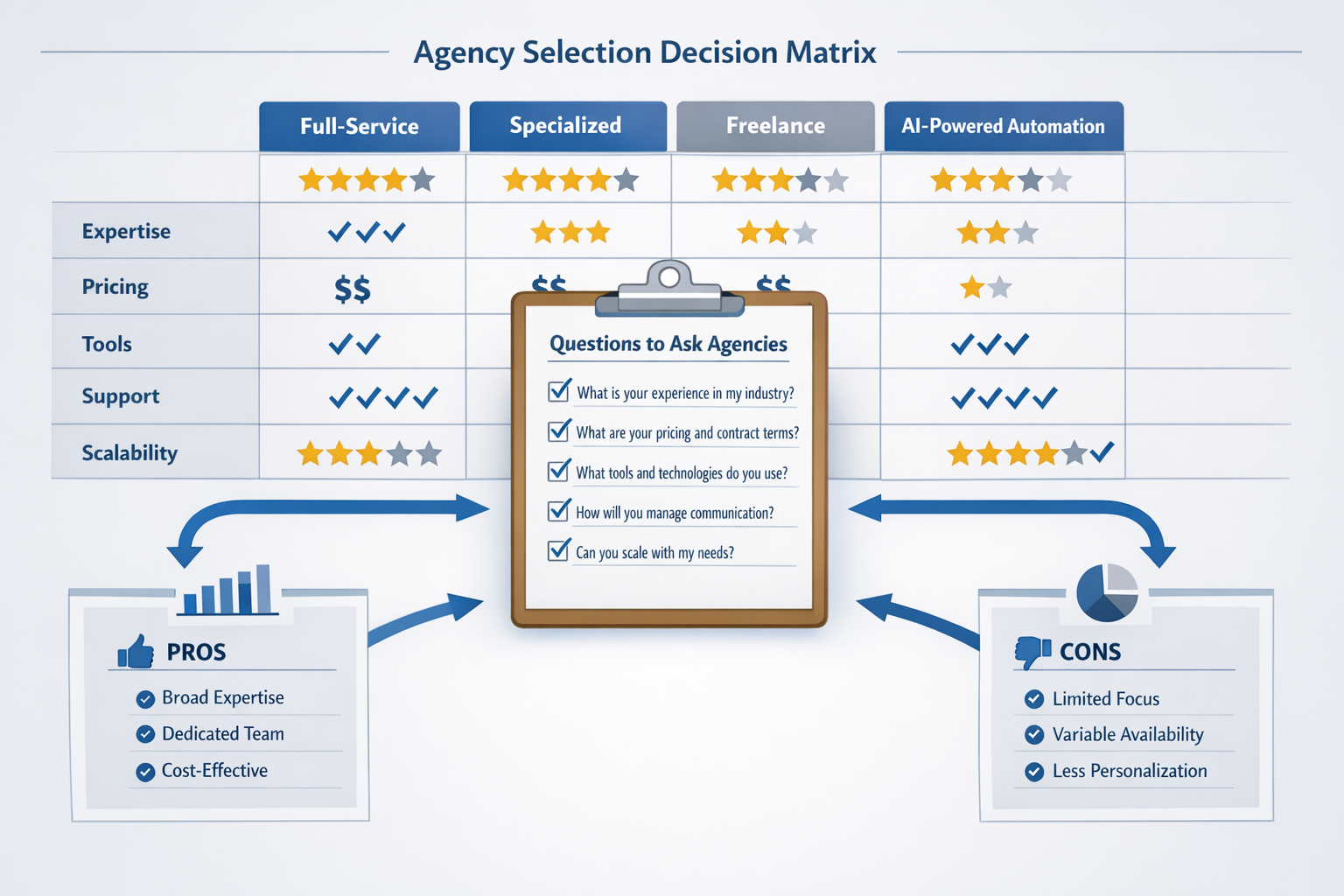
In 2026, leading agencies will use AI as a co-worker for content creation, analysis and automation. This accelerates processes, reduces costs and enables personalized content on a large scale.
How AI is changing the content creation process
In 2026, AI tools will take over repetitive tasks and support creative processes[3][6]:
Content ideation:
- AI analyzes trends and suggests relevant topics
- Automatic keyword and hashtag research
- Content gap analysis (what’s still missing?)
Text creation:
- First drafts for captions and posts
- Variant generation for A/B testing
- Translations for international markets
Image and video production:
- AI-generated graphics and illustrations
- Automatic video editing and subtitles
- Background removal and image optimization
Analysis and optimization:
- Predictive analytics (which content will perform?)
- Sentiment analysis for comments
- Automatic performance reports
Important: AI does not replace human creativity and strategy, but rather makes teams more efficient. The best results come from combining AI efficiency and human expertise[5].
The best tools for automated social media creation
All-in-one solutions:
- Hootsuite: Planning, posting, analytics for all platforms
- Buffer: Simple interface, good analytics
- Sprout Social: Enterprise level with comprehensive features
AI-powered content creation:
- Canva Magic Write: AI copywriting directly in the design tool
- Jasper AI: Specializes in marketing copy
- Midjourney/DALL-E: AI image generation
Video automation:
- Opus clip: Cuts long videos into social media clips
- Description: AI-powered video editing
- CapCut: Mobile-first video editor with AI features
Analytics and Insights:
- Brandwatch: Social listening and sentiment analysis
- Sprinkler: Enterprise Social Media Intelligence
Modernity Social media AI agencies combine these tools for maximum efficiency and measurable ROI increase.
Limits of automation
Despite all the technology, there are areas that need human judgment:
What AI can’t (yet) do:
- True empathy and emotional intelligence
- Complex strategic decisions
- Crisis management and sensitive communication
- Develop authentic brand voice
- Ethical assessment of content
Best practices: Leverage AI for efficiency in routine tasks (posting, first drafts, data analysis), but retain human control in strategy, sharing and community interaction.
FAQ: Have frequently asked questions about social media created
How long does it take to see results?
The first measurable results such as follower growth and engagement become apparent after 4-8 weeks. Significant business results (leads, inquiries) typically require 3-6 months of continuous work.
Can I have social media created and still post myself?
Yes, hybrid models are possible. The agency creates the majority of the content professionally; you add spontaneous posts or stories. Clear coordination is important so that the strategy remains consistent.
What happens to the content after the contract ends?
That depends on the contract. In most cases, you can continue to use content that has already been published, but raw files and templates remain with the agency. Clarify usage rights before signing the contract.
How much control do I have over the content?
You retain full control through approval processes. Reputable agencies won't post anything without your consent. Define in the contract how many correction loops are included and how releases work.
Is it possible to create social media even for small budgets?
Yes, there are solutions starting at €300-500 per month for basic packages with reduced services. Offer alternative Social@ALL packages simple, inexpensive entry-level solutions.
What information does the agency need from me?
The agency needs: access to your social media accounts, corporate design guidelines, product information, target group insights, previous marketing materials and clear goals. The more input, the better the result.
Can I change agency if I am dissatisfied?
Yes, pay attention to fair notice periods (4-8 weeks). Good agencies often offer a satisfaction guarantee for the first 3 months. Check contract terms before signing.
How do I measure the success of the agency?
Define clear KPIs in advance: follower growth, engagement rate, website traffic, inquiries, conversions. Demand monthly reports with these metrics and discuss optimizations.
Do I need separate agencies for different platforms?
No, specialized social media agencies cover all relevant platforms. A specialist agency can only make sense if there are very specific requirements (e.g. TikTok influencer campaigns).
Which is better: package price or hourly rate?
For ongoing support, package prices are more transparent and easier to plan. Hourly rates are suitable for project work or consulting. Most agencies work with flat monthly fees.
How often should you post?
That depends on the platform and target group. Guidelines for 2026: LinkedIn 3-5x/week, Instagram 5-7x/week (including stories), TikTok daily, Facebook 3-5x/week. But quality always beats quantity.
Can agencies also take on paid ads?
Yes, many full-service agencies also offer social ads management. This costs additional money (usually 15-20% of the ad budget as a management fee) and requires a separate advertising budget.
Key takeaways
- Have social media created is a strategic investment in 2026 that saves time and delivers professional quality - ideal for companies without an in-house team of experts
- Costs vary greatly: From €500 basic packages to €5,000+ full service per month, depending on the number of platforms and scope of services
- The process includes five phases: Strategy, planning, production, publishing and continuous optimization with data-driven adjustments
- Platform choice is crucial: B2B relies on LinkedIn, B2C on Instagram and TikTok – start focused instead of being present everywhere
- AI will revolutionize content creation in 2026: Agencies use AI as co-workers for efficiency, but human strategy and creativity remain essential[3][6]
- Realistic expectations are important: First results after 4-8 weeks, significant business successes after 3-6 months of continuous work
- Long-term partnerships pay off: Systematic processes and sustainable creator collaborations replace ad hoc posting[1][5]
- The right agency combined: Proven expertise, strategic approach, modern tools and transparent communication
- Hybrid models are possible: Professional content creation by an agency plus your own spontaneous posts for authenticity
- Success requires patience and data: Continuous optimization based on performance analysis leads to sustainable growth
Conclusion: Is social media worth creating?
For most companies, the answer in 2026 is clear: yes. The combination of time savings, professional quality and measurable results significantly outweighs the costs - provided you choose the right agency and set realistic expectations.
Social media is no longer a “nice-to-have” but rather an essential marketing channel for visibility, customer acquisition and employer branding. The question is no longer whether, rather How you implement social media professionally.
Your next steps
If you want to start now:
-
Define your goals: What do you want to achieve? More customers, better employer branding, higher brand awareness?
-
Determine your budget: How much can you invest monthly? This determines whether freelancer, agency or hybrid solution is suitable.
-
Identify your platforms: Where is your target group active? Start focused with 1-2 channels.
-
Research 3-5 providers: Check portfolios, request offers, conduct initial discussions.
-
Start with the test phase: Agree on a 3-month test period to evaluate the collaboration.
-
Track results: Define KPIs and review progress monthly.
Investing in professional social media management pays off – not immediately, but sustainably. With the right partners, clear strategy and a little patience, you can build a social media presence that delivers real business value.
Ready to get started? Use the checklists and questions in this guide to find the perfect solution for your company. Creating social media will be easier, more efficient and more effective than ever in 2026.
References
[1] Social Media Trends – https://www.seo-kueche.de/ratgeber/social-media-trends/
[2] Social Media Trends – https://suxeedo.de/magazine/social/social-media-trends/
[3] Social Media Marketing 2026 – https://polepositionsolutions.de/social-media-marketing-2026/
[4] Social Media Trends – https://omr.com/de/reviews/contenthub/social-media-trends
[5] Social Media 2026 Take Off – https://mediatouch.digital/social-media-2026-durchstarten/
[6] Social Media Trends 2026 – https://www.socialmediaakademie.de/blog/social-media-trends-2026/
[7] Social Media Report 2025 2026 – https://samsmedia.de/social-media-report-2025-2026/
KI-Offenlegung: HINWEIS: Bilder wurden mit KI erstellt oder bearbeitet und sind keine realen Abbildungen. Teile der Texte wurden mit Hilfe von KI erstellt und redaktionell von einem Mensch bearbeitet.